


David Haimes


I Left Oracle
I haven’t written on my blog at all in 2020 yet and I have never gone a whole year without blogging so I thought I would share my move out of Oracle that has been my home for 22 years, 7 months and 23 days.

Too many great memories to list, but I took this photo from my office window when I went to clear it out. I am immensely proud of the 8 patents that I was granted (still have a handful pending, it takes several years for them to be granted) not because it is recognition of doing new and groundbreaking things, but because every one of them has multiple names on them. The creative and collaborative work with amazingly bright people are the memories I will hold most dear. I was lucky to work with so many amazing people at Oracle and as we come to the end of 2020 I am a little sad I did not get to say goodbye properly, but I am hoping for a get together with everyone some time next year, maybe to mark one year after leaving!
Blockchain Sessions at Oracle OpenWorld

Next week is Oracle OpenWorld our annual conference that will take over San Francisco. The past few years I have presented a session about Blockchain, but this year I will be presenting Oracle Financials Overview, Strategy and Roadmap
(Wednesday 11:15 AM | Moscone West Room 2006/2008 ) instead.
However there is no need to fear, there are plenty of other sessions to choose form if you are interested in Blockchain, I listed all of them below
My Favorite Enterprise Blockchain Articles
For the past few years I have been working on Blockchain for Enterprises, and I get a lot of questions about where to get started. There are a lot of complicated explanations about the technology of blockchain, but I try to talk about how Blockchain (or Distributed Ledger Technology) is different to traditional databases; where it can be useful and how it will be adopted. If these things interest you too, then you will find the articles below a good starting point. I’m thrilled that I have had articles published in some prestigious publications, I hope you enjoy them. As always, I love feedback and discussions so please share your thoughts in the comments section below.
Forbes: 4 Real World Blockchain Use Cases
These four design patterns are a good way to categorize use cases and also stimulate ideas for use cases in your industry.
Channel Futures: Making Sense of Where Blockchain Can Impact Your Business
This is a more comprehensive (but very readable) explanation of the four patterns of use cases in a guest blog post I authored back in 2017.
Wall Street Journal: Why Blockchain Will Fundamentally Change Corporate Finance
This article captures a lot of important points in how back office functions will be impacted by Blockchain technology.
Database Trends and Applications: Why Permissioned Blockchain Technology Is Important to Enterprises
My article explains how blockchains are different to a database and why for some applications they are a better option. It was exciting to have this highlighted on the cover of the print edition last year.
Forbes: What Will Spark The Blockchain Explosion?
Some thoughts on where we will see the enterprise uptakes and what factors are needed for the “Killer App” to evolve.
Bloomberg Accounting Blog: Lack of Consensus Reigns with Blockchain
I was interviewed for this article after presenting at a conference, I like that they opened with:
“one of the common bifurcations of blockchain types is between private and public blockchains, such as explained here in a blog on the AICPA website. David Haimes, believes this to be a “false dichotomy.”
The article is a good read and I get to explain the differences between Permissioned versus Permissionless Blockchain networks.
Join me at Oracle OpenWorld
In under two weeks Oracle will have it’s annual conference here in San Francisco and it should be a very exciting time. I will be talking about Blockchain technology and how it is applicable to Enterprise Applications and business processes, with a particular focus on ERP applications.
I will also be putting my faith in the conference WiFi and showing some demos of prototypes we are working on.
My session details are below, last year my session was full so I advise you to register (here) as soon as possible to be sure you get a spot.
In this session learn where Blockchain can add real business value and how it fits into existing enterprise business applications ecosystems. See the types of patterns across multiple industries, including real-world examples. The session also includes live demos of a number of Blockchain applications.
David Haimes, Senior Director, Oracle
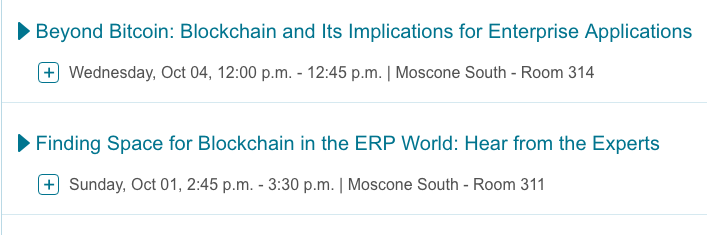
Wednesday, Oct 24, 11:15 a.m. – 12:00 p.m. | Moscone South – Room 154
Learn About Blockchain at Oracle OpenWorld
In less than two weeks tens of thousands of Oracle’s customers and partners will gathering for our annual conference in San Francisco. It’s always an exciting time, but this year I am more excited than normal because I’ll be talking about some of our work on Blockchain technology. Blockchain, or Distributed Ledger Technology (DLT) is one of the most exciting and disruptive technologies to emerge for a very long time and I’ve been quietly researching and working with it for quite a while in semi stealth mode (if you follow me on twitter you probably picked up on this) and this year a lot of Oracle experts will start showing you some of our work and sharing our views and insights. Given the level of interest in the topic, I expect all the Blockchain related sessions to be packed houses so register for them as soon as you can to avoid disappointment.
So three ways to find Blockchain sessions
- Use this Focus on Blockchain document that lists keynotes, demo, sessions, hands on and panel discussions.
- Go to the session Catalog and use the handy filter as seen below

- Just use this link to register for sessions I’m presenting


Oracle Joins Hyperledger and my Blockchain Session at Oracle OpenWorld
 Although it was announced in an Oracle blog post a few weeks ago, there was an announcement from Hyperledger today which has been picked up by coindesk and a lot of other news outlets.
I have been working on/with Blockchain or Disitributed Ledger Techncology(DLT)* for some time, as have many, many people inside Oracle. I have also been talking to A LOT of our customers, because when a technology has the possibility to make huge transformations to the way we do business, collaboration is critical. I love that I am able to not only be part of the conversation on how the technology evolves, but also how enterprises will be able to benefit from it and how it will impact existing applications and business processes in the short, medium and long term.
I will share some of my work in my session at Oracle OpenWorld in a few weeks, so if you are coming to San Francisco for that, hopefully you’ll join me at the below session (register now in case it gets fully booked)

There are plenty of other sessions discussing Blockchain, watch this space for a comprehensive list.
*The controversy on what is a Blockchain and what is DLT merits a blog post all of its own.


I’m speaking at Collaborate 17 in Las Vegas
This year will be my sixth year at Collaborate, according to my recollection I first presented there in 2011 and have only missed one year (2013) since then. It’s going to be a shorter visit than usual, so apologies if I don’t get to connect with you or attend your session. Here is where you can find me…
Monday
Two of the most knowledgeable speakers you will see are speaking at the same time, there should be a law against it. I might shuttle between the two, because I don’t want to miss either presentations
2:45 PM– Jasmine H – Mohan Iyer
How do I know where to use – FAH, FAHRCS or SLA?
2: 45 – South Seas I – Thomas Simkiss
Tips and Tricks – Get the most out of Financial Reporting in the Oracle Cloud
4:15 Jasmine H – General Ledger SIG – Always a good knowledgeable crowd.
Tuesday
7am – Morning run
Join myself, Peter Care (@FXLoader) and hopefully quite a few others for as many laps of the Mandalay bay pool complex as you feel up to. This is now officially an annual tradition, we ought to get OAUG to put it in the agenda. Best way to blow away the cobwebs and energize yourself for the day ahead.
8:30am – Keynote – Glenn Finch, IBM
I have been quietly spending a lot of time around blockchain for some time now, so this got my attention. If you don’t know about blockchain you should, I’m happy to talk about it at any opportunity. This excerpt from the description should give you an idea how big it really can be
“emerging technologies such as Blockchain, Cognitive and Quantum Computing will do more than change our businesses. They will transform industries and create their own ecosystems “
Expect to hear more from me about blockchain as the year goes on.
1:30pm – I’m speaking about @FAHRCS
Come see my session – 1:30 PM–2:30 PM South Seas G
How E-Business Suite Customers have achieved modern reporting in the cloud
2:15pm – Fintech Design Jam
I’m a mentor for this two hour Design Jam run by the Applications UX Innovation Events team. If you have not registered not sure if there is time now, but if you already are I will see you there. Our goal is to help the teams tell a story about how they would use Fintech in their work, helping them hone in on a manageable 3 minute story showcasing their design.
5pm – airport… (and breathe).


Is Your Job At Risk Of Automation?
Last week I blogged about Automated Accountants, which was discussing chatbot use cases rather than full automation of a person. However the concept of automating what knowledge workers do today to the point were we really do have a fully automated accountant is something I have been researching too.
I had a twitter discussion with Vinnie Mirchandani (@dealarchitect) about automation as he is authoring a book on the subject. I agree with him that dirty and dangerous jobs are the first candidates for automation, but I also believe knowledge jobs are good candidates too and it will happen faster than many expect. In the world of finance we have seen continual adoption of technology to move us from paper based Ledgers to highly automated cloud accounting software with integrated reporting, social networks, mobile etc. I think the pace of change will accelerate because new technology is now so easy to adopt in the cloud and innovations are rolled out faster than ever before. So automation will happen quicker for those corporations that are already adopting these cloud based business applications.
I came across an interesting article on the BBC entitled Will a Robot Take My Job? which has some nice tools to let you search for your job and determine how likely it is to be automated and despite my earlier assertions I was surprised that accounting professions were so high on the list of those that would be automated. You can see my summary graphic below

The full report from Oxford University’s Martin School is worth a read as it goes into a lot of detail of skills that are hard for a machine to replicate and those that are easier so you can understand the reasoning behind the ratings. My profession in software development has a pretty low chance of being automated, I have to come up with original ideas and negotiate and these are things it is harder (at the moment) for machines to automate but it might just be a matter of time.
This will not happen in one shot, but over time more and more tasks will be automated, which is good because it will give is some time to think about the much bigger issue; what do we do now so much of what we as a workforce do is automated? The common wisdom is the workers will gradually move to work on higher value tasks that cannot easily be automated and drive greater and greater value. There is a lot of evidence to support this, but that discussion probably deserves a blog post of it’s own.


Automated Accountants: Personal Assistant Technology
 In my house, Alexa (aka Amazon Echo) is part of the family. My young children check the weather whilst eating their breakfast, see how their favorite sports teams are doing, get some jokes, movie times and anything that pops into their head they will just “Ask Alexa”. They also have a lot of fun seeing how Apple’s Siri and Alexa answer the same questions and which works better for what. Observing these interactions and interacting myself has been a very good hands on research exercise and I have been thinking for a while of enterprise applications.
We can use personal assistant technology bots to use context and intelligence to provide a natural interface and increase participation in our cloud applications.We can increase participation on two groups of users
- Casual Users
- They have infrequent and limited interactions with the applications and do not have the time, or the training and familiarity with the capabilities to participate effectively. They don’t know what information they can get, never mind how to get it.
- Power Users
- For these users it is about reducing the time it takes to do highly repetitive or UI intensive tasks. This is like me at home getting sports scores or weather from Amazon Echo, I could easily look it up on my phone but it is easier to just say “Alexa, weather” whilst I am pouring my coffee.
I put together a team to enter a hackothon by our UX innovation team last month and we tried to focus on the former use case. A high level manager who is very busy, runs a team of 50-100 people and manages to budgets but does not have a secretary. We imagined her wanting to know details of budgets and implemented three flows
- Inquiry on remaining budget
- Details of who spent a budget on what
- Transfer funds from one budget to another (say from travel to computer hardware)
We spent a lot of time trying to make the interactions as natural as possible, so getting the natural language trained correctly was key and we also wanted to use Amazon Echo, IM and SMS messages to interact with the live data in an ERP Cloud environment.
It was a great experience and we learned a lot technically. but probably more of a revelation was the different design strategy for these types of interaction. The other teams also did some amazing things(read the event review here) so we were pleased to pick up third place overall and the People’s Choice Award (voted on by all the participants).
I fully expect Automated Personal Assistants to be a key interaction model for Enterprise applications going forward, just as we are seeing them start to take off in the consumer space. Exciting times.


The Times They Are A Changing

I am focusing on some new things here at Oracle. I’ll be dedicating a lot more of my time looking into emerging technology trends and how we should be applying them to the enterprise ERP or financial management space.
So how does this effect this blog?
I’ve been blogging for many years on Intercompany, Financial Management and ERP, mixing in some general technology posts. Now I plan to start writing about new technology trends a lot more. I have always been interested in this, but now I have more time to get deeper into it and I find blogging about things helps me understand them better and get feedback and insight from others, so it is a win-win. I have enjoyed all the comments on the blog and words of encouragement that people have given me in person, that has been a huge motivation to continue writing (even tho I have been posting as frequently as I would like the last few years) and respond to comments. I hope that feedback will continue.
So now I have got this announcement out of the way, I can get started… watch this space.


Oracle OpenWorld 2016 My Cloud ERP Sessions
-

OpenWorld is this month, so time to start planning your agenda. I’ll be presenting at a few different sessions this year with a focus on Financials Cloud (Part of the ERP Cloud) and E-Business Suite.
I’m busy preparing for the first two sessions, hope to see you there. Check out the content catalog for more details and to add them to your agenda.
How Oracle E-Business Suite Customers Have Achieved Modern Reporting in the Cloud [CON7313]David Haimes, Senior Director, Financial Applciations Development, OracleSara Mannur, Financial Systems Analyst, Niagara BottlingThis session discusses how to leverage powerful modern reporting tools with no disruption to your existing Oracle E-Business Suite implementation. You will learn the steps required to start using the cloud service. Customers who have implemented Oracle Fusion Accounting Hub Reporting Cloud Service share their implementation experiences and the business benefits they have realized.Conference SessionTuesday, Sep 20, 12:15 p.m. – 1:00 p.m. | Moscone West—3016Oracle ERP Cloud UX Extensibility: From Mystery to Magic [CON7312]David Haimes, Senior Director, Financial Applciations Development, OracleTim Dubois, Senior Director, Applications User Experience, OracleThe user experience (UX) design strategy of Oracle Enterprise Resource Planning Cloud (Oracle ERP Cloud)—including financials and product portfolio management—is about simplicity, mobility, and extensibility. Extensibility and admin personalization of Oracle ERP Cloud experiences include a range of tools, from a simplified approach for rebranding the applications, to match your company culture and image to page-level admin personalization and extension, to building your own simplified cloud application in platform as a service using the UX Rapid Development Kit (RDK). In this session, learn about RDK code samples, wireframing tools, and design patterns. Get a view into the RDK roadmap and where Oracle is going next. .Conference SessionThursday, Sep 22, 1:15 p.m. – 2:00 p.m. | Moscone West—3001Meet the Experts: Oracle Financials Cloud [MTE7784]Do not miss this opportunity to meet with Oracle Financials Cloud experts—the people who design and build the applications. In this session, you can have discussions regarding the Oracle Applications Cloud strategy and your specific business and IT strategy. The experts are available to discuss the value of the latest releases and share insights into the best path for your enterprise, so come ready with your questions.Meet the Experts SessionWednesday, Sep 21, 3:00 p.m. – 3:45 p.m. | Moscone West—3001A


Financial Apps Collaborate 16 Sessions
We’re just two days away from the start of Collaborate and there are so many session I want to get to, my focus is on Financial Applications both Cloud and E-Business Suite. I already listed sessions where you can find me presenting, but here are ones I think will be interesting, I will attend as many as I can
Firstly two cloud customers(Alex Lee and Westmont Hotels) talking about their experiences implementing cloud financials.
Fusion Financials Implementation Customer Success Experience
Monday April 11th 12:45 PM–1:45 PM – South Seas J
Derrick Walters, Corporate Applications Manager at Alex Lee
How Westmont Hospitality Benefited by Leveraging Cloud ERP
3:15 PM–4:15 PMApr 11, 2016 – South Seas I
Sacha Agostini Oracle Functional Consultant at Vigilant Technologies, LLC.
Next some AGIS, Legal Entity and related topics on E-Business suite. In these areas that have been out for some time, I generally learn something about innovative uses of the products. Our partners and customers are very smart.
Intracompany, Intercompany, AGIS – Unraveling the Mysteries!
2:15 PM–3:15 PM Apr 10, 2016 – South Seas A
Bharati ManjeshwarMs at Highstreet IT Solutions, LLC
Thomas Simkiss Vice-President of Consulting at Denovo Ventures, LLC
Its Not too Late! How to Replace Your eBTax Solution After You Have Upgraded
10:30 AM–11:30 AM Apr 11, 2016 – South Seas I
Mr Andrew BohnetDirector ateBiz Answers Ltd
3:30 PM–4:30 PMApr 10, 2016 – Jasmine H
Bharati ManjeshwarMs at Highstreet IT Solutions, LLC
3:15 PM–5:30 PM Apr 11, 2016 – Mandalay Bay C
Mohan Iyer Practice Director at Jade Global, Inc.
9:15 AM–11:45 AM Apr 12, 2016 – Mandalay Bay C
Mr Andrew Bohnet Director at eBiz Answers Ltd
12:45 PM–3:00 PM Apr 11, 2016 – Mandalay Bay C
Mohan Iyer Practice Director at Jade Global, Inc.


Catch Me at Collaborate in Las Vegas
The OAUG Collaborate conference kicks off in Las Vegas on Sunday April 10th. This conference is organized by Oracle user groups and is packed with content from customers, partners and Oracle have some sessions too. If you follow this blog you will know I am a big fan of the conference, I learn a lot from our customers and try to give back as much as I can by sharing information and answering questions. The twitter conversations are already starting, follow #C16LV now and certainly during conference week to see what people are talking about.
I will be presenting a session on Accounting Hub Reporting Cloud Service for Oracle E-Business Suite
1:00 PM–2:00 PM Apr 12, 2016 – South Pacific I
Register now for that one, I will leave plenty of time for questions because this cloud service is generating a lot of buzz.
I will also be at the OAUG GL SIG Meeting
3:00 PM–4:00 PM Apr 13, 2016 – South Seas J
I’m also planning to attend Meet the Experts: Oracle E-Business Suite Financials
2:15 PM–3:15 PM Apr 12, 2016 – Breakers G
I will help take questions, you can decide if that qualifies me as an expert or not.
I’ll also be attending Oracle E-Business Suite and Oracle Cloud Solutions: Update, Strategy and Roadmap
Nadia Bendjedou, Sr. Director, Product Strategy, Oracle
Monday, April 11, 2:00 – 3:00 PM – Banyan A
I am combing through the sessions to identify others that I want to go to and learn from, I will share those later, watch this space.


What is FAHRCS?
FAHRCS (pronounced farks) is the de facto acronym for the officially titled Accounting Hub Reporting Cloud Service. Is Stands for Fusion Accounting Hub Reporting Cloud Service, which is quite difficult to say. I have got pretty good at saying F.A.H.R.C.S quickly, but I think “farks” is probably the easiest.
If you are wondering what FAHRCS actually is, you can follow @FAHRCS on twitter, or check out https://cloud.oracle.com/en_US/accounting-hub-reporting-cloud for official documentation.
I’ll be presenting about it at the Higher Education User Group Conference, Alliance16 in March and again at OAUG Collaborate16 in April. So I hope to see you there and help you learn more about FAHRCS.


A week with Apple Watch: From Cynic to Believer
I had convinced myself the Apple Watch was an overpriced fitness band and that it wasn’t for me and was set to get a Garmin to track my running instead. Then out of the blue I was given an Apple Watch. So you can certainly put me down as a cynic, but I certainly like to think I am open minded, so here are my thoughts after a week with the watch.
The experience of getting it set up was surprisingly frustrating, I had to upgrade my phone to iOS 8 before I could activate the watch and that meant deleting things to free a few Gb of memory (to upgrade my Operating System, really?). So everything had to wait until after I got home and backed up my phone.
First I got this rather cool visual on my watch to scan with the phone and then it was paired and I got this screen telling me the model that I had bought. OK so I still could not get the time from this watch and I have had the thing all day, I’m getting a little impatient at this point.

After waiting about 5 minutes for it to synch, suddenly a load of my apps, including my email, texts, calendar, twitter fitness apps and more are available on my watch. This is about to get interesting.
The first thing I noticed is that it is actually really easy to ready and see at a glance the notifications that are sent to your watch, such as Calendar reminders, text messages and Oracle Social Network updates (glad to see we are quick to the new platform with our own mobile apps). This is good for me, I get a lot of these alerts and I found a glance at my wrist was much nicer than pulling out my phone and unlocking it and starting at it. This sounds like a very small thing, but it is these small improvements in frequent interactions that make for a great user experience. I also agree with Jeremy Ashley about the huge value in being able to retain eye contact, notifications on my watch are far less obtrusive and the glance at my wrist it is a great experience.
So I wanted to try using it for some different things so I decided to test out text messages first, a quick SMS to respond to my wife’s text ‘ETA?’ to let her know what time I am planning to get home.

My wife and I prefer very efficient communications.
So I tap once on that nice Reply button

I can now either pick from a set of pre-defined responses and they would be sent without any other interaction from me. However I like the personal touch, this is my wife after all, so I decide I will click on the microphone icon to dictate a response. I speak in my answer and see the sound wave at the bottom and the text comes up perfectly first time.

So now I click done and get a really option to either send the audio or to just tap on the text and send that. This is a great feature if maybe the voice to text didn’t work properly and I don’t want to waste time correcting it or speaking it again.

After tapping on the text I am now done. The whole interaction was very fast and felt very natural. At this point I am really starting to like the Apple Watch. In the next few days I try driving directions, twitter, my calendar, a variety of fitness apps and more and pretty much across the board I find the interactions are natural and quick and the fact I have to pull out my phone less is a much bigger deal than I expected. I find I can glance down at my watch see a text or meeting reminder and carry on a conversation in a way that was not really possible if I had to pull my phone out. The one app I haven’t yet mentioned is the time, I haven’t worn a watch for over 10 years and I have realized in the last week it’s much easier to glance at my wrist than to pull out my phone – who knew?


Speaking My Own Language for UKOUG Apps 14 Conference
Finally I will be at a conference where my British accent, specifically my North West of England accent will be understood. This will be my first time presenting at the UK OUG Conference and what better place than Liverpool to do it? Home of my beloved Everton F.C., hometown of my parents and less than 20 miles from where I grew up (People from Liverpool would call me a woollyback) just outside Wigan. So I will try to remember to shift from the Californian drawl I have picked up over the last 14 years and into my finest scouse accent.
I’m going to be presenting two papers which will showcase not just the powerful features that can revolutionize how you run your business, but also the amazing use experience, mobile and social features available in our ERP Cloud. Both are on Monday and one is right after the other, so I’m a little bit apprehensive about having 10 minutes to dash from one room to another, get set up and start again.
Here are the details of the sessions, or just search for ‘Haimes’ and you’ll find them. Add them to your agenda, because they are both ‘must not miss’ sessions.
First up, Monday December 8th, 2pm, Hall 11C
This is a great session with a lot of content to pack in but I know the area well and am very passionate about it and have seen first hand how big a deal this is for businesses.
Then 10 minutes to pack up and dash to Hall 1B for 3pm
Oracle ERP Cloud Service Social & Mobile Demonstrations.
Doing live demos, with multiple different devices to switch between and using a live cloud environment on a conference WiFi make this a logistical challenge. However when you have a phenomenal user experience, the best thing to do is show it live, so bear with me because we have some pretty cool features to show.


Accounting Hub Reporting Cloud Service
 So what is this new service and why was it such a big focus at Oracle OpenWorld this year?
- It’s a very exciting opportunity to experience the powerful Financial Reporting innovations in our Cloud offerings without disruption to your existing ERP investments.
- It’s a way to take advantage of the Simplified Financials Report Center, optimized for easy access to reports on your choice of mobile device
- It includes the sunburst data visualization tool, which was my killer demo last week at OpenWorld (see screen shot)
- It’s a way to move to cloud in an incremental manner, realizing business benefits quickly without disruption to your existing business processes and systems.
- It has a companion EBusiness Suite feature (available on 12.1.3 and 12.2.4) that will push all your set up and GL Balances to your cloud service and generate reports automatically for you. Giving you a zero configuration reporting solution for you EBS GL Balances data (watch out for more detailed posts on this soon)
- It has web services to load General Ledger data from PeopleSoft, JDE Edwards or any other ERP system.
- It’s a way to get your hands on the Oracle Social Network which is part of the platform our Cloud offerings are built on.
That’s a decent list to start with, but there are a few things that it isn’t which I should call out
- It is not(yet) the Accounting Hub Integration Platform with all the rule based accounting transformations provided by Subledger Accounting Architecture (SLA)
- It is not a new name designed to confuse you when we already have Financials Accounting Hub and Fusion Accounting Hub.
Look out for future posts going into more detail, or you can look at the cloud service page, which has important details such as pricing.


Focus on #WorkLifeBalance at Oracle OpenWorld
I promised my 9 year old son that I would run the school 5K fun run with him, little did I know it would clash with Oracle OpenWorld. I had a 5k run at 10am in Belmont and then a presentation to the OAUG GL Special Interest Group at 11am 20 mile sNorth in San Francisco. I was worried about the pace my son could do but we managed to average 9.5 minute miles even with a stop to tie a shoe lace and a lot of traffic of all ages and speeds. We had just enough time snap the picture below and then he went for the pancake breakfast with the rest of his friends and I ran another half mile to my car and headed to the Moscone Center. No time to change and straight up on stage, with 10 minutes to spare before I was due to speak. After that I caught up with a colleague who’s here from the UK over lunch and was home in time to upgrade my son’s home minecraft server to 1.8, write a blog and check on my demos for tomorrow’s Oracle Applications User Experience (OAUX) EXPO.

Only one of us got to stay for the pancake breakfast

No time to change, straight on stage and waiting to present.
later this evening I was pleased to see this tweet from Steve Miranda, our EVP who is also balancing his heavy workload at OpenWorld with family commitments too.

Steve makes time for family too.
So all in all a good day, here’s hoping the rest of the week is just as enjoyable.


Focus on Accounting Hub at Oracle OpenWorld
This is number three in my Focus on Oracle OpenWorld Series and this one is in on my home turf, it was the talk of Las Vegas earlier this year at Collaborate. I have explained the difference between Fusion Accounting Hub and Financial Accounting Hub before, but now we have the Accounting Hub Reporting Cloud Service. I’ll be talking about this briefly in the OAUG GL SIG meeting and there is also a session from my boss, Rob Zwiebach that will cover it (spoiler alert, we might use some of the same slides), but he will also have Alex from our internal finance org to give talk about their experience running the accounting hub for the last few years. Rob’s session details are below:
Introducing Oracle Fusion Accounting Hub Reporting Cloud Service [CON8404]Existing Oracle E-Business Suite customers now have an out-of-the-box coexistence strategy. With Oracle Fusion Accounting Hub Reporting Cloud Service, you can have the power of Oracle Fusion Reporting in the cloud. This session explains the benefits and details of Oracle Fusion Accounting Hub Reporting Cloud Service.
Alex SanJuan – VP Finance, Oracle
Rob Zwiebach, VP Financial Application Development, Oracle
Tuesday, Sep 30, 4:45 PM – 5:30 PM – Westin Market Street – Metropolitan II
I already have a number of customer meetings lined up to discuss accounting hub and a few more I’m trying to squeeze in, so it is shaping up to be an exciting new chapter for the Accounting Hub.


Focus on User Groups at Oracle OpenWorld
Anyone who reads my blog regularly might be tired of me praising user groups, but I believe it is worth repeating myself. The type of information sharing you get from user groups is unique and very valuable, it is important for Oracle to support that, be aware of it, but not interfere. I have been involved with the Oracle Apps User Group via the GL SIG for several years now but I will never push my agenda, I listen, provide information or presentations that are requested and I learn. Many of my colleagues will tell you the same. So Sunday is User Group day at OpenWorld and I look forward to seeing a lot of familiar faces and learning something new. I have a bit of a schedule crunch this year, 12 months ago I committed to run the 5k “Dolphin Dash” School fundraiser with my 8 year old son, I didn’t think for a minute it would fall on the same date as OpenWorld. So I have to run a 5k at 9am and then dash into San Francisco to present at the GL SIG for 11am, if I arrive in my running gear, still sweating please accept my apologies. I will stay around for more of the sessions and always I will be active on twitter, so you can find me that way too.
At the GL SIG I’ll be talking about and briefly showing the new Accounting Hub Reporting Cloud Service, which I am very excited about. You will also hear from Lakshmi Sampath from Dell about SLA on their upgrade to R12. The full agenda is below, I hope to see a lot of you there.
—————————————————————————————–
Agenda GL-SIG @ OpenWorld 2014 on Sunday, September 28th, 11.00am
Location – Moscone W – 3005
Agenda
- Introduction to the SIG
- Proactive support presentation
- Sponsor message (Excel4Apps)
- Lakshmi (SLA on Upgrade @ Dell)
- David Haimes new Accounting Hub Cloud Reporting Service
- Open questions
We will be joined by our Oracle colleagues to tell us about ProActive support and their leading practices to deliver content and help to the Oracle user community.
Excel4Apps will be helping us by sponsoring the meeting at this conference.
In the past many oracle apps customers have looked elsewhere for their reporting needs – until now – see a preview of “Accounting Hub Reporting Cloud Service”. See how many finance users are using their favorite tools for reporting – Smartview, Cubes, and related functionality to get their financials. Fusion Account Hub Reporting Cloud Service is a new subscription service provides out of the box integration with EBS R12 General Ledger for reporting. This session will provide an introduction to the new service, how it connects, works with EBS data, the reporting capabilities available and what it does and does not support. Come listen to David Haimes, Senior Director, Financials Product Development t alk about the new service.
Hear what Lakshmi Sampath from Dell has to say about their upgrade to R12. The presentation covers the R12 Upgrade Case-Study at Dell providing details on what happens during upgrade to R12 in various subledgers (PO, AP, AR, PA, FA) with respect to SLA. This presentation will also provide details on strategies for data conversion to SLA model during upgrade, and cover critical lessons learned during the upgrade @ DELL.
—————————————————————————————–

