


OCP Advisor

Oracle certification offers Oracle Certified Associate (OCA), Professional (OCP), Expert (OCE) and Master (OCM) credentials. This blog is a forum to share exam preparation and test taking experiences of Oracle Certified Professionals. Best of Luck! Disclaimer: Opinions expressed by the blog editor and authors are entirely their own and do not reflect the position of Oracle or any other corporation. Any recommendation or advice discussed here or on linked sites are not validated by Oracle.Mohan Duttnoreply@blogger.comBlogger281125
Updated: 1 week 3 days ago
A secret treasure house of Oracle books
One of the most prolific publishers of Oracle technology and application books - Packt Publishing just published its 1000 cover. Packt books are written by experts, many of whom are Oracle certified professionals. The books full of tips and how-to about new features and functionality that are not covered in-depth in user manuals.
 A treasure house of Oracle books is the online library of every Packt publication. To celebrate the 1000th title, Packt is offering free access to the library for a peek at the gems for a 7 day period. Also, one can download one free e-book.
Packt supports many of the Open Source projects covered by its books through a project royalty donation, which has contributed over $4,00,000 to Open Source projects up to now. As part of the celebration Packt is allocating $30,000 to share between projects and authors as part of the weekend giveaway, allocated based on the number of copies of each title downloaded.
Dave Maclean, founder of Packt Publishing based out of Birmingham, UK spoke recently to the media: “At Packt we set out 8 years ago to bring practical, up to date and easy to use technical books to the specialist tools and technologies that had been largely overlooked by IT publishers. Today, I am really proud that with our authors and partners we have been able to make useful books available on over 1000 topics and make our contribution to the development community.”


Packt supports many of the Open Source projects covered by its books through a project royalty donation, which has contributed over $4,00,000 to Open Source projects up to now. As part of the celebration Packt is allocating $30,000 to share between projects and authors as part of the weekend giveaway, allocated based on the number of copies of each title downloaded.
Dave Maclean, founder of Packt Publishing based out of Birmingham, UK spoke recently to the media: “At Packt we set out 8 years ago to bring practical, up to date and easy to use technical books to the specialist tools and technologies that had been largely overlooked by IT publishers. Today, I am really proud that with our authors and partners we have been able to make useful books available on over 1000 topics and make our contribution to the development community.”
Meet The Experts: Matthew Morris
OCP Advisor interviewed Matthew Morris, one of the earliest Oracle Certified Professional (OCP) and now a popular author of OCP study guides. Matthew was among the first hundred to be OCP DBA certified on Oracle 7.3 and has since upgraded his certification to releases 8i, 9i, 10g and 11g.

OCP Advisor: Hello Matt, on behalf of OCP blog readers we are delighted to have you as our featured Oracle Expert. Please tell us something about your professional experience.
Matthew Morris: In early 1996, I started working for Oracle Support as part of the RDBMS Server Technologies team. Over the first few months, I read every Oracle Press book I could get my hands on from cover-to-cover! I was the top rated support analyst and was asked to develop and deliver courses for team members. After four years of DBA support, I changed my focus to PL/SQL and Web development. I developed database tools and applications to assist managers and analysts in the Oracle Support team. Currently I work at Computer Sciences Corporation and is responsible for developing custom database applications using PL/SQL and Oracle APEX.
OCP Advisor: Please tell us about your Oracle Certification path and what motivated you on this path.
Matthew Morris: Two years after I started working for Oracle, Oracle Certified Professional program was launched. Sylvan created at testing center in our office building. I was interested in demonstrating my knowledge, so I took and passed all four of the OCP DBA tests. I learned that this made me one of the first hundred people to become an Oracle Certified Professional (OCP)! Later that year, Oracle introduced the Oracle Developer Certification and I took the four developer tests in a single day and became one of the first hundred Oracle Certified Developers. Since then, I have tried to keep my certifications current.
Matthew Morris: Two years after I started working for Oracle, Oracle Certified Professional program was launched. Sylvan created at testing center in our office building. I was interested in demonstrating my knowledge, so I took and passed all four of the OCP DBA tests. I learned that this made me one of the first hundred people to become an Oracle Certified Professional (OCP)! Later that year, Oracle introduced the Oracle Developer Certification and I took the four developer tests in a single day and became one of the first hundred Oracle Certified Developers. Since then, I have tried to keep my certifications current.
OCP Advisor: You are a popular author of several Oracle Certification guides. Please let us know how you started writing them.
Matthew Morris: In May 2011, I developed a study guide for 1Z0-050: New Features for Administrators. Then in late 2011, I began studying for 1Z0-450: Oracle Application Express 4: Developing Web Applications. For almost every exam, my preparation includes creating a study sheet with key testing points. For 1Z0-450, this sheet rapidly became much larger and more elaborate than usual. It seemed reasonable at the time to go the extra mile and make it into a publishable study guide. Ultimately, I found that doing this did not add an extra mile but rather an extra ten to fifteen miles! However, once it was published, the result was heartening. I modified the 1Z0-050 course material I had developed earlier into a second study guide and published it as well. Since those first two, I have published study guides for the SQL Expert and SQL Fundamentals exams. Currently, I am developing exam guides for the OCP DBA I and DBA II exams.
Matthew Morris: In May 2011, I developed a study guide for 1Z0-050: New Features for Administrators. Then in late 2011, I began studying for 1Z0-450: Oracle Application Express 4: Developing Web Applications. For almost every exam, my preparation includes creating a study sheet with key testing points. For 1Z0-450, this sheet rapidly became much larger and more elaborate than usual. It seemed reasonable at the time to go the extra mile and make it into a publishable study guide. Ultimately, I found that doing this did not add an extra mile but rather an extra ten to fifteen miles! However, once it was published, the result was heartening. I modified the 1Z0-050 course material I had developed earlier into a second study guide and published it as well. Since those first two, I have published study guides for the SQL Expert and SQL Fundamentals exams. Currently, I am developing exam guides for the OCP DBA I and DBA II exams.
OCP Advisor: Please share with our blog readers about the content of the Oracle Certification Guides you have published?
Matthew Morris: The Oracle Certification Prep series targets two groups of candidates. The first group consists of Oracle professionals who want to get certified in a subject they are experienced in and would like a reference guide to help them ‘bridge the gaps’. The second group are those who are already using another source of information in their study plan but would like to have a second reference. It is especially valuable for candidates using only Oracle documentation but would like to have an inexpensive reference against which to determine how well they did. To help both these audiences, the study guides present information about the test topics in a very condensed format. The intent is to deliver facts that candidates need to know, functions and features they need to recognize, in a compact format enough to revise several times.
Matthew Morris: The Oracle Certification Prep series targets two groups of candidates. The first group consists of Oracle professionals who want to get certified in a subject they are experienced in and would like a reference guide to help them ‘bridge the gaps’. The second group are those who are already using another source of information in their study plan but would like to have a second reference. It is especially valuable for candidates using only Oracle documentation but would like to have an inexpensive reference against which to determine how well they did. To help both these audiences, the study guides present information about the test topics in a very condensed format. The intent is to deliver facts that candidates need to know, functions and features they need to recognize, in a compact format enough to revise several times.
OCP Advisor: What advice do you have for candidates preparing for an Oracle Certification exams?
Matthew Morris: From the posts on the various certification forums I frequent, there are many candidates who are studying just to pass the exams rather than to gain knowledge. Learning how to pass a test does not prepare someone to perform well at professional level. Use the opportunity when studying for Oracle certification to make a concerted effort to learn the concepts first.
Matthew Morris: From the posts on the various certification forums I frequent, there are many candidates who are studying just to pass the exams rather than to gain knowledge. Learning how to pass a test does not prepare someone to perform well at professional level. Use the opportunity when studying for Oracle certification to make a concerted effort to learn the concepts first.
OCP Advisor: Please share with our blog readers one habit that has contributed most to your professional success?
Matthew Morris: Setting a realistic expectation determines whether you succeed or fail. I try to set a reasonable time frame and give my very best to deliver ahead of every deadline.
Matthew Morris: Setting a realistic expectation determines whether you succeed or fail. I try to set a reasonable time frame and give my very best to deliver ahead of every deadline.
Thanks Google Adsense! Sponsors Wanted!
Hundreds of clicks every week on this blog adds pennies to the dollar. The generous folks at Google Adsense check the meter reading and send in a small check once in a few months (actually when the total crosses a hundred dollars).
 This blog is a not-for-profit exercise and I hope to pay back the amount I received from Google in the form of Oracle Certification Exam Vouchers for a lucky reader or two. Greatly appreciate the Pay Per Click (PPC) spend of Google advertisers on my blog.
On a related note, the blog author invites sponsors to display their ads on the blog in return for sponsorship of exam vouchers to our loyal readers. Corporations interested in sponsorship may e-mail OCP Advisor at ocp.advisor@gmail.com



On a related note, the blog author invites sponsors to display their ads on the blog in return for sponsorship of exam vouchers to our loyal readers. Corporations interested in sponsorship may e-mail OCP Advisor at ocp.advisor@gmail.com
OUM Certified Implementation Specialist Certification
Oracle is shortly launching the production release of Oracle Unified Method (OUM) Certified Implementation Specialist Certification. OUM certified professionals would be skilled in Oracle’s all inclusive methodology. The certification covers the core features the Oracle Unified Method suite including Focus Areas, Uses Cases, and Requirements Gathering. The certification proves a baseline of the consultant’s knowledge and allows the implementation team to work as a cohesive team from day one.
This certification is available to all candidates but is geared toward members of the Oracle Partner Network (OPN) who are focused on selling and implementing this technology. OPN Members earning this certification will be recognized as OPN Certified Specialists, which helps their companies qualify for the Oracle Unified Method Specialization.
There is only one exam for this certification called Oracle Unified Method 5 Essentials (1Z0-568). Details about the exam is available in the OUM Exam Study Guide. Oracle provides OUM training for partners. DevelopMentor is offering OUM training to the general public. For details about the OUM training, click here. The blog author attended the Level 3 training at Oracle Global User Group Leaders Conference in 2011. Read his OUM blog and begin your certification journey for OUM.
Have you taken the latest survey from OCP Program team?
Click here to take the Oracle Certification Program Salary and Satisfaction Survey 2012.


This certification is available to all candidates but is geared toward members of the Oracle Partner Network (OPN) who are focused on selling and implementing this technology. OPN Members earning this certification will be recognized as OPN Certified Specialists, which helps their companies qualify for the Oracle Unified Method Specialization.
There is only one exam for this certification called Oracle Unified Method 5 Essentials (1Z0-568). Details about the exam is available in the OUM Exam Study Guide. Oracle provides OUM training for partners. DevelopMentor is offering OUM training to the general public. For details about the OUM training, click here. The blog author attended the Level 3 training at Oracle Global User Group Leaders Conference in 2011. Read his OUM blog and begin your certification journey for OUM.
Have you taken the latest survey from OCP Program team?
Click here to take the Oracle Certification Program Salary and Satisfaction Survey 2012.
OCP Advisor To Present At COLLABORATE12
Your blog author will be presenting at COLLABORATE12 - The Annual Oracle User Group jointly hosted by OAUG, IOUG and Quest. This will be OCP Advisor's 55th presentation at an Oracle conference. Since the conference is being hosted at Las Vegas, the presentation title is appropriately named: Show Me The Money!
The session abstract and objectives are reproduced below:
Equinix implemented Oracle Credit and Collections Suite to automate credit review and improve cash flow through automated collection strategies. This implementation case study describes rolling out Oracle Credit Management, Oracle Advanced Collections, Dun & Bradstreet Toolkit and integration with Oracle Order Management, Oracle Customer Online and Oracle Receivables. The presenters will share how the functionality was extended to include support for consolidated billing. This project promises to be a ROI winner!
Objective 1: Learn how to automate credit review using Oracle Credit Management
Objective 2: Learn how to automate collection strategies using Oracle Advanced Collections
Objective 3: Migration to Oracle Advanced Collections for Oracle Receivables Users
Objective 4: Extend functionality of Advanced Collections to support Consolidated Billing feature.


The session abstract and objectives are reproduced below:
Equinix implemented Oracle Credit and Collections Suite to automate credit review and improve cash flow through automated collection strategies. This implementation case study describes rolling out Oracle Credit Management, Oracle Advanced Collections, Dun & Bradstreet Toolkit and integration with Oracle Order Management, Oracle Customer Online and Oracle Receivables. The presenters will share how the functionality was extended to include support for consolidated billing. This project promises to be a ROI winner!
Objective 1: Learn how to automate credit review using Oracle Credit Management
Objective 2: Learn how to automate collection strategies using Oracle Advanced Collections
Objective 3: Migration to Oracle Advanced Collections for Oracle Receivables Users
Objective 4: Extend functionality of Advanced Collections to support Consolidated Billing feature.
Oracle OpenWorld 2011: OCP Advisor Presents
Robert Bungenstock from Kaplan Learning Technologies wins The Audience Prize!
One OCP Exam Voucher will be reaching Robert's inbox shortly ! Congratulations!
View the presentation and find one more way you can win an OCP Exam Voucher!
Oracle Openworld 2011 Schedule Builder is Now Live
Oracle OpenWorld 2011 Content Management team announced today that the conference Schedule Builder is now online. Registered attendees can log in to search through hundreds of sessions, partner exhibits, and Oracle demos and find content of interest to enroll in sessions and build your conference agenda.
A recommendation engine powered by Oracle Data Mining provides a list of sessions, demos and exhibits that are most relevant to you. Once a session is added to the personal agenda, any session change information or communication is automatically sent. It also provides the conference organizers an idea about the popularity of a session. In case the designated room is overbooked on the schedule builder, then the session is often moved to a location with more seating capacity. It is always a good idea to use the Schedule Builder to enroll in sessions and get early access. In order to gain early access attendees must be enrolled in the session and arrive at least ten minutes before the session start time. Enrolled attendees are seated first and then non-enrolled attendees are seated for the most popular sessions.
Those who are yet to register, please view the Content Catalog to see list of session topics, demos and exhibits. Please add Session # 8042 on your agenda for a session on Oracle Certification at Moscone Center West Room 3000 from 5.00pm - 6.00pm. One lucky attendee will win an Oracle Certification Exam exam voucher as the audience prize!
Plagiarism: The Sincerest Form of Flattery
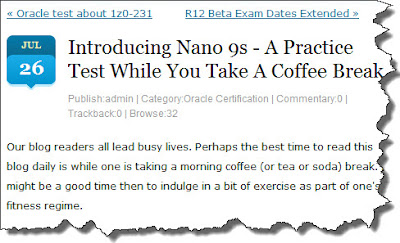
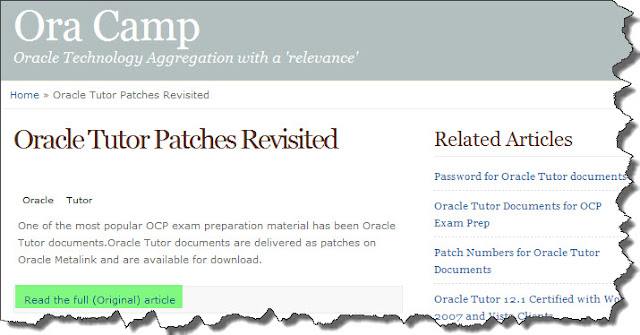
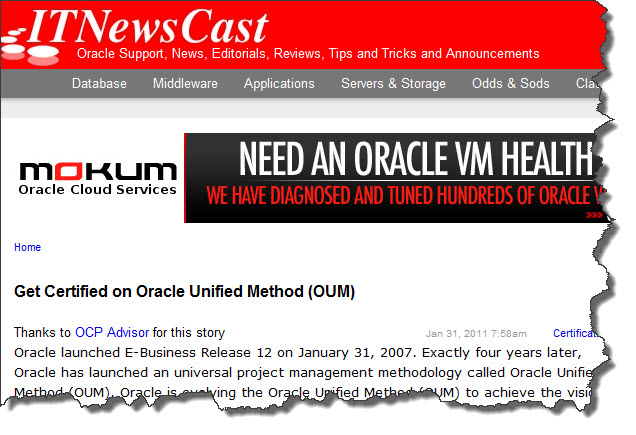
As the saying goes, "Imitation is the sincerest form of flattery". Copying published articles with acknowledging the author is called plagiarism. There are several sites on the world wide web that have copied blog posts from this blog and posted it in its entirety without any mention of the author or even a link to the original post. Some of the sites are selling illegal 'brain dump' question banks and that devalues the intent of this blog author to provide a forum for hard working certification candidates to prepare for exams and pass them with proper preparation and effort. There is no shortcut to success. Without publishing the URL of the offending sites, here are some snippets of plagiarism that pervades the Internet with links to the actual blog post below them. Plagiarism seems to be the sincerest form of flattery!
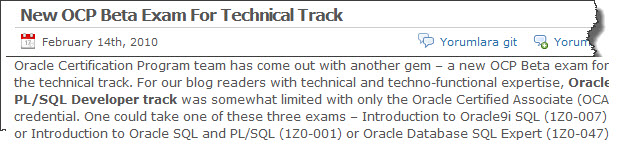 Here is the link to the original post: New OCP Beta Exam For Technical Track


Here is the link to the original post: Introducing Nano 9s - A Practice Test While You Take A Coffee Break


At least there are some sites that provide links to the original blog post like the one from OraComp. Here is the link to the original post: Oracle Tutor Patches Revisited

It is heartening that there are sites like ITSNewcast that acknowledges the blog author for their posting. Here is the link to the original post: Get Certified on Oracle Unified Method (OUM)
163 ACEs In This Deck
If Oracle OpenWorld 2011 content catalog was a deck of cards, there would be 163 Aces in the deck. The Oralce Technology Network (OTN) Blog lists the Oracle ACE holders presenting at Oracle OpenWorld in a blog post appropriately titled: Are You Kidding Me? 163 Oracle ACE Sessions at Oracle OpenWorld
 The Who's Who of the Oracle Universe is presenting and it is a very humble feeling to be included in the list. I hope to feature some of the illustrious names in the 'Meet The Experts' section of this blog. If you are attending Oracle OpenWorld 2011, add the ACE sessions to your schedule. Here is my wish list of ACE sessions to attend (apart from the one I am presenting!):


- Andy Katz - Upgrading to Oracle E-Business Suite Release 12.1 Without Losing Your Hair or Your Wallet
- Benjamin Prusinski - Lockdown: Secure Your Database in a Day
- Brian Huff - Creating a Global E-Commerce Site with Oracle E-Business Suite and Oracle Fusion Middleware
- Chris Muir - Angels in the Architecture: An Oracle Application Development Framework Architectural Blueprint
- Debra Lilley - Do I Upgrade or Go Straight to Oracle Fusion Applications?
- Elke Phelps - Advanced Oracle E-Business Suite Architectures: Maximum Availability, Security, and More
- Floyd Teter - The ABCs of Implementing Oracle Fusion Project Portfolio Management
- Jerry Ireland - Interfacing with Oracle E-Business Suite by Using Oracle SOA Suite
- John Stouffer - 12 Steps to Oracle E-Business Suite 12 Upgrade: Hazelden Foundation Release 12 Lessons Learned
- Kaberi Nayak - Upgrading to Oracle E-Business Suite Release 12.1: Technical/Functional Panel
- Karen Brownfield - Maximize Efficiency of Oracle E-Business Suite 11i and 12 Through Diagnostics
- Michael Brown - Oracle E-Business Suite Release 11.5.10.2 to Release 12.1.3: A Technical Perspective
- Pat Dues - Best Practices for Maintaining Oracle E-Business Suite 12
- Raimonds Simanovskis - Extending Oracle E-Business Suite with Ruby on Rails
- Wilfred van der Deijl - Four Ways to Transition from Oracle Forms to Oracle ADF
Oracle Certified Specialist - Time To Get Specialized
About 2 years ago, Oracle Partner Network (OPN) launched the OPN Specialized program. Specialization achievement has a key component of competency development. Partners who earn specialization in at least one area (and up to four areas) are eligible for entry to the Gold level. Those partners who obtain five or more specializations qualify for the elite Platinum partner program level, which is the highest partner program level offered by Oracle.
 Oracle Certification Program team has launched Oracle Certified Specialist credentials to certify Oracle Partners for their specialization level. OPN Certified Specialist credential identifies those Oracle Partners who have completed specified requirements for select Oracle Certified Associate (OCA), Oracle Certified Professional (OCP), Oracle Certified Expert (OCE), and Oracle Certified Specialist (OCS) certifications.
Oracle Partner employees who complete the certification requirements (for these select certifications) using their official OPN company ID will now also be awarded the OPN Certified Specialist designation for the technology as well as the original underlying OCA, OCP, OCE, or OCS credential, and their achievement is credited toward their company's OPN Specialized recognition.
Oracle Certified Specialist certification typically consists of just one exam. For example, passing 1Z0-518 Oracle EBS R12.1 Receivables Essentials qualifies one for Oracle E-Business Suite 12 Financial Management Certified Implementation Specialist: Oracle Receivables certification. For the corresponding Oracle Certified Expert certification one has to write two exams - Oracle E-Business Suite R12: E-Business Essentials and the Oracle E-Business Suite R12: General Ledger and Receivables Fundamentals mega exam. Even those who are not employees of Oracle Partners can register for the exams and qualify for Oracle Certified Specialist credentials. With a lesser number of exams to take to qualify for certification, this can be a great certification to aim if you have not enough time to prepare for more extensive exam content. It is time to get specialized!


Oracle Partner employees who complete the certification requirements (for these select certifications) using their official OPN company ID will now also be awarded the OPN Certified Specialist designation for the technology as well as the original underlying OCA, OCP, OCE, or OCS credential, and their achievement is credited toward their company's OPN Specialized recognition.
Oracle Certified Specialist certification typically consists of just one exam. For example, passing 1Z0-518 Oracle EBS R12.1 Receivables Essentials qualifies one for Oracle E-Business Suite 12 Financial Management Certified Implementation Specialist: Oracle Receivables certification. For the corresponding Oracle Certified Expert certification one has to write two exams - Oracle E-Business Suite R12: E-Business Essentials and the Oracle E-Business Suite R12: General Ledger and Receivables Fundamentals mega exam. Even those who are not employees of Oracle Partners can register for the exams and qualify for Oracle Certified Specialist credentials. With a lesser number of exams to take to qualify for certification, this can be a great certification to aim if you have not enough time to prepare for more extensive exam content. It is time to get specialized!
6 Degrees of Separation

They are as follows:
- Facebook - Like their Facebook page and get status updates on latest announcements
- Twitter - Follow @oraclecert
- YouTube - Subscribe to the Oracle Certification channel
- Blog - Subscribe to the blog feed and book mark the blog page
- E-Magazine - Subscribe to the monthly e-magazine delivered to your e-mail inbox
- Linkedin - Join more than ten thousand members on this active online community discussing almost everything about Oracle Certification and with lot of job postings from resourcing managers
Certification Preparation Showcase: uCertify PrepKit
Oracle Certified Professionals Blog is introducing a new feature called Certification Preparation Showcase to introduce blog readers to certification preparation education providers and their products. These independent review will highlight the features available in the offerings so that blog readers are aware of the vendors. This blog does not endorse or recommend any specific vendor. Certification candidates should use their best judgement before buying any products or services reviewed on this blog. OCP Advisor hopes that Certification Preparation Showcase will assist blog readers in the evaluation of certification related products or services.
The first product which is being reviewed in the Cert Prep Showcase is uCertify PrepKit from uCertify LLC. The company has been offering certification preparation study kits for more than a decade. The current portfolio covers certification study material for leading companies such Microsoft, Oracle, Cisco, IBM and others. The Oracle certification exams that are covered by uCertify include OCA and OCP 11g, Oracle EBS 11i DBA OCP and OCP Java EE among others.
The certification preparation material is available as a download with a list of 15 questions diagnostic test available for free. If you have bought the kit, a license key will reach your e-mail inbox to activate the complete features of the kit. The exam PrepKit consists of a Test Engine with multiple simulated tests. For review purposes, I had downloaded 1Z0-047: Oracle SQL Expert certification kit. There are 5 full-length practice tests and 1 'Final Test' to prepare oneself for the actual exams. One can also create a custom test and a fixed time test using the question bank in the test engine.

The test kit also provides nearly 300 flash cards, study notes and tips for taking the exam. The test kit covers all the sections mentioned in the exam content on the Oracle certification website. The test engine has been built to closely resemble the testing platform one would encounter for an actual exam. So preparing for a certification exam using the PrepKit will be a familiar experience on exam day. The best benefit of a Test PrepKit like this would be to use as a test simulation tool rather than a guide to learn concepts. There are several Oracle Press and other publications available for reference guides. A hands-on practice on any database is highly recommended. If one has no access to a test database, download Oracle XE and practice commands for Oracle SQL Expert Exam. Practice makes perfect and by taking the simulated tests multiple times, the chances of success is almost assured.
OCP Advisor interviewed Ron Dayal, Customer Happiness Manager at uCertify LLC about their certification preparing offerings.
OCP Advisor: Please tell us about your company. From when did you start offering Oracle Certification prep kits?
Ron: uCertify is a leading training provider for the IT Certifications exams. For the past 15 years, uCertify has specialized in exam preparation solutions for all major certification exams, from vendors, such as Microsoft, Oracle, Adobe, CompTIA, Cisco, EC Council and more. We are available 24 x 7 x 365. All uCertify PrepKits come with a 100% money back guarantee, which is the best in the business. Students pass in their first attempt using our prepkits, else we refund the cost of the prepkit. uCertify is committed to serving its customers with innovative, reliable, and high-quality products through constant research and development, keeping in mind the latest pattern of the various exams.We began offering our prepkits for Oracle certifications back in 2003. Since then, we have continuously added to the Oracle test prep suite keeping up with Oracle’s certification offerings, including all Sun based prepkits.
OCP Advisor: When would you recommend a candidate to start using your prep kit?
Ron: We recommend that students begin using our prepkits as soon as possible. Our prepkits provides information about exam objectives, lots of study material and dozens of practice questions which not help reinforce concepts, but hones practice skills until they have achieved mastery of the subject.
OCP Advisor: Tell us how you develop the practice tests?
Ron: Our prepkits are crafted by industry experts from within uCertify, as well as from the field, They are typically certified professionals themselves, and are subject matter experts in the area of certification they are writing for. These professionals understand the problems that students face while preparing for their certification exams, and ensure that the prepkit material they author, helps student pass their certification exam in their first attempts.
OCP Advisor: You advertise a very high success rate in certification exams (98% plus) for your customers. What makes that possible?
Ron: uCertify places a very high emphasis on content quality. Our content authors, be it in-house uCertify employees, or contracted IT professionals with relevant experience, are held to extremely high standards. In addition to stringent checklists and peer reviews, several prepkits are also reviewed by ProCertLabs, a company regarded by many certification vendors, as being very qualified to review a test prep provider’s work. Every piece of material in our prepkits is authored and reviewed via a strict checklist to ensure high quality standards.
OCP Advisor: What advise would you give to Oracle certification candidates preparing for certification exams?
Ron: Practice, Practice, Practice! Invest in a high quality prepkit provider such as uCertify, and go through all study material, and take/retake the tests until they score 95% or higher in all the practice tests they take. Readers of OCP blog can use discount code: UCPREP when checking out and avail of a 10% discount.
Certification Test Preparation Vendors who are interested in having their products reviewed in the Certification Preparation Showcase, please e-mail OCP Advisor at ocp.advisor@gmail.com


The first product which is being reviewed in the Cert Prep Showcase is uCertify PrepKit from uCertify LLC. The company has been offering certification preparation study kits for more than a decade. The current portfolio covers certification study material for leading companies such Microsoft, Oracle, Cisco, IBM and others. The Oracle certification exams that are covered by uCertify include OCA and OCP 11g, Oracle EBS 11i DBA OCP and OCP Java EE among others.
The certification preparation material is available as a download with a list of 15 questions diagnostic test available for free. If you have bought the kit, a license key will reach your e-mail inbox to activate the complete features of the kit. The exam PrepKit consists of a Test Engine with multiple simulated tests. For review purposes, I had downloaded 1Z0-047: Oracle SQL Expert certification kit. There are 5 full-length practice tests and 1 'Final Test' to prepare oneself for the actual exams. One can also create a custom test and a fixed time test using the question bank in the test engine.

The test kit also provides nearly 300 flash cards, study notes and tips for taking the exam. The test kit covers all the sections mentioned in the exam content on the Oracle certification website. The test engine has been built to closely resemble the testing platform one would encounter for an actual exam. So preparing for a certification exam using the PrepKit will be a familiar experience on exam day. The best benefit of a Test PrepKit like this would be to use as a test simulation tool rather than a guide to learn concepts. There are several Oracle Press and other publications available for reference guides. A hands-on practice on any database is highly recommended. If one has no access to a test database, download Oracle XE and practice commands for Oracle SQL Expert Exam. Practice makes perfect and by taking the simulated tests multiple times, the chances of success is almost assured.
OCP Advisor interviewed Ron Dayal, Customer Happiness Manager at uCertify LLC about their certification preparing offerings.
OCP Advisor: Please tell us about your company. From when did you start offering Oracle Certification prep kits?
Ron: uCertify is a leading training provider for the IT Certifications exams. For the past 15 years, uCertify has specialized in exam preparation solutions for all major certification exams, from vendors, such as Microsoft, Oracle, Adobe, CompTIA, Cisco, EC Council and more. We are available 24 x 7 x 365. All uCertify PrepKits come with a 100% money back guarantee, which is the best in the business. Students pass in their first attempt using our prepkits, else we refund the cost of the prepkit. uCertify is committed to serving its customers with innovative, reliable, and high-quality products through constant research and development, keeping in mind the latest pattern of the various exams.We began offering our prepkits for Oracle certifications back in 2003. Since then, we have continuously added to the Oracle test prep suite keeping up with Oracle’s certification offerings, including all Sun based prepkits.
OCP Advisor: When would you recommend a candidate to start using your prep kit?
Ron: We recommend that students begin using our prepkits as soon as possible. Our prepkits provides information about exam objectives, lots of study material and dozens of practice questions which not help reinforce concepts, but hones practice skills until they have achieved mastery of the subject.
OCP Advisor: Tell us how you develop the practice tests?
Ron: Our prepkits are crafted by industry experts from within uCertify, as well as from the field, They are typically certified professionals themselves, and are subject matter experts in the area of certification they are writing for. These professionals understand the problems that students face while preparing for their certification exams, and ensure that the prepkit material they author, helps student pass their certification exam in their first attempts.
OCP Advisor: You advertise a very high success rate in certification exams (98% plus) for your customers. What makes that possible?
Ron: uCertify places a very high emphasis on content quality. Our content authors, be it in-house uCertify employees, or contracted IT professionals with relevant experience, are held to extremely high standards. In addition to stringent checklists and peer reviews, several prepkits are also reviewed by ProCertLabs, a company regarded by many certification vendors, as being very qualified to review a test prep provider’s work. Every piece of material in our prepkits is authored and reviewed via a strict checklist to ensure high quality standards.
OCP Advisor: What advise would you give to Oracle certification candidates preparing for certification exams?
Ron: Practice, Practice, Practice! Invest in a high quality prepkit provider such as uCertify, and go through all study material, and take/retake the tests until they score 95% or higher in all the practice tests they take. Readers of OCP blog can use discount code: UCPREP when checking out and avail of a 10% discount.
Certification Test Preparation Vendors who are interested in having their products reviewed in the Certification Preparation Showcase, please e-mail OCP Advisor at ocp.advisor@gmail.com
Inviting Oracle Certified Professionals to Be Featured in OOW 2011 presentation

If you are Oracle certified, you are invited to get in touch with me at ocp.advisor@gmail.com to be featured as one of the case studies in the presentation. As a token of appreciation, I will send Amazon gift certificates for $25 if you are selected for the case study. A special shout out to Oracle ACE and Oracle ACE Directors to participate in this collaborative presentation. The session abstract can be found here.
Oracle University Full Day Sessions at Oracle Open World 2011
Oracle University is offering a one-day training event on October 2, 2011. There are eight deep-dive training sessions to choose on the first day of Oracle OpenWorld 2011. The sessions will be held at Hotel Nikko San Francisco. The registration fee for the Oracle University event is $800 for a full day of training.
The 8 training sessions are as follows:
 Those preparing for Oracle Certification exams and attending Oracle OpenWorld 2011 may like to add this Sunday schedule to their conference calendar.


The 8 training sessions are as follows:
- Oracle and Exadata. The Perfect Fit!
- OpenWorld Certification Exam Cram: Oracle Database 11g: New Features for Administrators
- Oracle Exalogic Elastic Cloud Overview
- Making the Most of Oracle User Productivity Kit (UPK)
- Oracle WebLogic Server 11g: Administration Essentials
- Oracle Business Intelligence 11g: Overview to Analyses and Dashboards
- Oracle SOA Suite 11g: Administration
- What's New in Oracle Solaris 11
 Those preparing for Oracle Certification exams and attending Oracle OpenWorld 2011 may like to add this Sunday schedule to their conference calendar.
Oracle Certification Discussion Forum
Oracle Technology Network hosts dozens of discussion forums online.
One of the Technology Network Community forum that every Oracle certification candidate should visit is the Certification forum.
 One can post questions and answers on this forum for certification related topics. All discussions are threaded so it is easy to find a discussion topic.
Participation on the forum is encouraged with points awarded for postings, helpful answers and correct answers. As one adds points, there are recognition levels of Pro, Expert and Guru that are awarded.
You are not alone when you are preparing for certification. There are hundreds all over the world who are preparing for the same exam and maybe thousands who have taken the exam before. Many certified professionals are regular forum members and answer your questions in a matter of hours! It is the best expert advice and it is all free!
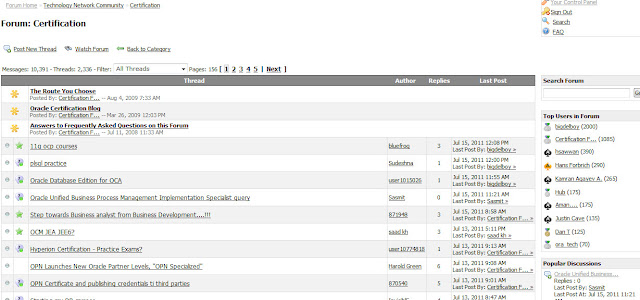


One of the Technology Network Community forum that every Oracle certification candidate should visit is the Certification forum.

Participation on the forum is encouraged with points awarded for postings, helpful answers and correct answers. As one adds points, there are recognition levels of Pro, Expert and Guru that are awarded.
You are not alone when you are preparing for certification. There are hundreds all over the world who are preparing for the same exam and maybe thousands who have taken the exam before. Many certified professionals are regular forum members and answer your questions in a matter of hours! It is the best expert advice and it is all free!

OCP Support Form - Help Is Just A Click Away
Certification candidates have questions for the certification program team. These used to be answered via e-mail. The volume of e-mails was difficult to manage and tracking requests were quite a daunting task for the OCP Program Team. The OCP Support Form has made correspondence through e-mail redundant.
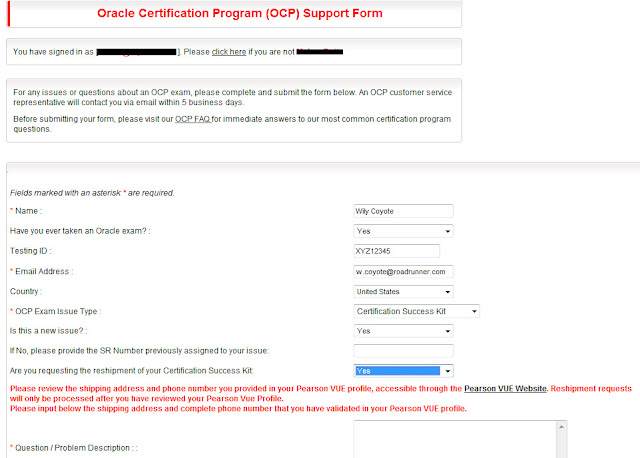
For any issues or questions about an OCP exam, please complete and submit the form below. An OCP customer service representative will contact you via email within 5 business days. It is always worthwhile to visit the OCP FAQ page before submitting the form. The answer may be already posted there.


For any issues or questions about an OCP exam, please complete and submit the form below. An OCP customer service representative will contact you via email within 5 business days. It is always worthwhile to visit the OCP FAQ page before submitting the form. The answer may be already posted there.
Oracle Learning Library - A Hidden Treasure Trove
The Oracle Learning Library is a hidden treasure trove of free online learning waiting for you to discover. The content originates from a variety of sources including Oracle Technology Network and Oracle Blogs.
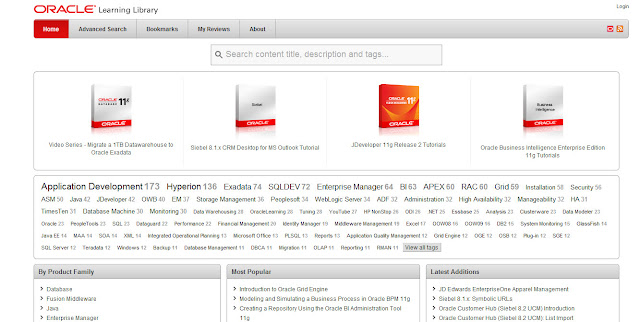
There are Oracle by Example (OBE) tutorials that provide hands-on, step-by-step instructions on how to implement various technology solutions to business problems. There are automated demonstration of product features are also available. There are tutorials also available with explanation of concepts and and step-by-step instructions for a particular product or topic. Blog posts and white papers from Oracle Development and Oracle Product Managers complete the portfolio.
One hopes that Oracle Learning Library is adopted increasingly by Oracle product teams as a key channel for information sharing. I am sure in the coming months and years you will hear more about this site. Remember, you first learnt about it here!


There are Oracle by Example (OBE) tutorials that provide hands-on, step-by-step instructions on how to implement various technology solutions to business problems. There are automated demonstration of product features are also available. There are tutorials also available with explanation of concepts and and step-by-step instructions for a particular product or topic. Blog posts and white papers from Oracle Development and Oracle Product Managers complete the portfolio.
One hopes that Oracle Learning Library is adopted increasingly by Oracle product teams as a key channel for information sharing. I am sure in the coming months and years you will hear more about this site. Remember, you first learnt about it here!
Oracle Unified Method (OUM) Certification - Beta Exam Available
Oracle Unified Method (OUM) is now the standard implementation and support methodology for all products. I had posted about OUM Training in a posting earlier this year. The training covered Level 3 instructor-led training and training material was provided for all levels.
Oracle Certification Program team has launched Oracle Unified Method 5 Certified Implementation Specialist certification. The exam content covers the following:
Blog Photos are courtesy of Fotolia (www.fotolia.com) where there are 13,000,000 + images. Browse the site and learn more why so many professionals within the media and communications industry are using the site.


Oracle Certification Program team has launched Oracle Unified Method 5 Certified Implementation Specialist certification. The exam content covers the following:
- Level 1 - Oracle Unified Method Overview and Awareness
- Level 2 - 3 Focus Area Specific Overview: Manage, Envision and Implement
- Level 2 - Use Case Overview
- Level 3 - Gathering Requirements


Blog Photos are courtesy of Fotolia (www.fotolia.com) where there are 13,000,000 + images. Browse the site and learn more why so many professionals within the media and communications industry are using the site.
Oracle EBS 11i Certification: Time for Retirement
Oracle Certification program team announced on their blog that several certificaton tracks and exams will be retired on November 1, 2011.

The EBS 11i Certification Paths being retired are as follows:
Oracle 11i Financials Certified Professional Consultant, Payables
Oracle 11i Financials Certified Professional Consultant, Receivables
Oracle 11i Supply Chain Certified Professional Consultant, Purchasing
Oracle 11i Supply Chain Certified Professional Consultant, Order Management
11i Workflow Certified Expert
11i System Administrator Certified Expert
Oracle 11i Applications Database Administrator Certified Professional
The related certification exams that are being retired as follows:
1Z0-211 Oracle 11i General Ledger Fundamentals
1Z0-212 Oracle 11i Payables Fundamentals
1Z0-213 Oracle Receivables 11i Fundamentals
1Z0-221 Oracle 11i Inventory Management Fundamentals
1Z0-222 Oracle 11i Purchasing Fundamentals
1Z0-223 Oracle 11i Order Management Fundamentals
1Z0-231 Oracle 11i 2.6 Implement Workflow
1Z0-232 Oracle 11i System Administration
1Z0-233 Oracle 11i Install, Patch and Maintain Applications
1Z0-235 Oracle 11i Applications DBA: Fundamentals I
1Z0-236 Oracle 11i Applications DBA Fundamentals II
What does this announcement mean for those who are already certified on EBS11i?
Certification credentials will continue to be valid after the EBS11i certificatin exams are discontinued.
What does this announcement mean for those who are preparing for EBS11i certification exams?
The certification exams will be offereed through October 31, 2011
Candidates must successfully complete the required certification exams by October 31,2011.
Re-takes will not be available after this date.
Hence, be sure of passing or schedule EBS R12 certification exams instead!
Blog Photos are courtesty of Fotolia (www.fotolia.com) where there are 13,000,000 + images. Browse the site and learn more why so many professionals within the media and communications industry are using the site.


All the certification tracks and exams have the next release already available.
For Oracle EBS 11i certificaions launched more than 5 years ago, this signifies an end of an era where EBS certification resarted again after R11.
Oracle 11i Financials Certified Professional Consultant, Payables
Oracle 11i Financials Certified Professional Consultant, Receivables
Oracle 11i Supply Chain Certified Professional Consultant, Purchasing
Oracle 11i Supply Chain Certified Professional Consultant, Order Management
11i Workflow Certified Expert
11i System Administrator Certified Expert
Oracle 11i Applications Database Administrator Certified Professional
The related certification exams that are being retired as follows:
1Z0-211 Oracle 11i General Ledger Fundamentals
1Z0-212 Oracle 11i Payables Fundamentals
1Z0-213 Oracle Receivables 11i Fundamentals
1Z0-221 Oracle 11i Inventory Management Fundamentals
1Z0-222 Oracle 11i Purchasing Fundamentals
1Z0-223 Oracle 11i Order Management Fundamentals
1Z0-231 Oracle 11i 2.6 Implement Workflow
1Z0-232 Oracle 11i System Administration
1Z0-233 Oracle 11i Install, Patch and Maintain Applications
1Z0-235 Oracle 11i Applications DBA: Fundamentals I
1Z0-236 Oracle 11i Applications DBA Fundamentals II
What does this announcement mean for those who are already certified on EBS11i?
Certification credentials will continue to be valid after the EBS11i certificatin exams are discontinued.
What does this announcement mean for those who are preparing for EBS11i certification exams?
The certification exams will be offereed through October 31, 2011
Candidates must successfully complete the required certification exams by October 31,2011.
Re-takes will not be available after this date.
Hence, be sure of passing or schedule EBS R12 certification exams instead!
Blog Photos are courtesty of Fotolia (www.fotolia.com) where there are 13,000,000 + images. Browse the site and learn more why so many professionals within the media and communications industry are using the site.
OCP Advisor To Present At Oracle OpenWorld 2011
 Oracle OpenWorld 2011 conference will be held in San Francisco, CA from October 2-6, 2011. The session catalog is already available online here. Once again, Oracle Certification blog author, OCP Advisor, has been invited to present at the conference. If you are attending the conference, please visit Moscone West Room 3000 on Monday, October 3, 2011 from 5.00-6.00pm to hear: "OCP Advisor Tips on How to Become an Oracle Certified Professional".
 This is one of the 1785 sessions being presented at the mega event. One lucky member of the audience will win a FREE certification voucher for an Oracle Certification exam!
So please mark you calendar to attend the session.