


Look Smarter Than You Are

Created by Edward Roske, Oracle ACE Director in the Hyperion space. An expert on Essbase and Hyperion in general, Edward devotes this space to all the Hyperion news that's fit to blog.Edward Roskehttp://www.blogger.com/profile/04386477801237753018noreply@blogger.comBlogger200125
Updated: 1 week 5 days ago
I gave up my cell phone & laptop for the weekend: This is what I learned
It was time for a technology detox. When I left work on Good Friday, I left my laptop at the office. I got home at 3PM and put my mobile phone on a charger that I wouldn't see until Monday at 9AM. And my life free of external, involuntary, technological distraction began... along with the stress of being out of touch for the next 3 days. Here's what I learned.
Biggest Lessons
Why in the name of God?
Things I thought I couldn't live without
Things I actually missed
Photos. I didn't realize how many photos I take of the world around me, until I couldn't take any photos at all. I had to use a long-forgotten mental trick called "memory." It made me pay a lot more attention to the world around me, and I genuinely remember more of how I experienced the weekend than if I had been trying to catalog everything through pictures. I'm sure photos would have made this blog more appealing, but I'm doing all this from memory, so all we have are words.
Connection. I wanted to know what my friends and family were doing and to let them know I was thinking of them. Without technology, this is almost impossible nowadays. I had to resort to seeing them in-person: I met a couple of them at a restaurant and we got together with another friend for cycling, a movie, and Game of Thrones. But it turns out that those friends - the ones I spent time with in-person - I felt more deeply connected to than before the weekend started. Texting is about surface-level connecting, but facetime (note that this is different than FaceTime) is about bonding.
What changed over the weekend?For one, I spent a lot more time outside. I played frisbee, went on a fourteen-mile bike ride, worked out at the gym, walked around some, went to the mall, saw a movie, and in general, I actually experienced more of the world than I normally do. I also didn't trip over a curb once, because unlike normal, I was looking up the whole time.
I read more instead of looking at my phone each night to fall asleep. I made it 100 pages into a book that I've been meaning to read for a year now. And in the morning I didn't reach for my phone on my bedside table either. I tend to forget how immersed you can get in a book when you don't have notifications popping up constantly telling you what you should be doing instead of reading in peace.
I spent a lot of time with my wife this weekend to the point that she was probably sick of me by Sunday night, but we spent real time with each other without any technological distractions. I finally gave her an Edward Break last night by heading off to take a long bath while reading more of my book (Stealing Snow, if you're curious). She fell asleep and I stayed up reading until midnight.
Any lasting effects?I thought I would be longing for my phone and my laptop (particularly text and emails) at exactly 9AM this morning. I waited until 9AM and opened up my laptop to see what appointment I had at 9AM. It turns out no one needs me - or loves me? - until 10:30AM, so I opened up a browser window to write my first blog entry in many, many months. My cell phone is still face down, and as of 10AM, I still have no idea who texted or emailed me all weekend. I'm blissfully writing away, and I have to admit, I'm not looking forward to going back to my constantly-connected world.
Will giving up your technology addiction for a weekend give you some sort of mystical clarity, a purity of soul that let's you know how the Dalai Lama must feel when he's between text messages? No, but it will help you find out just how addicted you are, and how strong your willpower is. It'll help you understand what you're missing when you're disconnected, and if you're like me, you'll find that in some ways, you actually like it.
Now will I ever do this again? I'll let you know after I log into my email, read all my texts, and see just how bad the world got over the weekend. Until then, I'm blissfully unaware.
Biggest Lessons
- It's really stressful at first, but you get over it.
- All those people you told "if it's an emergency, contact my significant other" will not have any emergencies suitable for contacting your significant other.
- It will leave you wanting more.
I learned far more about myself and we'll get to that in a second.
Thanks to the cruel "Screen Time" tracking feature of my Apple iPhone, I found that on the average day, I lift up my phone more than 30 times before 11AM every day and then it gets worse from there. In general, I am using my phone 6+ hours per day and many days are a lot worse. I pay more attention to my phone than the people around me: if it's always within arm's reach and I use it for everything. As a CEO, my outward reason for my phone addiction is that I have to be connected: emails and text messages must be dealt with immediately and without my calendar, I might miss a Very Important Meeting. In reality, I am completely addicted to my cell phone and the whole "I have to stay connected" thing is largely rationalization.
But about a week ago, I looked around at the people in my life and realized that we're all addicted: for some of us, it's about communication. Others live in their games. Some people are on Instagram looking at puppies and kittens. Whatever your thing, you're getting it through either your phone or your laptop.
So why take a break? Mostly to find out 1) if I could make it for 42 hours; and 2) what I could learn from the experience. I settled on Easter weekend (April 19-22).
Texting. According the aforementioned Evil Screen Time, I knew that I spent 1.5 hours a day on text messaging. To be clear, I'm not a tween: my company uses text messaging more than any other communication vehicle, it's how I stay in contact with friends (who has time for phone calls?), and it's about the only way my kids will talk to me.
Email. While texting is great for short communications and quick back-and-forths, I get around 200 non-spam emails on the average day and about 50 on the average weekend. When you have something longer to say or it's not urgent, email is the way to go.
Navigation. I have long since forgotten how to drive without the little blue dot directing me. There are about four places I felt I could find on my own (work, home, airport, grocery store), but I was sure that I would be lost without Google Maps or Waze.
Games. I am level 40 on Pokemon Go (humble brag) and I have played it every day since July 2016. It's literally the only game on my phone, but I have to keep my daily streak going lest... I don't know, actually, but the stress of missing out on my 7-day rewards was seriously getting to me.
Turns out, I didn't miss Pokemon Go, I'm actually a decent driver without a phone (it's like falling off a bike: you never forget how), and if you're off email, you never know what you're missing. I did miss texting, but not in the way I thought I would. So what did I actually miss?
Bitmoji. I genuinely missed sending cute pictures around to my friends of me as the Easter Bunny and receiving their pictures dressed up inside Easter eggs. I kept wanting to sneak peeks at my wife's phone to see if she was getting anything cute, though I did manage to resist.
Information. I had forgotten the days when questions didn't have answers. What's the address of Academy Sports? I didn't know, so I just had to drive in the general area where I thought it was. What time does Salata open? No idea, so I drove there and got to wander outside for a bit until they opened for the day (fun fact: stores still post actual opening/closing hours on their front doors!). What time is the movie Little playing at the AMC Grapevine Mills 30? Who won the Texas Rangers game (when in doubt, assume it's the team they're playing against)? Who is the actor that plays that one character in that movie, oh, come on, you know who I'm talking about, that guy, let me just look it up for you, oh, damn, I can't until Monday, FML?
Calendar. I worried all weekend about my schedule for the upcoming week: when was my first appointment on Monday, what did I have scheduled for after work, was there anything I should be preparing for, when was I leaving town next, where was I supposed to be for Memorial Day weekend? It went on-and-on, and it turns out that none of it matters.
Photos. I didn't realize how many photos I take of the world around me, until I couldn't take any photos at all. I had to use a long-forgotten mental trick called "memory." It made me pay a lot more attention to the world around me, and I genuinely remember more of how I experienced the weekend than if I had been trying to catalog everything through pictures. I'm sure photos would have made this blog more appealing, but I'm doing all this from memory, so all we have are words.
Connection. I wanted to know what my friends and family were doing and to let them know I was thinking of them. Without technology, this is almost impossible nowadays. I had to resort to seeing them in-person: I met a couple of them at a restaurant and we got together with another friend for cycling, a movie, and Game of Thrones. But it turns out that those friends - the ones I spent time with in-person - I felt more deeply connected to than before the weekend started. Texting is about surface-level connecting, but facetime (note that this is different than FaceTime) is about bonding.
What changed over the weekend?For one, I spent a lot more time outside. I played frisbee, went on a fourteen-mile bike ride, worked out at the gym, walked around some, went to the mall, saw a movie, and in general, I actually experienced more of the world than I normally do. I also didn't trip over a curb once, because unlike normal, I was looking up the whole time.
I read more instead of looking at my phone each night to fall asleep. I made it 100 pages into a book that I've been meaning to read for a year now. And in the morning I didn't reach for my phone on my bedside table either. I tend to forget how immersed you can get in a book when you don't have notifications popping up constantly telling you what you should be doing instead of reading in peace.
I spent a lot of time with my wife this weekend to the point that she was probably sick of me by Sunday night, but we spent real time with each other without any technological distractions. I finally gave her an Edward Break last night by heading off to take a long bath while reading more of my book (Stealing Snow, if you're curious). She fell asleep and I stayed up reading until midnight.
Any lasting effects?I thought I would be longing for my phone and my laptop (particularly text and emails) at exactly 9AM this morning. I waited until 9AM and opened up my laptop to see what appointment I had at 9AM. It turns out no one needs me - or loves me? - until 10:30AM, so I opened up a browser window to write my first blog entry in many, many months. My cell phone is still face down, and as of 10AM, I still have no idea who texted or emailed me all weekend. I'm blissfully writing away, and I have to admit, I'm not looking forward to going back to my constantly-connected world.
Will giving up your technology addiction for a weekend give you some sort of mystical clarity, a purity of soul that let's you know how the Dalai Lama must feel when he's between text messages? No, but it will help you find out just how addicted you are, and how strong your willpower is. It'll help you understand what you're missing when you're disconnected, and if you're like me, you'll find that in some ways, you actually like it.
Now will I ever do this again? I'll let you know after I log into my email, read all my texts, and see just how bad the world got over the weekend. Until then, I'm blissfully unaware.
Categories: BI & Warehousing
Why Cloud? The reason changed in 2017…twice
In 2017, the predominant reason companies considered moving to the Cloud changed multiple times. While the “how” tends to shift frequently, seeing the “why” fundamentally shift twice in one year was fascinating (though not quite as fascinating as yesterday when LinkedIn suggested I might know both Jessica Alba and Ashton Kutcher).
The Cloud will save us money2017 started off with companies moving to the Cloud to save money. This makes sense in a theoretical sense: you pay-as-you-go for your software instead of all up-front, you don’t have to buy your own servers, there’s no need to do installations, and there’s no IT staff needed to handle the frequent maintenance that an on-premises solution requires.
But while that’s 100% correct in the abstract (any new company would buy Cloud first before ever considering an on-prem product), there’s a sunk cost issue with existing solutions: companies already paid for all their software (minus the annual “support maintenance”), they already bought their servers, someone already installed the software, and there’s an existing staff dedicated to maintaining servers that has plenty of other things they can be doing once they stop dealing with the drudgery of daily maintenance activities. While there’s money to be saved with new solutions, and there’s definitely money to be saved in the long-run on converting existing implementations to the Cloud, the short-term savings are trumped by the sunk cost fallacy.
As companies started moving en masse to the Cloud, a compelling new motivation began appearing in Spring of 2017.
Let’s make our server someone else’s problemCompanies began realizing that servers and data centers are a huge headache: a distraction from their core competencies. Trying to make sure servers stay up and running whenever we need to access them shouldn’t be any more of a focus than starting our car: the engine should always work and if it doesn’t, someone far more qualified than we are should fix it.
All of a sudden, people were going to the Cloud so they never had to deal with their servers again: uptime was assumed, patches were someone else’s problem, and backups just happened. And as this happened, the Cloud became more like Google: when was the last time you pondered where Google’s servers are located or when the last time was that Google did a backup? And the reason you don’t invest brain power into Google maintenance thought experiments is that it’s Google’s problem. While the Cloud may be causing someone else sleepless nights keeping those servers up and running, that someone is not making their problem your problem.
So, we spent the next several months of “The Year of the Cloud” (trademark pending) going to the Cloud so we never had to deal with our servers again.
Power to the People!In late 2017, organizations going to the Cloud began to notice something weird: business people were starting to own their own systems and access their data directly. A noble aim long desired by users everywhere, this has heretofore been impossible because on-premises systems take a lot of effort to administrate. It took consultants or IT personnel to build the systems, modify them, and in the end, those same people controlled access to the systems.
The Cloud changed all that: with a new focus on end users and self-service, the power to change things (add an account, build a new report, modify a form, create new analysis) moved to the people who are the first to know when a change needs to be met. At first, I thought this self-service paradigm would increase the workload on the business, but it turns out that they were having to do all the requesting of the changes anyway and quickly making those changes themselves was far faster. Why should I have to make a request to see my own data rather than just go wander through it on my own (preferably on a mobile device)?
And so we ended 2017 with a new drive – a new “why” – of the Cloud. Give the power to the people. The other reasons aren’t lost: they just took a backseat to the new user-first world of the Cloud. Now when someone asks me “why should our company move to the Cloud?”, I tell them “because it gives your business people the power to make better business decisions faster.”
At least, that’s my answer at the start of 2018.
What’s the next shift?Each year, I conduct a global survey of Business Analytics. Last year, I asked over 250 companies how they were doing in the world of reporting, analysis, planning, and consolidation. If you want to see where the next shift is coming from before it happens, I’m unveiling the results of this year’s survey on a webcast January 31, 2018, at 2PM Eastern, where you’ll learn how your BI & EPM (Business Intelligence & Enterprise Performance Management) stacks up against the rest of the world. To register, go to:
If you have any questions, ask them in the comments or tweet them to me @ERoske.
Categories: BI & Warehousing
The Biggest Change to Reporting & Analysis in 2018 Won’t Be the Cloud
 Screenshot from https://www.oracle.com/solutions/business-analytics/day-by-day.html
Companies spent most of 2017 either preparing their journey to the Cloud, getting started on moving their applications to the Cloud, or hoping the whole Cloud thing would go away if we just ignored it long enough (like my late fees at Blockbuster). But in the end, the Cloud isn’t revolutionary: the Cloud just means someone else is managing your server for you. While it’s nice that your servers are now someone else’s problem, there is an actual revolution happening in reporting & analysis and it’s a technology that’s been around for decades.
The Future of Reporting & Analysis Can Also Take SelfiesUp to this point, mobile has been an afterthought in the world of reporting & analysis: we design for a laptop first and if something ends up mobile-enabled, that’s a nice-to-have. The commonly held belief is that mobile devices (phones, tablets) are too small of a footprint to show formatted reports or intricate dashboards. That belief is correct in the same way that Microsoft Outlook is way too complex of an application to make reading emails on a mobile device practical… except that most emails in the world are now read on a mobile device. They’re just not using Outlook. We had to rethink of a smaller, faster, easier, more intuitive (sorry, Microsoft) way of consuming information to take email mobile.
Reporting & analysis will also hit that tipping point in 2018 where we ask ourselves simply “what questions do I need answered to make better business decisions faster?” and then our phones will give us exactly that without all the detail a typical report or dashboard provides. Will mobile analytics kill off desktop applications? No more than the desktop killed off paper reports. They all have their place: paper reports are good for quickly looking at a large amount of formatted information, desktops will be good for details (Excel will live on for the foreseeable future), and mobile will take its rightful place as the dominant form of information consumption.
Forget the Past and Pay Attention to the PresentThe greatest thing about mobile is that everyone has their phone less than six feet from them at all times [you just glanced over at yours to see if I’m right]. But would you ever look at your phone if your screen took a month to update? Traditional reports are very backwards-looking. Your typical Income Statement, for instance, tells you how you spent the last year, it sometimes tells you about the upcoming forecast, but it rarely tells you, “am I making money at this moment?” Just like the dashboard of a car would be awfully useless if it gave you last month’s average gas tank reading – hey, I was 75% full in December! – mobile reports won’t be for looking at historically dated information. Instead, we’ll look to mobile to give us just the information we need to take physical actions now.
But Why is 2018 the Year of Mobile Analytics?Quite simply, we didn’t have the technology to support our decisions until now. While we could take reports or dashboards and interact with them on mobile devices, we don’t want to actually perform analytics on our phones. We want the computers doing the analysis for us. While we’ve had data mining for years, it was relegated to high-priced data scientists or not-so-highly-paid analysts.
We now have artificial intelligence that can look through our data 24/7 and with no guidance from us, determine what drivers correlate with which results. Machine learning can then determine which information it delivers do we truly find useful. And so we don’t have to dig through all the results to find out what the system is trying to tell us, the mobile analytics apps in 2018 will convert complex information into natural language. It will simply tell us in plain English (or your language of choice), “I looked through all your information and here are the things you need to be aware of right now.”
While that may seem like distant promises to many people, it’s here now. At Oracle’s OpenWorld 2017 conference, there was an amazing demonstration of everything I mentioned in the last paragraph. The audience was even more amazed when told that all that functionality would be in Oracle Analytics Cloud before OpenWorld 2018. I’m sure the employees of Microsoft, Tableau, QlikView, and others are either busy working on their own technological magic or they’re busier working on their resumés.
Am I Ready for the Future?Start finding out at EPM.BI/Survey. Each year, I conduct a global survey of Business Analytics. Last year, I asked over 250 companies how they were doing in the world of reporting, analysis, planning, and consolidation. To participate in this year’s survey, go to EPM.BI/Survey and spend 15 minutes answering questions about your State of Business Analytics that you maybe haven’t thought of in years. In exchange for filling in the survey, you’ll be invited to a webcast on January 31, 2018, at 1PM Eastern, where you’ll learn how your BI & EPM (Business Intelligence & Enterprise Performance Management) stacks up against the rest of the world.
If you have any questions, ask them in the comments or tweet them to me @ERoske.
Categories: BI & Warehousing
Top 5 Quotes from Oracle’s 2017 Modern Finance Experience
Three days of Oracle’s Modern Finance Experience set my personal new record for “Most Consecutive Days Wearing a Suit.” Surrounded by finance professionals (mostly CFOs, VPs of FP&A, and people who make money from Finance execs), I came prepared to learn nothing… yet found myself quoting the content for days to come.
The event featured top notch speakers on cutting edge concepts: the opening keynote with Mark Hurd, a panel on the changing world of finance with Matt Bradley & Rondy Ng, Hari Sankar on Hybrid in the world of Oracle EPM, and even one of my competitors (more on that in a second).
For those of you who couldn’t be there (or didn’t want to pay a lot of money to dress up for three days), I thought I’d share my top five quotes as best as I could transcribe them.
“IT currently spends 80% of its budget on maintenance. Boards are demanding increased security, compliance, and regulatory investment. All these new investments come from the innovation budget, not maintenance.”
- Mark Hurd, Oracle, Co-Chief Executive Officer
Mark Hurd was pulling double duty: he gave the opening keynote at Oracle HCM World (held at a nearby hotel) and then bolted over to Oracle Modern Finance Experience to deliver our keynote. He primarily talked Oracle strategy for the next few years which – to badly paraphrase The Graduate – can be summed up in one word: Cloud.
He gave a compelling argument for why the Cloud is right for Oracle and businesses (though server vendors and hosting providers should be terrified). Now let me be clear: much of this conference was focused around the Cloud, so many of these quotes will be too, but what I liked about Mark’s presentation was it gave clear, concise, and practically irrefutable arguments of the benefits of the Cloud.
The reason I liked the quote above is it answers the concerns from all those IT departments: what happens to my job if I don’t spend 80% of our resources on maintaining existing systems? You’ll get to spend your time on actually improving systems. Increased innovation, greater security, better compliance … the things you’ve been wanting to get to but never have time or budget to address.
“The focus is not on adding lots of new features to on-premises applications. Our priority is less on adding to the functional richness and more on simplifying the process of doing an upgrade.”
- Hari Sankar, Oracle, GVP of Product Management
I went to a session on the hybrid world of Oracle EPM. I knew Hari would be introducing a customer who had both on-premises Hyperion applications and Cloud applications. What I didn’t know is that he would be addressing the future of Oracle EPM on-premises. As most of you know, the current version for the on-premises Oracle EPM products is 11.1.2.4.x. What many of you do not know is that Oracle has taken future major versions (11.1.2.5 and 12c) of those products off the roadmap.
Hari spoke surprisingly directly to the audience about why Oracle is not abandoning EPM on-prem, but why they will not be pushing the Cloud versions and all their cool new functionality back down to the historical user base. To sum up his eight+ minute monologue, the user base is not requesting new functionality. They want simplicity and an easy path to transition to the Cloud eventually, and that’s why Oracle will be focusing on PSUs (Patch Set Updates) for the EPM products and not on “functional richness.”
Or to put it another way: Hyperion Planning and other Hyperion product users who want impressive new features? Go to the Cloud because they’re probably never coming to on-premises. To quote Hari once more, “create a 1-3 year roadmap for moving to a Cloud environment” or find your applications increasingly obsolete.
“Hackers are in your network: they’re just waiting to pull the trigger.”
- Rondy Ng, Oracle, SVP of Applications Development
There was an entertaining Oracle panel led by Jeff Jacoby (Master Principal Sales Consultant and a really nice guy no matter what his family says) that included Rondy Ng (he’s over ERP development), Matt Bradley (he’s over EPM development), and Michael Gobbo (also a lofty Master Principal Sales Consultant). While I expected to be entertained (and Gobbo’s integrated ERP/HCM/EPM demo was one for the ages), I didn’t expect them to tackle the key question on everyone’s mind: what about security in the Cloud?
Mark Hurd did address this in his keynote and he gave a fun fact: if someone finds a security flaw in Oracle’s software on a Tuesday, Oracle will patch in by Wednesday, and it will take an average of 18 months until that security patch gets installed in the majority of their client base. Rondy addressed it even more directly: if you think hackers haven’t infiltrated your network, you’re sticking your head in the sand.
Without going into all of Rondy’s points, his basic argument was that Oracle is better at running a data center than any of their customers out there. He pointed out that Oracle now has 90 data centers around the world and that security overrides everything else they do. He also said, “security is in our DNA” which is almost the exact opposite of “Danger is my middle name,” but while Rondy’s line won’t be getting him any dates, it should make the customer base feel a lot safer about letting Oracle host their Cloud applications.
“Cloud is when not if.”
- David Axson, Accenture, Managing Director
I have to admit, I have developed a man crush on one of my competitors. I wrote down more quotes from him than from every other speaker at the event put together. His take on the future of Finance and Planning so closely paralleled my thoughts that I almost felt like he had read the State of Business Analytics white paper we wrote. For instance, in that white paper, we wrote about Analysis Inversion: that the responsibility for analyzing the report should be in the hands of the provider of the report, not the receiver of the report. David Axson put it this way: “The reporting and analysis is only as good as the business decisions made from it. In finance, your job starts when you deliver the report and analysis. Most people think that's when it ends.”
The reason I picked the quote above is because it really sums up the whole theme of the conference: the Cloud is not doing battle with on-premises. The Cloud did that battle, won with a single sucker punch while on-prem was thinking it had it made, and Cloud currently dancing on the still unconscious body of on-prem who right now is having a bad nightmare involving losing its Blackberry while walking from Blockbuster to RadioShack.
David is right: the Cloud is coming to every company and the only question is when you’ll start that journey.
“Change and Certainty are the new normal. Combat with agility.”
- Rod Johnson, Oracle, SVP North America ERP, EPM, SCM Enterprise Business
So, what can we do about all these changes coming to Finance? And for that matter, all the changes coming to every facet of every industry in every country on Earth? Rod Johnson (which he assures me is his not his “stage” name) said it best: don’t fight the change but rather embrace it and make sure you can change faster than everyone else.
"Change comes to those who wait, but it’s the ones bringing the change who are in control."
- Edward Roske, interRel, CEO
To read more about some of those disruptive changes coming to the world of Finance, download the white paper I mentioned above.
Categories: BI & Warehousing
7 Signs Your EPM is Lagging Behind Your Competition
Regardless of industry, regardless of size, regardless of duration, all companies have similar issues in their financial analysis, planning, and consolidation areas. From building budgets to financial reporting, how can CFOs, VPs of Finance, Directors of FP&A and Controllers tell if their FP&A teams are falling behind their competitors? Here are seven signs that your Enterprise Performance Management (EPM) environments are stuck in the last decade:
- Strategy is planned verbally or in spreadsheets. While the majority of strategic CFO’s agree that Finance should be looking forward and not backward, most strat planning is done in Excel or worse, out loud in various meetings. There is no modeling unless someone comes up with a bunch of linked spreadsheet formulas. Strategies are agreed to in conference rooms and conveyed at a high-level via email (or they aren’t communicated at all). Strategies are evaluated by whomever has the best anecdote: “well, the last time that happened, we did this…” The only thing worse than not having a solution for strategic planning is not doing strategic planning at all. Speaking of spreadsheets…
- Excel is the key enabling technology in your FP&A department. One sure way to tell if your EPM function is falling behind is to ask “what is the single most important tool your department uses when running reports? Performing analysis? Coming up with a strategic plan? Preparing the budget? Modeling business changes?” If the answer to four-out-of-five of those is “Microsoft Excel”, ask yourself if that was by design or if people just used Excel because they didn’t have a better system. Excel is a wonderful tool (I open it every morning and don’t close it until I leave), but it was meant to be a way to look at grids of data. It was not meant to store business logic and it was never meant to be a database. Force your FP&A group to do everything with Excel and expect to be waiting for every answer… and then praying everyone got their formulas right when you make business decisions based on those answers.
- There is only one version of the budget. No one really thinks that there’s only one way that the year will end up, but most companies insist on a single version of a budget (and not even a range, but a specific number). Not only are EPM Laggards (companies with EPM trailing behind their peer groups) not planning multiple scenarios, they’re insisting that the whole company come up with a single number and then stick to it no matter what external factors are at play. Ron Dimon refers to scenario plans as “ready at hand plans” waiting to be used once we see how our strategic initiatives are enacted. EPM Laggards not only don’t have additional plans ready, they insist on holding everyone in the organization accountable to one single number, outside world be damned.
- Budgets favor precision over timeliness. Your competition realizes that a forecast that’s 95% accurate delivered today is more helpful than a budget that was 98% accurate 6 months ago. Yet EPM Laggards spend months coming up with a budget that’s precise to the dollar and then updating it periodically at a high level. It’s amazing how often FP&A groups end up explaining away budget vs. actual discrepancies by saying “the budget was accurate at the start of the year, but then things happened.” Budgets should be reforecasted continuously whenever anything material changes. Think about it: if you had one mapping app that gave you an estimate of your arrival time to the 1/100th of a second at the time you departed and another mapping app that constantly refined your arrival time as you drove, which one would you choose?
- No one takes actions on the reports. Edward’s Rule of Reporting: every report should either lead to a better question or a physical action. If your department is producing a report that doesn’t lead someone to ask a bigger, better, bolder question and doesn’t lead someone to take a physical action, change the report. Or stop producing the report entirely. EPM Laggards spend an inordinate amount of time collecting data and generating reports that don’t lead to any change in behavior. EPM Leaders periodically stop and ask themselves “if I arrived today, is this what I would build?” Half the time, the answer is “no,” and the other half the time, the answer is “if I arrived today, I actually wouldn’t build this report at all.”
- Most time is spent looking backwards. Imagine you’re driving a car. Put your hands on the wheel and look around. Notice that most of your visual space is the front windshield which shows you what’s coming up ahead of you. Some of what you see is taken up by the dashboard so you can get a real-time idea of where you are right now. And if you glance up, there’s a small rear-view mirror that tells you what’s behind you. A combination of all three of these (windshield, dashboard, and rearview mirror) gives you some idea of when you should steer right or left, brake, or accelerate. In a perfect EPM world, your time would be divided the same way: most would be spent looking ahead (budgeting and forecasting), some time would be spent glancing down to determine where you are at the moment, and very little would be spent looking backwards since, let’s face it, the past is really difficult to change. In your car, you’d only look at the mirror if you were changing lanes or you were worried about being hit from behind, and business is similar yet most EPM Laggards drive their cars by looking backwards.
- Labor is devoted to collecting & reporting and not planning & analyzing. If you spend all of your time gathering data, reconciling data, and reporting on data, you’re answering the question “what happened?” Your competition is spending their time analyzing (“why did this happen?”) and then planning to take action (“what should I do next?”). There is a finite amount of time in the world and sadly, that holds true in our FP&A departments too. If your EPM system is focused on collecting, consolidating, & reporting and your competition has their EPM focused on analyzing, modeling, & planning, who do you think will win in the long run?
If you look at those seven top signs you’re lagging in your EPM functions and wonder how to improve, the first step is to stop building anything new. While this seems counterintuitive, if you take a tactical approach to solving any one area, you’re going to put in place a single point solution that will need to be thrown away or redone as you get closer to your overall vision for EPM. So what’s step 1? Have an EPM vision. Ask yourself where you want your company to be in three years. What do you want out of consolidation, reporting, analysis, modeling, and planning and how will all of those functions be integrated?
You are not alone. I have seen hundreds of FP&A departments in my time struggle with having a vision for just one area let alone a long-range vision. Even when leadership has a vision, it quite often focuses on system improvements (we’re not sure what to do, so let’s throw technology at it!) rather than try to improve processes too. Thankfully, there is hope and as my good friends at G.I. Joe always say, knowing is half the battle.
Wednesday, May 25, at 1PM Eastern, I’m holding a webcast to share lessons I’ve learned over the years on how to turn EPM Laggards into EPM Leaders. If you want help coming up with your three year EPM Roadmap, visit http://bit.ly/StrategyWC to sign up. It’s free and you’ll come away with some hopefully valuable ideas on where to go with performance management at your company.
If you have any questions, ask them in the comments or tweet them to me @ERoske.
Categories: BI & Warehousing
Learn About Hyperion & Oracle BI... 5 Minutes at a Time
Since early 2015, we've been trying to figure out how to help educate more people around the world on Oracle BI and Oracle EPM. Back in 2006, interRel launched a webcast series that started out once every two weeks and then rapidly progressed to 2-3 times per week. We presented over 125 webcasts last year to 5,000+ people from our customers, prospective customers, Oracle employees, and our competitors.
#PlayItForward is our attempt to make it easier for people to learn by making it into a series of free videos. Each one focuses on a single topic. Here's one I did that attempts to explain What Is Big Data? in under 12 minutes:
To see all the videos we have at the moment, go to epm.bi/videos. I'm looking for advice on which TechRef videos I should record next. I'm trying to do a lot more calculation functions and Essbase.CFG settings before I move on to things like MDX functions and MaxL commands, but others may take up that mantle. If you have functions you'd like to see a video on, shoot an email over to epm.bi/videos, click on the discussion tab, and make a suggestion or two. If you like the videos and find them helpful (or you have suggestions on how to make them more helpful), please feel free to comment too.
I think I'm going to go start working on my video on FIXPARALLEL.
In 2007, we launched our first book and in the last 8 years, we've released over 10 books on Essbase, Planning, Smart View, Essbase Studio, and more. (We even wrote a few books we didn't get to publish on Financial Reporting and the dearly departed Web Analysis.) In 2009, we started doing free day-long, multi-track conferences across North America and participating in OTN tours around the world. We've also been trying to speak at as many user groups and conferences as we can possibly fit in. Side note, if you haven't signed up for Kscope16 yet, it's the greatest conference ever: go to kscope16.com and register (make sure you use code IRC at registration to take $100 off each person's costs).
We've been trying to innovate our education offerings since then to make sure there were as many happy Hyperion, OBIEE, and Essbase customers around the world as possible. Since we started webcasts, books, and free training days, others have started doing them too which is awesome in that it shares the Oracle Business Analytics message with even more people.
The problem is that the time we have for learning and the way we learn has changed. We can no longer take the time to sit and read an entire book. We can't schedule an hour a week at a specific time to watch an hour webcast when we might only be interested in a few minutes of the content. We can't always take days out of our lives to attend conferences no matter how good they are. So in June 2015 at Kscope16, we launched the next evolution in training (epm.bi/videos):
#PlayItForward is our attempt to make it easier for people to learn by making it into a series of free videos. Each one focuses on a single topic. Here's one I did that attempts to explain What Is Big Data? in under 12 minutes:
As you can see from the video, the goal is to teach you a specific topic with marketing kept to an absolute minimum (notice that there's not a single slide in there explaining what interRel is). We figure if we remove the marketing, people will not only be more likely to watch the videos but share them as well (competitors: please feel free to watch, learn, and share too). We wanted to get to the point and not teach multiple things in each video.
Various people from interRel have recorded videos in several different categories including What's New (new features in the new versions of various products), What Is? (introductions to various products), Tips & Tricks, deep-dive series (topics that take a few videos to cover completely), random things we think are interesting, and my personal pet project, the Essbase Technical Reference.
Essbase Technical Reference on VideoYes, I'm trying to convert the Essbase Technical Reference into current, easy-to-use videos. This is a labor of love (there are hundreds of videos to be made on just Essbase calc functions alone) and I needed to start somewhere. For the most part, I'm focusing on Essbase Calc Script functions and commands first, because that's where I get the most questions (and where some of the examples in the TechRef are especially horrendous). I've done a few Essbase.CFG settings that are relevant to calculations and a few others I just find interesting. I'm not the only one at interRel doing them, because if we waited for me to finish, well, we'd never finish. The good news is that there are lots of people at interRel who learned things and want to pass them on.
I started by doing the big ones (like CALC DIM and AGG) but then decided to tackle a specific function category: the @IS... boolean functions. I have one more of those to go and then I'm not sure what I'm tackling next. For the full ever-increasing list, go to http://bit.ly/EssTechRef, but here's the list as of this posting:
Various people from interRel have recorded videos in several different categories including What's New (new features in the new versions of various products), What Is? (introductions to various products), Tips & Tricks, deep-dive series (topics that take a few videos to cover completely), random things we think are interesting, and my personal pet project, the Essbase Technical Reference.
Essbase Technical Reference on VideoYes, I'm trying to convert the Essbase Technical Reference into current, easy-to-use videos. This is a labor of love (there are hundreds of videos to be made on just Essbase calc functions alone) and I needed to start somewhere. For the most part, I'm focusing on Essbase Calc Script functions and commands first, because that's where I get the most questions (and where some of the examples in the TechRef are especially horrendous). I've done a few Essbase.CFG settings that are relevant to calculations and a few others I just find interesting. I'm not the only one at interRel doing them, because if we waited for me to finish, well, we'd never finish. The good news is that there are lots of people at interRel who learned things and want to pass them on.
I started by doing the big ones (like CALC DIM and AGG) but then decided to tackle a specific function category: the @IS... boolean functions. I have one more of those to go and then I'm not sure what I'm tackling next. For the full ever-increasing list, go to http://bit.ly/EssTechRef, but here's the list as of this posting:
- @ISACCTYPE
- @ISANCEST and @ISIANCEST
- @ISCHILD and @ISICHILD
- @ISDESC and @ISIDESC
- @ISGEN
- @ISLEV
- @ISMBR
- @ISMBRUDA
- @ISPARENT
- @ISSAMEGEN
- @ISSAMELEV
- @ISSIBLING and @ISISIBLING
- @ISUDA
- @RETURN
- @SUBSTRING
- AGG
- CALC ALL
- CALC DIM
- FIX and ENDFIX
- SET CalcParallel
- SET CalcTaskDims
- SET UpdateCalc
- SSPROCROWLIMIT
I think I'm going to go start working on my video on FIXPARALLEL.
Categories: BI & Warehousing
Oracle Exalytics X4-4 - Bigger, Better, Stronger
X4-4 - Same price as the X3-4 but with more powerThe big announcement about it is today at OpenWorld (it would be awesome if they mentioned it during the Intel keynote tonight), but the Exalytics X4-4 is actually available now. It's the same price as the X3-4 ($175,000 at list not including software, maintenance, tax, title, license, yada yada). This does mean the X3 is - effective immediately - no longer available, but then again, since the new one is the same price, I'm not sure why anyone would want the older one. No word yet on if you can upgrade an X3 to an X4, but since they did offer an upgrade kit from X2 to X3 (though I never heard of anyone buying it), I'm guessing there will be one for those wanting to make an X3 into an X4.
X4-4 SpecsThe main improvement over the X3 is the number of cores: it's still 4 Intel chips, but those chips all now have 15 cores on them, meaning the X4 has 60 cores compared to the X3's 40 cores. Here are the important details:
You probably heard about this last July. Oracle worked with Intel to design a line of their Xeon E7-889x chips specifically for Oracle. What we didn't realize until we saw it show up on the X4 spec sheet was that the chips were going in the Exalytics X4. Simply put, on the fly, Exalytics can vary how many cores it uses and when it's fewer cores, the speed goes up. If it's running 15 cores per chip, Intel sets the speed to 2.8 GHz. If it's only using 2 cores per chip the speed goes all the way to 3.6 GHz (a GHz is one billion clock ticks per second).
But wait, you math geniuses say. Isn't 3.6 * 2 less than 2.8 * 15 (so why wouldn't Oracle just always leave all 60 cores on at the slower speed)? Well, yes, if you're actually using all those cores, and this is where you know the chip was apparently designed for Essbase (though it did premiere in Exadata first). As much as I love my Essbase, there are still transactions that end up single threading (or using far less than the available cores on the box).
Cool Thing 2: You Don't Need BIFS
What's Next: HFM on Exalytics
X4-4 SpecsThe main improvement over the X3 is the number of cores: it's still 4 Intel chips, but those chips all now have 15 cores on them, meaning the X4 has 60 cores compared to the X3's 40 cores. Here are the important details:
- 4 Intel Xeon E7-8895v2 processors running at 2.8 - 3.6 GHz
- 8 - 60 cores (capacity on demand, more on this in a second)
- 2 TB of RAM
- 2.4 TB of PCI flash
- 7.2 TB of hard disk running at 10K RPMs (not that fast these days)
- 2 Infiniband ports running at 40 Gb/s
- 4 Ethernet ports running at up to 10 Gb/s
You probably heard about this last July. Oracle worked with Intel to design a line of their Xeon E7-889x chips specifically for Oracle. What we didn't realize until we saw it show up on the X4 spec sheet was that the chips were going in the Exalytics X4. Simply put, on the fly, Exalytics can vary how many cores it uses and when it's fewer cores, the speed goes up. If it's running 15 cores per chip, Intel sets the speed to 2.8 GHz. If it's only using 2 cores per chip the speed goes all the way to 3.6 GHz (a GHz is one billion clock ticks per second).
But wait, you math geniuses say. Isn't 3.6 * 2 less than 2.8 * 15 (so why wouldn't Oracle just always leave all 60 cores on at the slower speed)? Well, yes, if you're actually using all those cores, and this is where you know the chip was apparently designed for Essbase (though it did premiere in Exadata first). As much as I love my Essbase, there are still transactions that end up single threading (or using far less than the available cores on the box).
Say I'm running a massive allocation and despite my best efforts (and FIXPARALLEL), it's still single threading or running at 8 CPUs or fewer. In this case, Exalytics is now smart enough to talk to those impressive new E7-8895v2 chips, scale down to as few cores as are actually needed, and in the process, up the clock speed for the remaining cores. Take that, commodity hardware. This really is the killer feature that makes Exalytics do something no other server running Essbase can do.
On a side note, Intel seems to be dropping the power on the non-used cores to nearly zero when not in use meaning the power consumption of your Exalytics box actually lowers on-demand. So if your boss won't sign off on your new Exalytics X4, tell her she hates the planet.
Per the current Engineered Systems Price List (buried down in note 13), you longer have to purchase BIFS (BI Foundation Suite) to buy Exalytics (either the X4 or T5). You can now own BIFS, OBIEE, Essbase+, or Hyperion Planning+ without having to get a VP to sign off for a special exemption. That's right, Planning people preferring to purchase pure premium power, you can now buy Exalytics. With this change, I presume that any new Planning customer looking for the best user experience will be buying Exalytics X4 along with Planning.
Also buried in the footnotes, you apparently can now buy Exalytics for as few as 20 named users. Last time I checked (and I don't read every edition of the footnotes, haters who think I have no life), the minimum was 100 named users.
We heard about it on the opening developer's day at Kscope: HFM should finally run on Exalytics in version 11.1.2.4 (which we're hoping to see by the end of 2014). I'm not sure if it will run on both the T5 (Solaris) and the X4 (Linux) by year-end, but Linux is almost a given. That said, I don't work for Oracle, so don't base any buying decisions on the belief that HFM will definitely run on the X4. Just when it happens, be pleasantly surprised that you can now consolidate all your major Oracle Business Analytics apps together.
So any T5 news? Not at the moment. It's still available running it's 128 cores with 4 TB of RAM (and other cool things) so if you're looking for major horsepower and server consolidation, look to the T5.
I'll be updating this post after the OpenWorld keynote to include any new Exalytics news but if you hear any other Exalytics updates in the meantime, post it in the comments.
Categories: BI & Warehousing
Oracle Tours Africa and the Middle East
Happy Father's Day, everyone! I got up early this morning to write about my recent experience traveling the world on Oracle's behalf. I got to attend the first annual Oracle Technology Network tour of Africa and the Middle East. It made 2 stops in North Africa (both in Tunisia), 2 stops in Saudi Arabia, and the final stop was in Dubai, UAE.
Tariq Farooq first mentioned the idea of doing a MENA (Middle East & North Africa) tour to me in Beijing last fall. He asked if I'd be willing to travel half-way around the world to speak to people in English that primarily spoke French and Arabic, and I - of course - said "yes." Here's Tariq being interviewed by Lillian Buziak at Collaborate 2014 (audio is a bit difficult to hear):
I had two reasons for wanting to go: I do love educating/evangelizing for Oracle EPM, BI, and Business Analytics. The possibility of reaching new audiences for the first time was exciting. My other reason for going was that I wanted to experience totally different cultures than I ever have before. I've spoken on 5 continents (now 6 after this tour and I'm anxiously awaiting the OTN Tour to Antarctica) before and have seen presented everywhere from a women's college in Mumbai that was 95F with no air conditioning in the presentation room to a ballroom in the Philippines that had 3 simultaneous English sessions going on (in one room!) all happily observed by smiling Filipinos. From China to India to Australia to Germany, I have seen some amazing slices of life, but nothing prepared me for the differences I saw on this tour.
In each of the sections below, I have linked the header to a blog from my new best German friend, Bjoern Rost. He blogged after every stop and unlike me, he actually understood all the Oracle RDBMS sessions on the tour. Visit http://portrix-systems.de/blog/author/brost/ to see his entertaining blog posts. (Warning: though I think Bjoern is hilarious, being German, you may find his posts to be 'not funny.' German humor is an acquired taste.)
I left for the first stop, Tunisia, on Memorial Day (in the USA), May 26, 2014...
Tunisia, May 27To get to Tunisia in time for my session, I left Dallas. Texas at 10AM on Monday, flew to JFK (New York City), flew to Rome, flew to Tunis, and had a nice car waiting for me at the airport compliments of our hosts in Tunisia. I landed at 10:30AM on Tuesday and considering I was flying to Africa, I felt that the trip went by quickly. I made it through customs in Tunis in about 15 minutes, walked out the front door of the hotel, and was in an entirely different world.
Speaking in North America, South America, Europe, Asia, and Australia had done absolutely nothing to prepare me for Africa. The closest thing I could compare it to in my life (but the comparison does not do it justice) was the cities of India: chaotic, dirty, cramped, foreign, and chaotic (worth mentioning again). Now take all that, remove the cows, and make it Muslim.
My host picked me up in a nice car and we began the hour drive to Beja where the conference was being held. We passed mounds of trash piled up in the center of the roads though thankfully the heat (high was ~75F when I arrived) didn't make the place smell horribly. Traffic laws seemed to be non-existent, but it moved fairly quickly being in the middle of the day. I loved looking out the window at the shops along the road and carts selling watermelon approximately every 100 feet (I was told by my host that it was watermelon season).
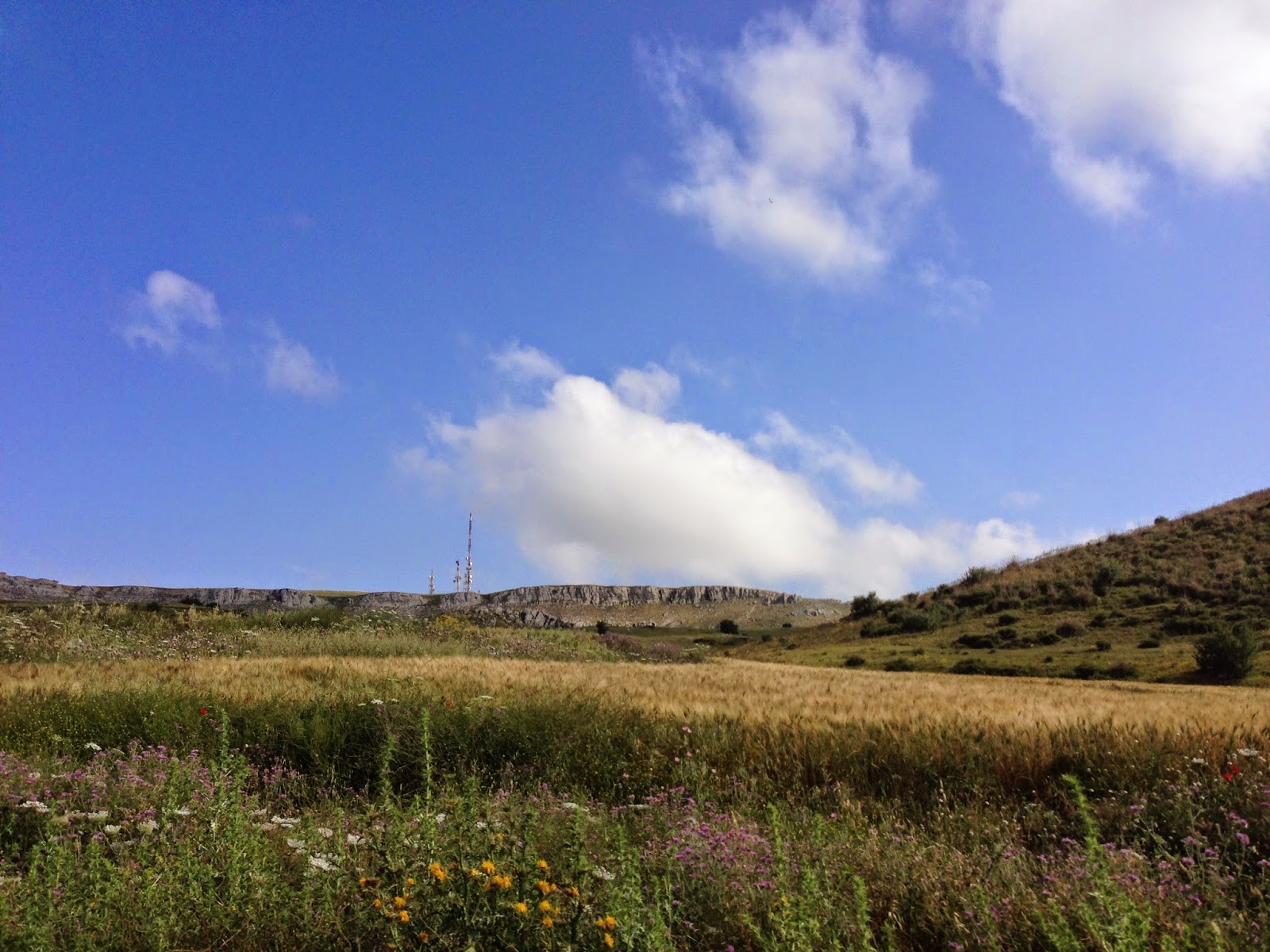 We left the city about 20 minutes after I got in the car and I was suddenly in Tuscany. At least, it looked like Tuscany: fields of amber waves of grass, wide open spaces, wildflowers, lakes, olive groves, country life, gorgeous hills... truly one of the most beautiful countrysides I've seen in my entire life. Since I had been traveling for over a day, the pleasant scenery soon lulled me to sleep.
 My driver woke me up when we got to the technical university in Beja. I walked in to find Tariq trying to explain Oracle Enterprise Manager to a bunch of college students who didn't seem to understand databases let alone Oracle. I tried to hide in one of the back seats, but Tariq immediately called me up on stage to answer a question about how to develop optimal databases.
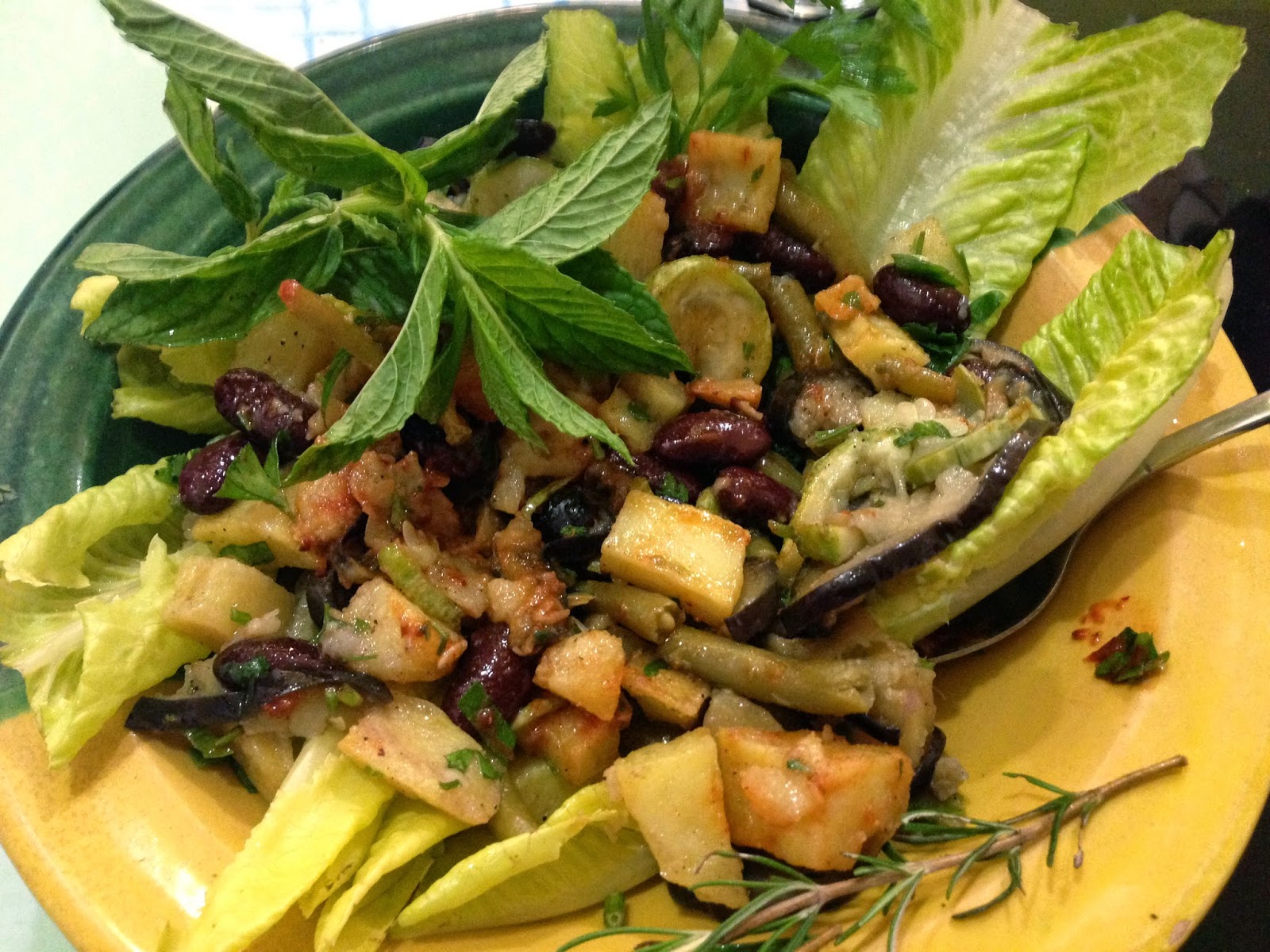 Not long after I got there, we broke for lunch. Our hosts took us to a traditional Tunisian restaurant in downtown Beja. They were kind enough to make me vegetarian food. Lunch is apparently a sacred event not-to-be-hurried in Tunisia, so we made it back to the university over 2 hours after we left, fully satiated.
I volunteered to give a session introducing Big Data and Analytics to the college kids, because I felt that it required little technical background. It seemed to go over well. My favorite part was when I told a joke about the differences in social media sites and only 10 people laughed. The people on either side of those 10 then asked them to repeat in Arabic and French what I had said, which caused those people to laugh. They then shared it around the room and it was like a disease vector of laughter that took 2 minutes to make it around to the 150+ students in the room. In case you haven't seen it, here's essentially what I said out-loud:
 After the sessions were over, I asked one of the professors why everyone listened so intently if they had no background in Oracle. I mentally wondered if it was because I was an awesome presenter bringing the gospel of Oracle to the future of Africa. I was told "they didn't understand a lot of what you were saying, but they love listening to people speak English." So much for my future African disciples.
Our hosts offered to drive us to Dougga, the so-called "best preserved Roman ruins outside of Italy." It sounded like an exaggeration, but it was actually an understatement. Dougga was once a "small" Roman town on the fringes of the empire... and the miles of town are for the most part still there. We arrived shortly after they closed the gates for the day. Our hosts got out of the front car in our 4-car caravan to talk to the guards. I was in the last car and saw an interesting polite dialog when our hosts started pointing to my car. I waved back. The guard smiled and raised the gates for our caravan to enter. I wondered if bribing had occurred, so I asked how we got in after hours. Our gracious hosts explained that I was renowned historian, Edward Roske, a visiting professor from the United States of America whose sole purpose for being in Tunisia was to see the Dougga ruins. They said I should take lots of pictures and walk around looking officially important. I discovered later that they weren't kidding: they really did tell this to the guard, so I took at least 50 pictures and took some very official selfies to help sell my renowned historian status.


The ruins were truly majestic. Every time I came around a bend, there was another temple, theatre, circus, road, market, tunnel, column, arch, statue, or something else 2,000 years old to be seen. It is all in a semi-wild state with no borders separating the ruins from the countryside. There were even wildflowers growing in the central square:
 My favorite moment of the entire trip occurred when I broke away from the rest of our group to go explore some arches on the edge of the ruins. I went to take a picture of one of the doorways, and I got photobombed:
 I went through the doorway to discover a local sheepherder grazing his sheep right in the ruins:

They started on the edge of the ruins but eventually the herder marched his sheep right down the center of the 2,000 year old road leading through Dougga. Tariq decided to join their herd:
 I can't stress enough how amazing this site is. I would encourage people to visit Tunisia if for no other reason than to see Dougga and Carthage. You have never felt Roman society like you can wandering around the ancient town with only sheep to keep you company.
Eventually, the guards at the entrance (the only guards in the place, so far as we could tell) came to find our renowned historian group because they wanted to go home. We stayed the night in the Golden Tulip Hotel in Carthage which was a 4-star hotel for under $200 USD per night. I recommend it to anyone. The next morning, the OTN MENA 5 (Tariq, Mike Ault, Bjoern, me, and Jim Czuprynski) headed for the flight to Cairo then on the Riyadh.

Saudi Arabia, May 29-31While the Islam is a part of the culture in Tunisia, Islam is the culture in Saudi Arabia. I have never seen a country more dominated by a single religion than Saudi Arabia. It is one of the most difficult places in the world to get a visa (they suspended tourist visas 5 years ago) and it's even harder for a non-Muslim like me. I spent 4 hours clearing customs which gave me a lot of time to study up on what I was in for.
My guidebook (and several websites) told me about all the things I wasn't allowed to do, say, or maybe even think when I got to Saudi. Here's what I was told versus what actually happened:
- Muslims everywhere. Yes, 100% true. They have calls to prayers everywhere and we had to stop presenting when it was time for prayer. The whole city stops, for that matter, when it's prayer time. I was lucky enough to be in a public park for evening prayer one day. The sounds of the call to prayers across the city were beautiful.
- Traffic fatalities. 90% true. Saudi apparently has the highest incidence of traffic fatalities in the world because traffic laws are more like traffic vague suggestions only to be followed if everyone has plenty of time and sort of feels like it. I was prepared to almost die every time I got in a car, and while I saw no deaths, I saw multiple car accidents of the fender bender type each day I was in Saudi. At one point, we were stopped at a red-light to make a left turn. With traffic coming from both directions in front of us, a car behind us who wanted to make a left-hand turn felt that our stopping was delaying his day. He didn't honk or behave rudely in any way: he just drove around us and made the left-turn on the red into oncoming traffic. No one seemed annoyed at the man for doing it.
- Pornography. 100% nonexistent in Saudi. They even go through the magazines in the shops and black out with a sharpie anything that's considered too revealing (shoulders, waists, knees, etc.). They also sharply monitor the web and block out any site deemed inappropriate (including Bing.com with safe search set to anything but strict).
 - Pictures of other people. 0% true. I was told before I went that Muslims do not believe in having images taken of people. What I actually found was the most selfie-absorbed culture I've ever seen, and I live in America with a teenage child. I couldn't walk 10 feet at the Riyadh or Jeddah events without someone taking a picture. I was also told that you couldn't take pictures of public buildings or in public buildings (like the national museum). Totally untrue: people were taking pictures of just about anything except women.
- Women being covered. 100% true. All the women wore black abbeyahs at all times. You're not allowed to film them or talk to them. That said, I didn't see that many. Both the events in Riyadh and Jeddah were male-only. We did see women in the public places particularly near retail outlets and in the city parks & museums.
- Men wearing suits. 25% true. For the most part, the men wore traditional dress shirts and head coverings. I wore a suit (no tie) which considering it was 110F+, was quite a sacrifice. My fellow presenters wore ties in addition to their suits which proves they're more willing to sacrifice for the cause of Oracle.
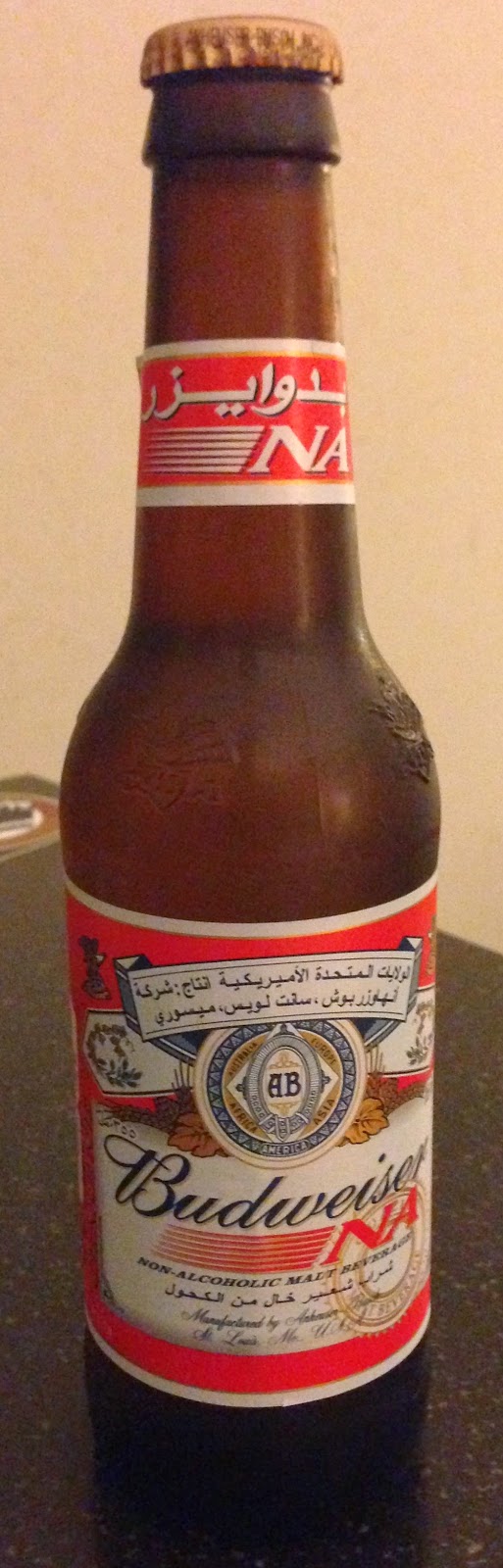
- No alcohol. 100% true but weird. The first night I got to Riyadh, I opened my minibar to find... a Budweiser. Closer examination revealed it was a "Budweiser NA" signifying no alcohol. Every restaurant we went to offered us "Saudi champagne" or "Saudi wine" which apparently means alcohol-taste without any actual alcohol. Since I hate the taste of alcohol, I didn't think non-alcoholic alcohol would taste any better, so I avoided it.
- No narcotics. 100% true so far as I was willing to test it. I actually panicked during customs at the thought that maybe I had some prescription drug in my laptop bag that had a narcotic in it. Narcotics are a capital crime in Saudi, and I spent most of my 4 hours wondering if Ambien counts as a narcotic. Luckily for me, I wasn't executed for sleep aid smuggling.
After the worst customs experience of my entire life at the airport in Riyadh, I got to the Marriott hotel for about 4 hours sleep before the day was to begin. I got to go up to the concierge floor for an elaborate breakfast and a great view of the Riyadh skyline.

The Riyadh venue was spectacular. The hosts (eSolutions) put on one of the best events I've ever attended on an OTN tour. From the venue to the signage to the elaborate Lebanese food lunch to the photographer to the videographer to the speaker gifts, it was all top-notch. Like in Beja, I presented on "Taming Big Data with Analytics" to an enthusiastic audience. There were about 75 (all male) people there including several male children of the attendees. They were some of the best behaved children I have ever seen even though some were elementary school age.
 I got introduced at one point as "Edward Roske from the United States, a rich man who did not inherit his business from his father." That was unique and though it left me speechless, the audience seemed very impressed at my ability to become head of a business without my father having to die first.
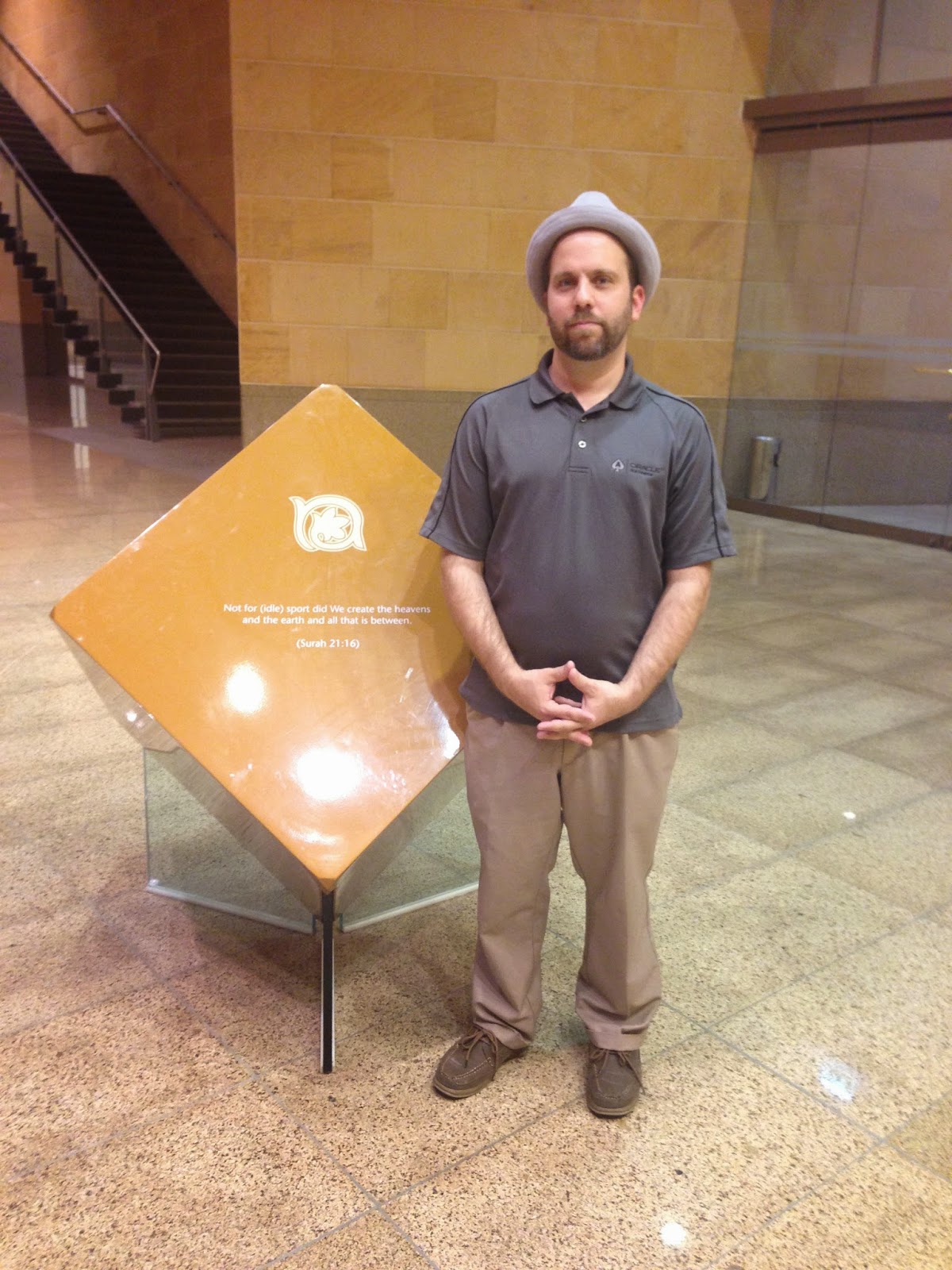 After the conference, our hosts took us to the National Museum. Like much of Riyadh, it looks like it was built in the last 5 years, and in the case of a museum, this worked very well. Since they built it all at once (versus many amazing museums around the world that were created over hundreds of years), it was able to tell a complete story from the beginning of the universe up through today (as opposed to just having rooms of collections). It was a very Muslim-centric view of history, but I found the educational aspects fascinating. The sign on the way in said no photography, but since the massive museum apparently only had 4 people working in it (all at the front desk), everyone ignored it. I found a cube in the first hall that seemed Essbase-like.
My favorite exhibit was a scale model of Mecca and Medina as viewed at night. Being non-Muslim, I will never see Mecca, so this is as close as I will ever get:
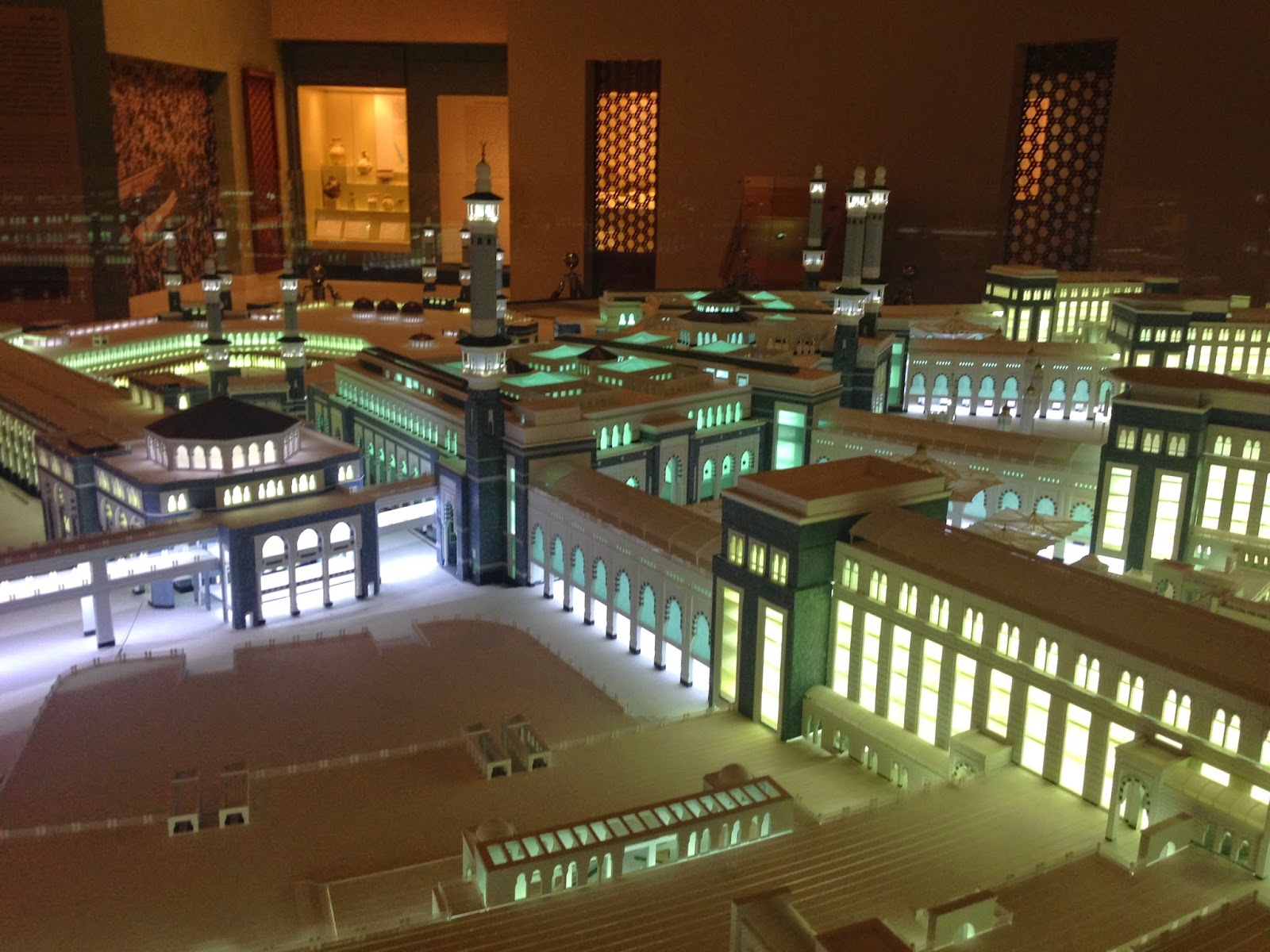 After the museum, our hosts took us to Kingdom Centre, the tallest building in Saudi Arabia (for now). It has 30+ open stories at the top with a skybridge connecting them. Here's a view from the ground of the building (notice the necklace like architecture with the bridge on top) and a view from the building of the ground:

 Our hosts took us to dinner (which was unfortunately a meat-on-a-stick restaurant, unfortunately for me since I'm a vegetarian). Since I wasn't able to eat much, I got to talk at length to the CEO of eSolutions. He was a fascinating man who told me all about how Saudi Arabia and the Gulf Coast Community is ready for analytics and reporting. He was a former Pakistani military man, but his love of country and family shined through in everything he said.
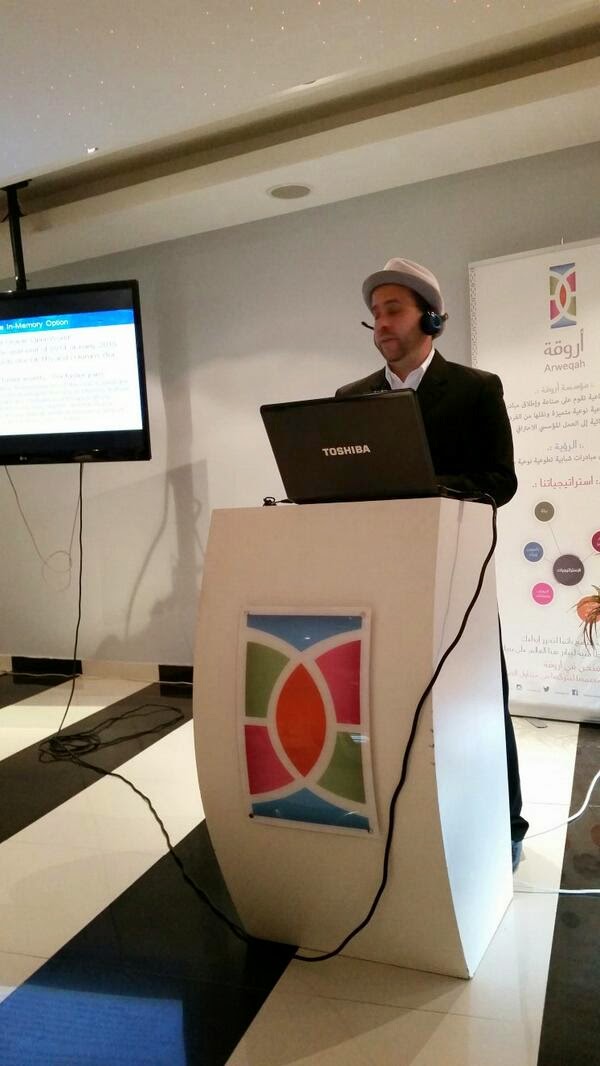 The following morning, we journeyed to Jeddah over on the Red Sea coast of Saudi near Mecca. The weather was like Riyadh except with crazy humidity. It reminded me of Houston on the hottest day of summer. We were in Jeddah for less than 24 hours so I don't admittedly have a ton to say about it. I saw nothing more than the airport, the drive to/from the hotel, the venue where we presented, and a fast casual restaurant (more tasty Lebanese food!) where we had dinner.
The venue was small since it was a half-day event and lightly attended. I did ask if I could present on a different topic since I had gotten a bit bored talking Big Data all the time. This time, I spoke on "In-Memory Databases" which is a hot topic these days thanks to the SAP guys saying "Hana" at least once every sentence. After the morning event, the OTN MENA 5-1 (Bjoern went straight to Dubai since there weren't enough speaker slots in Jeddah) headed for the airport for the flight to the United Arab Emirates. Getting out of Saudi took 2 minutes at Customs which goes to show, I guess, that they're a lot happier to get rid of you than let you in.

Dubai UAE, June 1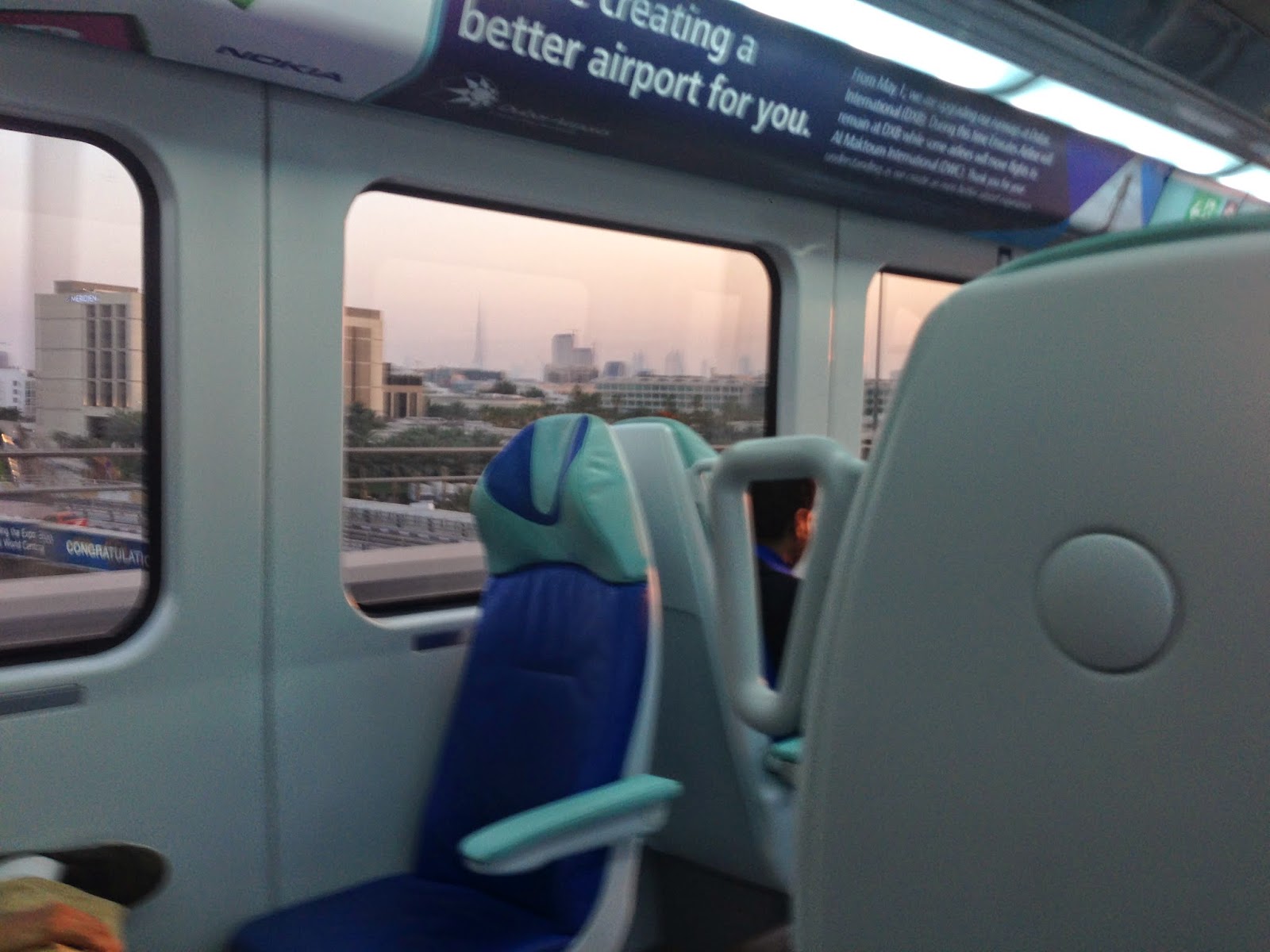 I honestly don't know where to begin with Dubai. It is truly one of the most amazing cities on Earth and almost indescribable to anyone who hasn't actually witnessed it. My flight landed on Saturday evening in the largest airport I think I've ever seen. Clearing customs took minutes then I headed for the cleanest (and probably newest since it just opened in 2009) train system in the world. The view from the Dubai Metro was stunning. If Riyadh looks like it was built in the last 10 years, Dubai looks like it was built in the last 10 minutes. It reminds me of New York City if they took out all the advertising, 90% of the people, and any building under 1,000 feet tall.

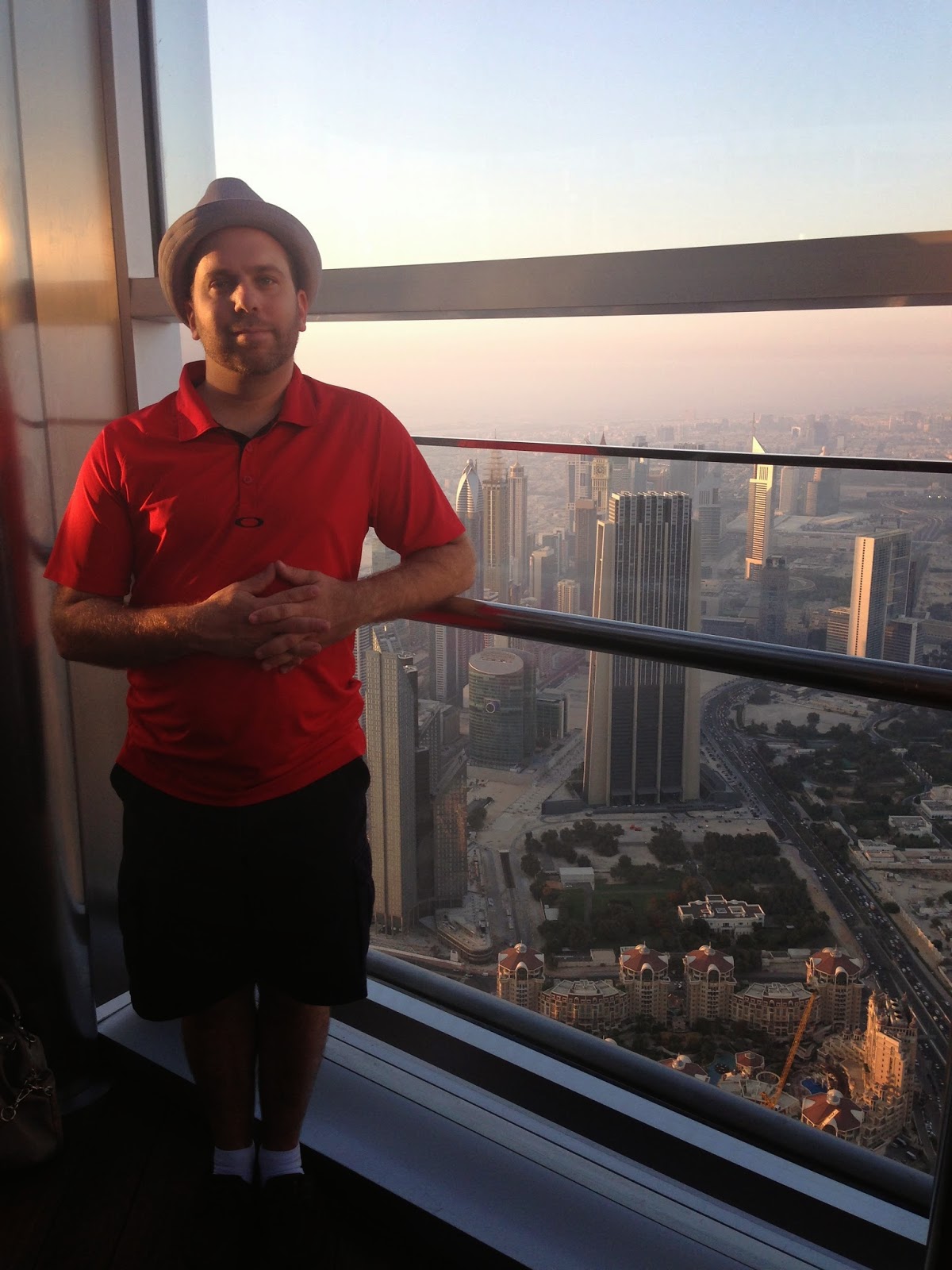
I was lucky enough to stay at a hotel in the Burj Khalifa, the tallest building in the world (by far: the Burj is over 200 stories tall at over 2,500 feet). The Burj sets all kinds of "tallest" records including the tallest outdoor observation deck. Here's a view of several buildings below that are all over 1,000 feet tall (with an Edward in it for perspective).
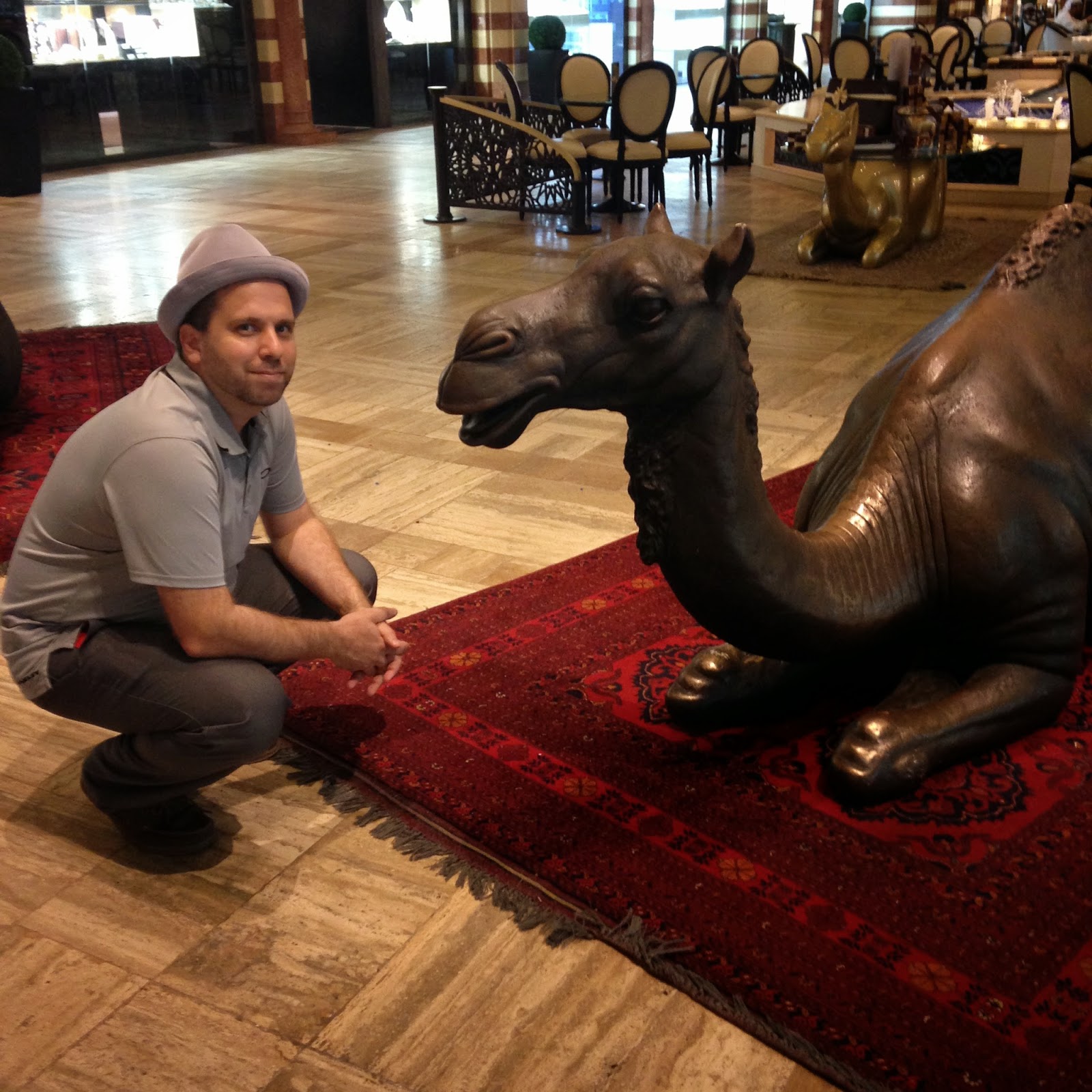
At the base of the Burj Khalifa is the Dubai Mall, the largest mall in the world (you hear a lot in Dubai of "that's the largest _____ in the world"). It's 3-4 times the size of Mall of America if that puts it in perspective. It has over 1,200 shops, over 150 restaurants, and some of the strangest (yet up-scale) stores you've ever seen. There was one selling full-size metal camels, for instance (these were the only camels I saw on my trip). I ate at the Dubai Mall every day I was in Dubai and felt I could eat there every day for a year without repeating an entree. I am normally not a fan of malls, but I loved the Dubai Mall. It wasn't crowded and the people that were there kept to themselves. This could actually be said about everywhere in the Middle East: the people are nice, but they keep to themselves. For an introvert like me, it's heaven. You can be alone in a crowd.
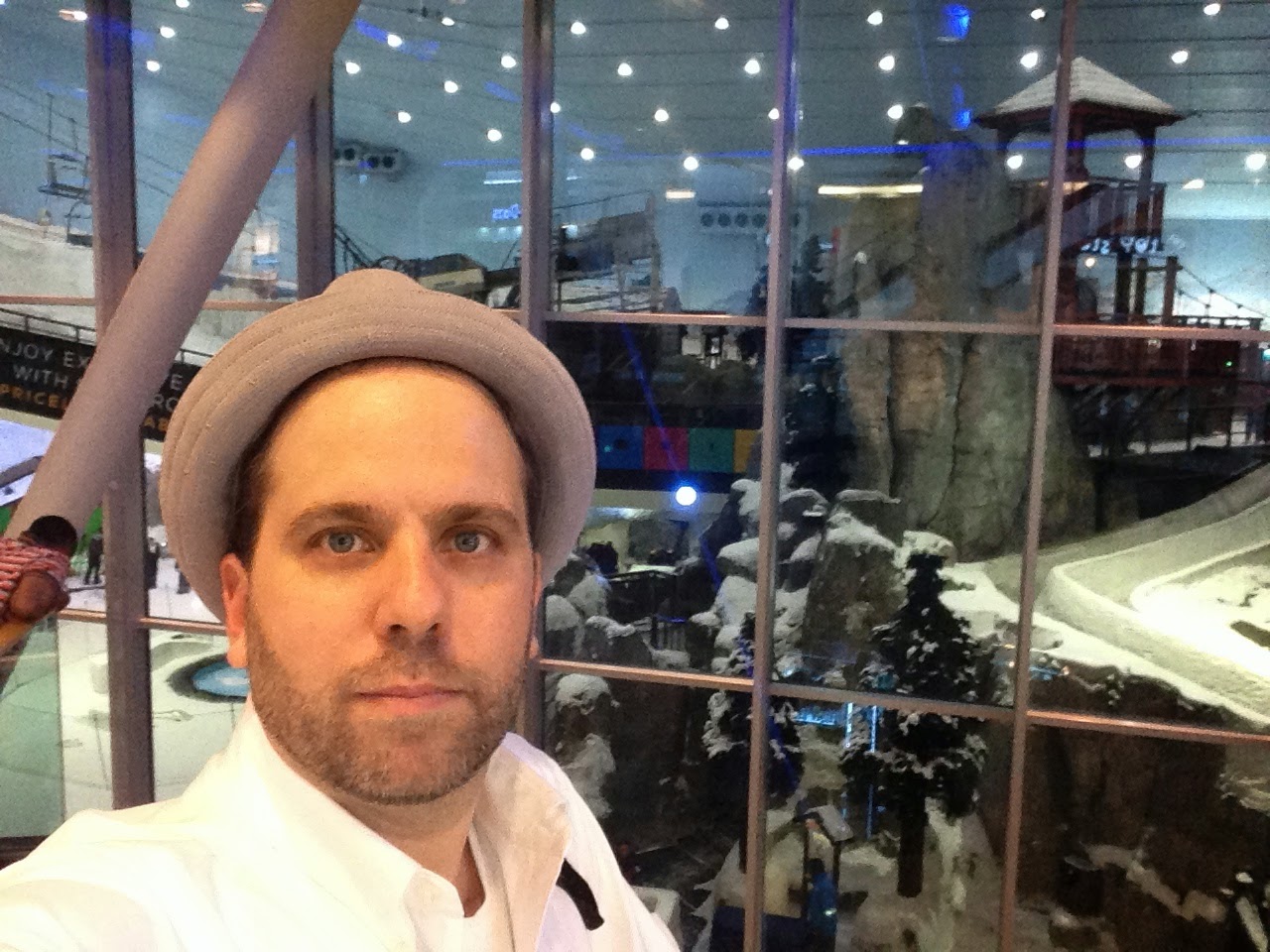 The first full day I was there, I presented in the morning, burned my feet on the sands of a beautiful beach at lunch, and was skiing in the afternoon. Yes, skiing. The Mall of the Emirates (another mall that dwarfs anything we have in the USA) is not only massive, it has its own indoor ski resort inside. It's not a tiny ski hill either: it's 1,200 feet long with three separate runs (a blue/intermediate run, a green/beginner run, and a small terrain park). They also have lots of other fun activities to do including a penguin exhibit, ziplining over the ski hill, sledding, and large transparent hamster balls to roll down the hill in.
 For around $50 USD, you get a lift ticket, ski pants, ski jacket, boots, skis, and poles for 2 hours. A full-day pass is only around $15 USD more but I opted for 2 hours. (You can only ski indoors in Dubai so much, obviously.) There were at most 15 people skiing, but there were hundreds of people from the Middle East paying their $50 to ride up and down the ski lift basking in the glory of being cold. The whole place is chilled to around 23F and the snow is glorious: it's soft and velvety because they actually make it snow indoors every night (unlike the ice blowers we use for man-made "snow" in the USA). I skied for my full 2 hours without a break and I loved that I was so cold by the end that I had to go back into the mall and get a soy hot chocolate at Starbucks.
I had too many amazing experience to recount (and this is already seeming a bit like an advertisement for Dubai) but the most fundamentally changing experience of my trip was a visit to a mosque in Dubai. Hosted by an eloquent British Muslim woman in a black abbeyah, she spent an hour educating a group of Westerners all about Islam. I was taken aback by how... peaceful their religion is. She covered the 5 pillars of Islam in a way that made me understand 1,000,000,000+ Muslims far better than I ever have. I think that if everyone in the Western world could attend that one hour I did, we would have a level of cultural understanding that would ease a ton of our current fears. They let us take lots of pictures and even let us video them doing 5 minutes of prayers. It was moving and if you are ever in Dubai, make sure you visit the Jumeirah Mosque during one of their visitation hours (it's free unlike most everything else in Dubai).
My final presentation was in Dubai and it was a bittersweet end to a whirlwind week. Every single day was spent traveling, speaking, or both, so it was nice to finally have a break. That said, I will consider the other members of the OTN MENA 5 to be friends for life and I miss them already. As I finished my presentation on Big Data (for the third time on the trip), I looked out at the anxious faces in the audience and realized that I would miss the Muslim world far more than I ever expected to.

If there's ever a 2nd OTN tour of the Middle East, Africa, or both, sign me up. Until then, thank you for letting me be a part of the most inspirational, educational tour I've ever experienced.
Tariq Farooq first mentioned the idea of doing a MENA (Middle East & North Africa) tour to me in Beijing last fall. He asked if I'd be willing to travel half-way around the world to speak to people in English that primarily spoke French and Arabic, and I - of course - said "yes." Here's Tariq being interviewed by Lillian Buziak at Collaborate 2014 (audio is a bit difficult to hear):
I had two reasons for wanting to go: I do love educating/evangelizing for Oracle EPM, BI, and Business Analytics. The possibility of reaching new audiences for the first time was exciting. My other reason for going was that I wanted to experience totally different cultures than I ever have before. I've spoken on 5 continents (now 6 after this tour and I'm anxiously awaiting the OTN Tour to Antarctica) before and have seen presented everywhere from a women's college in Mumbai that was 95F with no air conditioning in the presentation room to a ballroom in the Philippines that had 3 simultaneous English sessions going on (in one room!) all happily observed by smiling Filipinos. From China to India to Australia to Germany, I have seen some amazing slices of life, but nothing prepared me for the differences I saw on this tour.
In each of the sections below, I have linked the header to a blog from my new best German friend, Bjoern Rost. He blogged after every stop and unlike me, he actually understood all the Oracle RDBMS sessions on the tour. Visit http://portrix-systems.de/blog/author/brost/ to see his entertaining blog posts. (Warning: though I think Bjoern is hilarious, being German, you may find his posts to be 'not funny.' German humor is an acquired taste.)
I left for the first stop, Tunisia, on Memorial Day (in the USA), May 26, 2014...
Tunisia, May 27To get to Tunisia in time for my session, I left Dallas. Texas at 10AM on Monday, flew to JFK (New York City), flew to Rome, flew to Tunis, and had a nice car waiting for me at the airport compliments of our hosts in Tunisia. I landed at 10:30AM on Tuesday and considering I was flying to Africa, I felt that the trip went by quickly. I made it through customs in Tunis in about 15 minutes, walked out the front door of the hotel, and was in an entirely different world.
Speaking in North America, South America, Europe, Asia, and Australia had done absolutely nothing to prepare me for Africa. The closest thing I could compare it to in my life (but the comparison does not do it justice) was the cities of India: chaotic, dirty, cramped, foreign, and chaotic (worth mentioning again). Now take all that, remove the cows, and make it Muslim.
My host picked me up in a nice car and we began the hour drive to Beja where the conference was being held. We passed mounds of trash piled up in the center of the roads though thankfully the heat (high was ~75F when I arrived) didn't make the place smell horribly. Traffic laws seemed to be non-existent, but it moved fairly quickly being in the middle of the day. I loved looking out the window at the shops along the road and carts selling watermelon approximately every 100 feet (I was told by my host that it was watermelon season).
 We left the city about 20 minutes after I got in the car and I was suddenly in Tuscany. At least, it looked like Tuscany: fields of amber waves of grass, wide open spaces, wildflowers, lakes, olive groves, country life, gorgeous hills... truly one of the most beautiful countrysides I've seen in my entire life. Since I had been traveling for over a day, the pleasant scenery soon lulled me to sleep.
 Not long after I got there, we broke for lunch. Our hosts took us to a traditional Tunisian restaurant in downtown Beja. They were kind enough to make me vegetarian food. Lunch is apparently a sacred event not-to-be-hurried in Tunisia, so we made it back to the university over 2 hours after we left, fully satiated.
I volunteered to give a session introducing Big Data and Analytics to the college kids, because I felt that it required little technical background. It seemed to go over well. My favorite part was when I told a joke about the differences in social media sites and only 10 people laughed. The people on either side of those 10 then asked them to repeat in Arabic and French what I had said, which caused those people to laugh. They then shared it around the room and it was like a disease vector of laughter that took 2 minutes to make it around to the 150+ students in the room. In case you haven't seen it, here's essentially what I said out-loud:
The ruins were truly majestic. Every time I came around a bend, there was another temple, theatre, circus, road, market, tunnel, column, arch, statue, or something else 2,000 years old to be seen. It is all in a semi-wild state with no borders separating the ruins from the countryside. There were even wildflowers growing in the central square:
They started on the edge of the ruins but eventually the herder marched his sheep right down the center of the 2,000 year old road leading through Dougga. Tariq decided to join their herd:
Eventually, the guards at the entrance (the only guards in the place, so far as we could tell) came to find our renowned historian group because they wanted to go home. We stayed the night in the Golden Tulip Hotel in Carthage which was a 4-star hotel for under $200 USD per night. I recommend it to anyone. The next morning, the OTN MENA 5 (Tariq, Mike Ault, Bjoern, me, and Jim Czuprynski) headed for the flight to Cairo then on the Riyadh.
Saudi Arabia, May 29-31While the Islam is a part of the culture in Tunisia, Islam is the culture in Saudi Arabia. I have never seen a country more dominated by a single religion than Saudi Arabia. It is one of the most difficult places in the world to get a visa (they suspended tourist visas 5 years ago) and it's even harder for a non-Muslim like me. I spent 4 hours clearing customs which gave me a lot of time to study up on what I was in for.
My guidebook (and several websites) told me about all the things I wasn't allowed to do, say, or maybe even think when I got to Saudi. Here's what I was told versus what actually happened:
- Muslims everywhere. Yes, 100% true. They have calls to prayers everywhere and we had to stop presenting when it was time for prayer. The whole city stops, for that matter, when it's prayer time. I was lucky enough to be in a public park for evening prayer one day. The sounds of the call to prayers across the city were beautiful.
- Traffic fatalities. 90% true. Saudi apparently has the highest incidence of traffic fatalities in the world because traffic laws are more like traffic vague suggestions only to be followed if everyone has plenty of time and sort of feels like it. I was prepared to almost die every time I got in a car, and while I saw no deaths, I saw multiple car accidents of the fender bender type each day I was in Saudi. At one point, we were stopped at a red-light to make a left turn. With traffic coming from both directions in front of us, a car behind us who wanted to make a left-hand turn felt that our stopping was delaying his day. He didn't honk or behave rudely in any way: he just drove around us and made the left-turn on the red into oncoming traffic. No one seemed annoyed at the man for doing it.
- Pornography. 100% nonexistent in Saudi. They even go through the magazines in the shops and black out with a sharpie anything that's considered too revealing (shoulders, waists, knees, etc.). They also sharply monitor the web and block out any site deemed inappropriate (including Bing.com with safe search set to anything but strict).
- Pictures of other people. 0% true. I was told before I went that Muslims do not believe in having images taken of people. What I actually found was the most selfie-absorbed culture I've ever seen, and I live in America with a teenage child. I couldn't walk 10 feet at the Riyadh or Jeddah events without someone taking a picture. I was also told that you couldn't take pictures of public buildings or in public buildings (like the national museum). Totally untrue: people were taking pictures of just about anything except women.- Women being covered. 100% true. All the women wore black abbeyahs at all times. You're not allowed to film them or talk to them. That said, I didn't see that many. Both the events in Riyadh and Jeddah were male-only. We did see women in the public places particularly near retail outlets and in the city parks & museums.
- Men wearing suits. 25% true. For the most part, the men wore traditional dress shirts and head coverings. I wore a suit (no tie) which considering it was 110F+, was quite a sacrifice. My fellow presenters wore ties in addition to their suits which proves they're more willing to sacrifice for the cause of Oracle.
- No alcohol. 100% true but weird. The first night I got to Riyadh, I opened my minibar to find... a Budweiser. Closer examination revealed it was a "Budweiser NA" signifying no alcohol. Every restaurant we went to offered us "Saudi champagne" or "Saudi wine" which apparently means alcohol-taste without any actual alcohol. Since I hate the taste of alcohol, I didn't think non-alcoholic alcohol would taste any better, so I avoided it.
- No narcotics. 100% true so far as I was willing to test it. I actually panicked during customs at the thought that maybe I had some prescription drug in my laptop bag that had a narcotic in it. Narcotics are a capital crime in Saudi, and I spent most of my 4 hours wondering if Ambien counts as a narcotic. Luckily for me, I wasn't executed for sleep aid smuggling.
After the worst customs experience of my entire life at the airport in Riyadh, I got to the Marriott hotel for about 4 hours sleep before the day was to begin. I got to go up to the concierge floor for an elaborate breakfast and a great view of the Riyadh skyline.
After the conference, our hosts took us to the National Museum. Like much of Riyadh, it looks like it was built in the last 5 years, and in the case of a museum, this worked very well. Since they built it all at once (versus many amazing museums around the world that were created over hundreds of years), it was able to tell a complete story from the beginning of the universe up through today (as opposed to just having rooms of collections). It was a very Muslim-centric view of history, but I found the educational aspects fascinating. The sign on the way in said no photography, but since the massive museum apparently only had 4 people working in it (all at the front desk), everyone ignored it. I found a cube in the first hall that seemed Essbase-like.My favorite exhibit was a scale model of Mecca and Medina as viewed at night. Being non-Muslim, I will never see Mecca, so this is as close as I will ever get:
The following morning, we journeyed to Jeddah over on the Red Sea coast of Saudi near Mecca. The weather was like Riyadh except with crazy humidity. It reminded me of Houston on the hottest day of summer. We were in Jeddah for less than 24 hours so I don't admittedly have a ton to say about it. I saw nothing more than the airport, the drive to/from the hotel, the venue where we presented, and a fast casual restaurant (more tasty Lebanese food!) where we had dinner.The venue was small since it was a half-day event and lightly attended. I did ask if I could present on a different topic since I had gotten a bit bored talking Big Data all the time. This time, I spoke on "In-Memory Databases" which is a hot topic these days thanks to the SAP guys saying "Hana" at least once every sentence. After the morning event, the OTN MENA 5-1 (Bjoern went straight to Dubai since there weren't enough speaker slots in Jeddah) headed for the airport for the flight to the United Arab Emirates. Getting out of Saudi took 2 minutes at Customs which goes to show, I guess, that they're a lot happier to get rid of you than let you in.
Dubai UAE, June 1
I honestly don't know where to begin with Dubai. It is truly one of the most amazing cities on Earth and almost indescribable to anyone who hasn't actually witnessed it. My flight landed on Saturday evening in the largest airport I think I've ever seen. Clearing customs took minutes then I headed for the cleanest (and probably newest since it just opened in 2009) train system in the world. The view from the Dubai Metro was stunning. If Riyadh looks like it was built in the last 10 years, Dubai looks like it was built in the last 10 minutes. It reminds me of New York City if they took out all the advertising, 90% of the people, and any building under 1,000 feet tall.I was lucky enough to stay at a hotel in the Burj Khalifa, the tallest building in the world (by far: the Burj is over 200 stories tall at over 2,500 feet). The Burj sets all kinds of "tallest" records including the tallest outdoor observation deck. Here's a view of several buildings below that are all over 1,000 feet tall (with an Edward in it for perspective).
My room had a view of the Dubai Fountains. No offense, Vegas, but these fountains put the Bellagio fountains to shame. They're more agile, faster, better lit, larger, and frankly, classier. And if you're staying in the hotel in the Burj Khalifa, you can listen to the fountain music through the TV:
At the base of the Burj Khalifa is the Dubai Mall, the largest mall in the world (you hear a lot in Dubai of "that's the largest _____ in the world"). It's 3-4 times the size of Mall of America if that puts it in perspective. It has over 1,200 shops, over 150 restaurants, and some of the strangest (yet up-scale) stores you've ever seen. There was one selling full-size metal camels, for instance (these were the only camels I saw on my trip). I ate at the Dubai Mall every day I was in Dubai and felt I could eat there every day for a year without repeating an entree. I am normally not a fan of malls, but I loved the Dubai Mall. It wasn't crowded and the people that were there kept to themselves. This could actually be said about everywhere in the Middle East: the people are nice, but they keep to themselves. For an introvert like me, it's heaven. You can be alone in a crowd.
The first full day I was there, I presented in the morning, burned my feet on the sands of a beautiful beach at lunch, and was skiing in the afternoon. Yes, skiing. The Mall of the Emirates (another mall that dwarfs anything we have in the USA) is not only massive, it has its own indoor ski resort inside. It's not a tiny ski hill either: it's 1,200 feet long with three separate runs (a blue/intermediate run, a green/beginner run, and a small terrain park). They also have lots of other fun activities to do including a penguin exhibit, ziplining over the ski hill, sledding, and large transparent hamster balls to roll down the hill in.I had too many amazing experience to recount (and this is already seeming a bit like an advertisement for Dubai) but the most fundamentally changing experience of my trip was a visit to a mosque in Dubai. Hosted by an eloquent British Muslim woman in a black abbeyah, she spent an hour educating a group of Westerners all about Islam. I was taken aback by how... peaceful their religion is. She covered the 5 pillars of Islam in a way that made me understand 1,000,000,000+ Muslims far better than I ever have. I think that if everyone in the Western world could attend that one hour I did, we would have a level of cultural understanding that would ease a ton of our current fears. They let us take lots of pictures and even let us video them doing 5 minutes of prayers. It was moving and if you are ever in Dubai, make sure you visit the Jumeirah Mosque during one of their visitation hours (it's free unlike most everything else in Dubai).
My final presentation was in Dubai and it was a bittersweet end to a whirlwind week. Every single day was spent traveling, speaking, or both, so it was nice to finally have a break. That said, I will consider the other members of the OTN MENA 5 to be friends for life and I miss them already. As I finished my presentation on Big Data (for the third time on the trip), I looked out at the anxious faces in the audience and realized that I would miss the Muslim world far more than I ever expected to.
If there's ever a 2nd OTN tour of the Middle East, Africa, or both, sign me up. Until then, thank you for letting me be a part of the most inspirational, educational tour I've ever experienced.
Categories: BI & Warehousing
My Friend, Mike Riley, Has Cancer
I found out this summer that one of my best friends - one of the entire Hyperion community's best friends - has cancer. This is his story.
But first, a mea culpa:
In 2008, I Was An IdiotBack in early 2008, I wrote a blog entry comparing Collaborate, Kaleidoscope, and OpenWorld. In this entry, I said that Collaborate was the obvious successor to the Hyperion Solutions conference and I wasn't terribly nice to Kaleidoscope. Here's me answering which of the three conferences I think the Hyperion community should attend (I dare you to hold in the laughter):
Now which one would I attend if I could only go to one?Collaborate. Without reservation. If I'm going to a conference, it's primarily to learn. As such, content is key.I actually got asked a very similar question on Network 54's Essbase discussion board just yesterday (apparently, it's a popular question these days). To parrot what I said there, OpenWorld was very, very marketing-oriented. 80% of the fewer than 100 presentations in the Hyperion track were delivered by Oracle (in some cases, with clients/partners as co-speakers). COLLABORATE is supposed to have 100-150 presentations with 100+ of those delivered by clients and partners.In the interest of full-disclosure, my company, interRel, is paying to be a 4-star partner of COLLABORATE. Why? Because we're hoping that COLLABORATE becomes the successor to the Solutions conference. Solutions was a great opportunity to learn (partying was always secondary) and I refuse to believe it's dead with nothing to take it's mantle. We're investing a great deal of money with the assumption that something has to take the place of Hyperion Solutions conference, and it certainly isn't OpenWorld.Is OpenWorld completely bad? Absolutely not. In addition to the great bribes, it's a much larger conference than COLLABORATE or ODTUG's Kaleidoscope, so if your thing is networking, by all means, go to OpenWorld. OpenWorld is the best place to get the official Oracle party line on upcoming releases and what not. OpenWorld is also the place to hear better keynotes (well, at least by More Famous People like Larry Ellison, himself). OpenWorld has better parties too. OpenWorld is also in San Francisco which is just a generally cooler town. In short, OpenWorld was very well organized, but since it's being put on by Oracle, it's about them getting out their message to their existing and prospective client base.So why aren't I recommending Kaleidoscope (since I haven't been to that either)? Size, mostly. Their entire conference will have around 100 presentations, so their Hyperion track will most likely be fewer than 10 presentations. I've been to regional Hyperion User Group meetings that have more than that (well, the one interRel hosted in August of 2007 had 9, but close enough). While Kaleidoscope may one day grow their Hyperion track, it's going to be a long time until they equal the 100-150 presentations that COLLABORATE is supposed to have on Hyperion alone.If you're only going to one Hyperion-oriented conference this year, register for COLLABORATE. If you've got money in the budget for two conferences, also go to OpenWorld. If you're a developer that finds both COLLABORATE and OpenWorld to be too much high-level fluff, then go to Kaleidoscope.
So, ya, that entry may live in infamy. [Editor's Note: Find out a way to delete prior blog posts without anyone noticing.] Notice that of the three conferences, I recommended Kaleidoscope last and dared to say that it would take them a long time until they had 100-150 sessions like Collaborate. Interestingly, Collaborate peaked that year at 84 Hyperion sessions, and Kaleidoscope is well over 150 Business Analytics sessions, but I'm getting ahead of myself.
In 2008, Mike Riley Luckily Wasn't An Idiot
I had never met Mike Riley, but he commented directly on my blog. He was gracious even though I was slamming his tiny little conference in New Orleans: Hyperion users are blessed with many training opportunities. I agree with Edward, the primary reason for going to a conference is to learn, but I disagree that Collaborate is the best place to do that. ODTUG Kaleidoscope, Collaborate, and OpenWorld all have unique offerings.
It’s true that ODTUG is a smaller conference, however that is by choice. At every ODTUG conference, the majority of the content is by a user, not by Oracle or even another vendor. And even though Collaborate might seem like the better buy because of its scale, for developers and true technologists ODTUG offers a much more targeted and efficient conference experience. Relevant tracks in your experience level are typically consecutive, rather than side-by-side so you don’t miss sessions you want to attend. The networking is also one of the most valuable pieces. The people that come to ODTUG are the doers, so everyone you meet will be a valuable contact in the future.
It’s true, COLLABORATE will have many presentations with a number of those delivered by clients and partners, but what difference does that make? You can’t attend all of them. ODTUG’s Kaleidoscope will have 17 Hyperion sessions that are all technical.
In the interest of full disclosure, I have been a member of ODTUG for eight years and this is my second year as a board member. What attracted me to ODTUG from the start was the quality of the content delivered, and the networking opportunities. This remains true today.
I won’t censor or disparage any of the other conferences. We are lucky to have so many choices available to us. My personal choice and my highest recommendation goes to Kaleidoscope for all the reasons I mentioned above (and I have attended all three of the above mentioned conferences).
One last thing; New Orleans holds its own against San Francisco or Denver. All of the cities are wonderful, but when it comes to food, fun, and great entertainment there’s nothing like the Big Easy. Mike was only in his second year as a board member of ODTUG, but he was willing to put himself out there, so I wrote him an e-mail back. In that e-mail, dated February 10, 2008, I said that for Kaleidoscope to become a conference that Hyperion users would love, it would require a few key components: keynote(s) by headliner(s), panels of experts, high-quality presentations, a narrow focus that wasn't all things to all people, and a critical mass of attendees.
At the end of the e-mail, I said "If Kaleidoscope becomes that, I'll shout it from the rooftops. I want to help Kaleidoscope be successful, and I'm willing to invest the time and effort to help out. Regarding your question below, I would be more than happy to work with Mark [Rittman] and Kent [Graziano] to come up with a workable concept and I think I'm safe in saying that Tim [Tow] would be happy to contribute as well. For that matter, if you're looking for two people to head up your Hyperion track (and enact some of the suggestions above), Tim and I would be willing (again, I'm speaking on Tim's behalf, but he's one of the most helpful people on planet Hyperion)."
K(aleido)scope
Kaleidoscope 2008 ended up being the best Hyperion conference I ever attended (at the time). It was a mix of Hyperion Solutions, Arbor Dimensions, and Hyperion Top Gun. With only 4 months prep time, we had 175 attendees in what then was only an Essbase track. Though it was only one conference room there in New Orleans, the attendees sat in their seats for most of a week and learned more than many of us had learned in years.
After the conference, Mike and the ODTUG board offered Tim Tow a spot on the ODTUG board (a spot to which he was later elected by the community) to represent the interests of Hyperion. I founded the ODTUG Hyperion SIG along with several attendees from that Kaleidoscope 2008. I eventually became Hyperion Content Chair for Kaleidoscope and passed my Hyperion SIG presidency on to the awesome Gary Crisci. In 2010, Mike talked me into being Conference Chair for Kaleidoscope (which I promptly renamed Kscope since I never could handle how "kaleidoscope" violated the whole "i before e" rule). Or maybe I talked him into it. Either way, I was Conference Chair for Kscope11 and Kscope12.
During those years, Mike worked closely with the Kscope conference committee in his role as President of ODTUG. Mike rather good-naturedly ("good-natured" is, I expect, the most commonly used phrase to describe Mike) put up with whatever crazy thing I wanted him to do. In 2011, he was featured during the general session in several reality show parodies (including his final, climactic race with John King to see who got to pick the location for Kscope12). I decided to up the ante in 2012 by making the entire general session about him in a "Mike Riley, This Is Your Life" hour and we found ourselves laughing not at Mike, but near him. It included Mike having to dance with the Village Persons (a Village People tribute band) and concluded with Mike stepping down as President of ODTUG...
... to focus his ODTUG time on being the new Conference Chair for Kscope. Kscope13 returned to New Orleans and Mike did a fabulous job with what I consider to be Hyperion's 5 year anniversary with Kscope. Mike was preparing Kscope14 when I got a phone call from him. I expected him to talk over Kscope, ODTUG, or just to say hi, but I'll never forget when Mike told me he had stage 3 rectal cancer. My father died in 2002 of colorectal cancer, and the thought that one of my best friends was going to face this was terrifying... and I wasn't the one with cancer.
I feel that the Hyperion community was saved by Mike (what would have happened if we had all just given up after Collaborate 2008 was a major letdown?) and now it's time for us to do our part. Whether you've attended Kscope in the past or just been envious of those of us who have, you know that it's the one place per year that you can meet and learn from some of the greatest minds in the industry.
Mike Helped Us, Let's Help Him
Kscope is now the best conference for Oracle Business Analytics (EPM and BI) in the world, and Mike, I'm shouting it from every rooftop I can find (although I wish when I climbed up there people would stop yelling "Jump! You have nothing else to live for!"). I tell everyone I know how much I love Kscope, and on behalf of all the help you've given the Hyperion community over the last 5 years, Mike, it's now time for us to help you.
After many weeks of chemo, Mike goes into surgery tomorrow to hopefully have the tumor removed. Then he has many more weeks of chemo after that. He's a fighter, but getting rid of cancer is expensive, so we've set up a Go Fund Me campaign to help offset his medical bills. If you love Kscope, there is no one on Earth more responsible for its current state than Mike Riley. If you love ODTUG, no one has more fundamentally changed the organization in the last millennium than Mike Riley. If you love Hyperion, no one has done more to save the community than Mike Riley.
And if after reading this entry, you love Mike for all he's done, go to http://bit.ly/HelpMike and donate generously, because we want Mike to be there at the opening of Kscope14 in Seattle on June 22. Please share this entry, and even if you can't donate, send Mike an e-mail at mriley@odtug.com letting him know you appreciate everything he's done.
But first, a mea culpa:
In 2008, I Was An IdiotBack in early 2008, I wrote a blog entry comparing Collaborate, Kaleidoscope, and OpenWorld. In this entry, I said that Collaborate was the obvious successor to the Hyperion Solutions conference and I wasn't terribly nice to Kaleidoscope. Here's me answering which of the three conferences I think the Hyperion community should attend (I dare you to hold in the laughter):
Now which one would I attend if I could only go to one?Collaborate. Without reservation. If I'm going to a conference, it's primarily to learn. As such, content is key.I actually got asked a very similar question on Network 54's Essbase discussion board just yesterday (apparently, it's a popular question these days). To parrot what I said there, OpenWorld was very, very marketing-oriented. 80% of the fewer than 100 presentations in the Hyperion track were delivered by Oracle (in some cases, with clients/partners as co-speakers). COLLABORATE is supposed to have 100-150 presentations with 100+ of those delivered by clients and partners.In the interest of full-disclosure, my company, interRel, is paying to be a 4-star partner of COLLABORATE. Why? Because we're hoping that COLLABORATE becomes the successor to the Solutions conference. Solutions was a great opportunity to learn (partying was always secondary) and I refuse to believe it's dead with nothing to take it's mantle. We're investing a great deal of money with the assumption that something has to take the place of Hyperion Solutions conference, and it certainly isn't OpenWorld.Is OpenWorld completely bad? Absolutely not. In addition to the great bribes, it's a much larger conference than COLLABORATE or ODTUG's Kaleidoscope, so if your thing is networking, by all means, go to OpenWorld. OpenWorld is the best place to get the official Oracle party line on upcoming releases and what not. OpenWorld is also the place to hear better keynotes (well, at least by More Famous People like Larry Ellison, himself). OpenWorld has better parties too. OpenWorld is also in San Francisco which is just a generally cooler town. In short, OpenWorld was very well organized, but since it's being put on by Oracle, it's about them getting out their message to their existing and prospective client base.So why aren't I recommending Kaleidoscope (since I haven't been to that either)? Size, mostly. Their entire conference will have around 100 presentations, so their Hyperion track will most likely be fewer than 10 presentations. I've been to regional Hyperion User Group meetings that have more than that (well, the one interRel hosted in August of 2007 had 9, but close enough). While Kaleidoscope may one day grow their Hyperion track, it's going to be a long time until they equal the 100-150 presentations that COLLABORATE is supposed to have on Hyperion alone.If you're only going to one Hyperion-oriented conference this year, register for COLLABORATE. If you've got money in the budget for two conferences, also go to OpenWorld. If you're a developer that finds both COLLABORATE and OpenWorld to be too much high-level fluff, then go to Kaleidoscope.
In 2008, Mike Riley Luckily Wasn't An Idiot
It’s true that ODTUG is a smaller conference, however that is by choice. At every ODTUG conference, the majority of the content is by a user, not by Oracle or even another vendor. And even though Collaborate might seem like the better buy because of its scale, for developers and true technologists ODTUG offers a much more targeted and efficient conference experience. Relevant tracks in your experience level are typically consecutive, rather than side-by-side so you don’t miss sessions you want to attend. The networking is also one of the most valuable pieces. The people that come to ODTUG are the doers, so everyone you meet will be a valuable contact in the future.
It’s true, COLLABORATE will have many presentations with a number of those delivered by clients and partners, but what difference does that make? You can’t attend all of them. ODTUG’s Kaleidoscope will have 17 Hyperion sessions that are all technical.
In the interest of full disclosure, I have been a member of ODTUG for eight years and this is my second year as a board member. What attracted me to ODTUG from the start was the quality of the content delivered, and the networking opportunities. This remains true today.
I won’t censor or disparage any of the other conferences. We are lucky to have so many choices available to us. My personal choice and my highest recommendation goes to Kaleidoscope for all the reasons I mentioned above (and I have attended all three of the above mentioned conferences).
One last thing; New Orleans holds its own against San Francisco or Denver. All of the cities are wonderful, but when it comes to food, fun, and great entertainment there’s nothing like the Big Easy. Mike was only in his second year as a board member of ODTUG, but he was willing to put himself out there, so I wrote him an e-mail back. In that e-mail, dated February 10, 2008, I said that for Kaleidoscope to become a conference that Hyperion users would love, it would require a few key components: keynote(s) by headliner(s), panels of experts, high-quality presentations, a narrow focus that wasn't all things to all people, and a critical mass of attendees.
K(aleido)scope
Mike Helped Us, Let's Help Him
Categories: BI & Warehousing
Competitors, Welcome to Our Webcasts
I was happy to be a part of Oracle's EPM Showcase yesterday in New York City. It was a half-day event (plus a happy hour) that had Oracle giving a keynote followed by two 90-minute breakout session timeslots (with two sessions happening concurrently). I was speaking during the first timeslot on Hyperion DRM (Data Relationship Management) along with Nikki from Verizon and Erin Lineberry from interRel. In my talk, I described how companies need a single system of record for hierarchies and explained how DRM was a really good fit particularly with the new data governance module in 11.1.2.3.
 There were partners in my session, and I had no problem at all with it. After all, this was a conference open to anyone and I am a firm believer that when people learn more, the whole community benefits. This is what motivates me to write all of my books, cause believe me, it's not for the money (Google "Starving Authors" before you ever think to make money writing). I also speak at way too many events around the world each year from tiny user groups to massive conferences like Kscope, Collaborate, and OpenWorld with no concerns that my sessions are primarily filled with Oracle partners looking to improve.
After my session was over, there was one more timeslot for the day and since I didn't want to sit in the hall for 90 minutes, I went to Huron Consulting Group's (they're the company that bought Blue Stone) session on the future of Planning. It sounded more interesting than Hackett's session which was my other possibility and I saw that one of the speakers was Mike Nader who is a great presenter. If nothing else, I would get to hear Mike's engaging take on the world since he joined Blue Stone. I sat in the room in the back row (there were plenty of extra seats, but I wanted to leave the good seats for potential customers).
Right as the session was about to start, Rick Schmitt from Huron (Blue Stone) came over to me and asked me to leave. I was curious why since I was an official attendee at the event and he said that they were going to be talking over "some proprietary stuff." I assumed he meant his slides at the beginning on the Blue Stone acquisition or "why Blue Stone is the best at XYZ," so I offered to leave for the first few slides. I don't need nor want competitive info and I certainly didn't want to make him nervous during his sales pitch. He said that no, they were going to share lots of proprietary info throughout the session and he didn't want competitors in the room during their session at all.
Rather embarrassed but more bemused, I smiled, gathered my things, and walked out of the room. I sat in the hall for a while wondering what cool things I was missing and feeling jealous of the 50 clients that got to hear from Blue Stone. (There's nothing like being excluded from something to make you want it more.) As I sat there, I pondered my own stance on information sharing. Personally, I believe that if the community as a whole gets better - if the community learns more - the quality of Hyperion implementations will rise. Satisfaction with Oracle EPM will rise, and as the reputation of Hyperion gets better, the Hyperion market will grow which benefits the entire community: customers, Oracle, and partners.
So starting effective immediately, all of the public webcasts interRel does (and we did over 100 webcasts last year) will be open to everyone. That's right: competitors, please come join our webcasts and we'll share all the information that we spend months putting together with you. You've always had access to our books, our sessions at user groups, our presentations at conferences, and now you have access to our webcasts too. I hope that this starts a trend: I strongly encourage our competition to open up their sessions and webcasts to anyone who wants to attend. Don't be afraid: if you're good at what you do, you shouldn't be afraid to help the competition get better too. Information is meant to be free and to point out the obvious, if the Hyperion market gets bigger from happier clients telling everyone they know to buy Hyperion, your potential customer base gets bigger too.
Our next webcast is Thursday, October 31. It's on how Smart View is finally an awesome replacement for the Essbase Excel Add-In and I hope to see a ton of our competition on the webcast. Visit http://bit.ly/iRWebcasts to register.

After my session was over, there was one more timeslot for the day and since I didn't want to sit in the hall for 90 minutes, I went to Huron Consulting Group's (they're the company that bought Blue Stone) session on the future of Planning. It sounded more interesting than Hackett's session which was my other possibility and I saw that one of the speakers was Mike Nader who is a great presenter. If nothing else, I would get to hear Mike's engaging take on the world since he joined Blue Stone. I sat in the room in the back row (there were plenty of extra seats, but I wanted to leave the good seats for potential customers).
Right as the session was about to start, Rick Schmitt from Huron (Blue Stone) came over to me and asked me to leave. I was curious why since I was an official attendee at the event and he said that they were going to be talking over "some proprietary stuff." I assumed he meant his slides at the beginning on the Blue Stone acquisition or "why Blue Stone is the best at XYZ," so I offered to leave for the first few slides. I don't need nor want competitive info and I certainly didn't want to make him nervous during his sales pitch. He said that no, they were going to share lots of proprietary info throughout the session and he didn't want competitors in the room during their session at all.
Rather embarrassed but more bemused, I smiled, gathered my things, and walked out of the room. I sat in the hall for a while wondering what cool things I was missing and feeling jealous of the 50 clients that got to hear from Blue Stone. (There's nothing like being excluded from something to make you want it more.) As I sat there, I pondered my own stance on information sharing. Personally, I believe that if the community as a whole gets better - if the community learns more - the quality of Hyperion implementations will rise. Satisfaction with Oracle EPM will rise, and as the reputation of Hyperion gets better, the Hyperion market will grow which benefits the entire community: customers, Oracle, and partners.
And it made me ask what I could be doing better.
So starting effective immediately, all of the public webcasts interRel does (and we did over 100 webcasts last year) will be open to everyone. That's right: competitors, please come join our webcasts and we'll share all the information that we spend months putting together with you. You've always had access to our books, our sessions at user groups, our presentations at conferences, and now you have access to our webcasts too. I hope that this starts a trend: I strongly encourage our competition to open up their sessions and webcasts to anyone who wants to attend. Don't be afraid: if you're good at what you do, you shouldn't be afraid to help the competition get better too. Information is meant to be free and to point out the obvious, if the Hyperion market gets bigger from happier clients telling everyone they know to buy Hyperion, your potential customer base gets bigger too.
Our next webcast is Thursday, October 31. It's on how Smart View is finally an awesome replacement for the Essbase Excel Add-In and I hope to see a ton of our competition on the webcast. Visit http://bit.ly/iRWebcasts to register.
Categories: BI & Warehousing
Exalytics - Version X3-4 is Here
I've mentioned before that the Exalytics X3-4 was nearly available (the first clue was when it hit the engineered system price list back on June 4). It was talked about at-length during the Kscope13 Sunday Developer's Symposium and... it's finally here.
 Hardware Upgrades
Software
Pricing: $175,000
What if I Already Bought an X2-4?
Availability
- RAM. Doubling from 1 terabyte to 2 terabytes. This will help everything on the box but those of us running Essbase now have even more RAM to use for making RAM drives.
- Flash. Exalytics now comes standard with 2.4 TB of flash. I mentioned this earlier as an upgrade option to the Exalytics X2-4, but it now is native to the X3-4. As mentioned in my earlier article, flash impacts Essbase performance far more than OBIEE (which isn't as disk I/O intensive). Having .25 millisecond read latency (what these flash drives are rated) means there's virtually no seek time finding values in an Essbase cube on disk. I'm expecting most Essbase customers will put their physical cubes on the flash drives and then quickly load them into a RAM drive upon start up (which has better performance than reading into the Essbase caches for each database).
- Hard Drive. They are upping the traditional hard drives from 3.6 TB to 5.4 TB. It still has 6 physical drives in it, but they are going from 600GB drives to 900GB drives. [Updated on 8-25-2013.]
The cores (still 40) stay the same... for now. At some point, someone is going to start hitting these limits and they're probably up the cores and I wouldn't be surprised if they went 100% flash drives in a future release.
X3-4 supports OBIEE 11.1.1.7, Endeca 3.0, Essbase 11.1.2.3, and any Linux-allowed Hyperion EPM product on 11.1.2.3. They also strongly imply that there are some Essbase optimizations in 11.1.2.3 that only work on Exalytics, but I haven't found them yet to verify. Regardless, Exalytics X3-4 is the best engineered system you can currently buy for Essbase, bar none.
The X2-4 was $135,000 for the hardware (software sold separately), but to add-on flash, you paid an additional $35,000 giving us a real price for X2-4 of $170,000. The new box is $175,000... and for that additional $5,000, they double the RAM and increase the hard drives 50%. In other words, you're getting a hell of a deal. For what is literally $40,000 more in total, you're getting 1 TB more of RAM, 2.4 TB of really good flash, and 1.8 TB of additional hard drive.
First of all, congratulations. You're really smart, despite what your high school guidance counselor said. To upgrade your X2-4 to an X3-4, you can buy an upgrade kit! The upgrade kit (to get flash and the 1 TB of RAM) does cost $105,000 though. So your X2-4 with an upgrade to an X3-4 will end up costing you $240,000 in total. Oracle will support your X2-4 under their lifetime support policy even though it is being phased out.
You can order an X3-4 now. I haven't seen one actually ship yet, but it was just officially launched yesterday. While I think you can still buy the X2-4 until the end of this quarter (August 31, 2013), I'm not at all sure why you would. Find the extra $40K and get not only blazingly fast flash drives but more RAM than you know what to do with.
Categories: BI & Warehousing
Major Price Cuts in Essbase, OBIEE, BIFS, and OSSM
Pricing Went Down 25-40%While Oracle is pretty good at giving discounts off list price, it's rare when they actually cut their list prices. Shockingly, they just lowered (for what I believe is the first time since these products made it onto the price lists) the per processor prices on several of their Business Intelligence offerings: Essbase, OBIEE (Oracle Business Intelligence Foundation Suite), BIFS (Business Intelligence Foundation Suite), and OSSM (Oracle Scorecard & Strategy Management).
Per the price list dated June 25, 2013, the per processor prices have dropped substantially:
Core Factors
Per the price list dated June 25, 2013, the per processor prices have dropped substantially:
- Essbase went from $184,000 to $138,000. That's a 25% decrease.
- OBIEE went from $295,000 to $221,250. That's also a 25% decrease.
- BIFS went from $450,000 to $300,000. That's a 33% decrease.
- OSSM went from $149,250 to $89,550. That's a 40% decrease.
Now think about this for a second. BIFS (Business Intelligence Foundation Suite) comes with Essbase, OBIEE, OSSM, and a few other fun things like EAL4HFM (Essbase Analytics Link for HFM). BIFS was already a great deal because just buying Essbase, OBIEE, and OSSM separately was setting you back $628,250 but as a bundle costs you only $450,000. That's a 28% decrease off just those 3 components separately. Now those separate components list at $448,800 or if you buy the BIFS bundle, $300,000 which is a 33% discount off the components separately.
In other words, you now get OBIEE, Essbase, OSSM, and some other products for just $5,000 more per processor than OBIEE cost alone 2 weeks ago (it was $295,000, remember). The named user costs for these products has not changed which means that they are positioning these price cuts directly at the enterprise customers: companies who are looking to adopt Oracle Business Analytics across their organization. Considering those prices above are list, enterprise customers should be getting a discount starting off those prices which makes processor licensing start to seem very attractive for large deployments.
Also remember that Oracle doesn't charge this full price for every core on the processor. They have a "processor factor" which charges less per core. Depending on the type of processor, the Oracle Processor Core Factor Table will charge between 25% and 100% of the list processor price.
Take Exalytics X2-4, for example. It has 4 Intel Xeon E7-4800 chips in it. Each of those chips has 10 cores giving you 40 cores in total. Based on the Processor Factor, these cores count as only half a processor. In other words, to license a full X2-4, you'd need to pay for 20 processor licenses which at the new $300,000 price means a list of $6,000,000. That's the maximum (not including tax, maintenance, TimesTen, etc.) that you'd pay but it would assumedly come in less than that which is really impressive to license an entire Exalytics box for unlimited users. Unlimited, people. Your whole organization could access OBIEE and Essbase for at most $6MM in software.
This may be the pricing discount your company needs to buy unlimited user licenses of Oracle Business Analytics. And don't hold your breath for Oracle to drop any more list prices. Take it as a gift and buy it before they change their minds.
Update as of 7-15-13According to an article on Information Week, during the release of Exalytics X3-4, Paul Rodwick was asked about the recent price decreases mentioned above. He gave the intriguing response that while the prices did go down, it's "old news" because Oracle stealthily did it 9 months ago. While I don't have the technology price list he's referring to (if you do, post a link to it in the comments), here's Paul's quote:
The cost for BI Foundation Suite on a named-user basis has never been changed, but about nine months ago we adjusted per-CPU pricing in part because we were seeing more customers want to license the full complement of Exalytics.
Update as of 7-15-13According to an article on Information Week, during the release of Exalytics X3-4, Paul Rodwick was asked about the recent price decreases mentioned above. He gave the intriguing response that while the prices did go down, it's "old news" because Oracle stealthily did it 9 months ago. While I don't have the technology price list he's referring to (if you do, post a link to it in the comments), here's Paul's quote:
The cost for BI Foundation Suite on a named-user basis has never been changed, but about nine months ago we adjusted per-CPU pricing in part because we were seeing more customers want to license the full complement of Exalytics.
Categories: BI & Warehousing
Kscope - Oracle Business Analytics Strategy & New Features
"Business Analytics is a key strategic priority for Oracle."
- Paul Rodwick
I'm sitting in the Kscope13 BI Symposium listening to keynote speaker Paul Rodwick, VP of Oracle BI Product Management. Paul was rather interesting despite his flight having landed in New Orleans at 4AM. On 3-4 hours sleep, Paul reviewed Oracle's Business Analytics strategy. It's surprising to me how little Oracle's EPM/BI architecture has changed over the last 5 years (other than the renaming to "Oracle Business Analytics." This is a good thing.
 Why? Because over the last 5 years, the architecture has gone from a products-integrating-is-a-theoretically-good-idea-so-let's-put-it-on-a-slide-cross-our-fingers-and-see-what-happens to an actual integrated solution that uses the various products in the Oracle Business Analytics line together with each product doing a key part. Instead of "Essbase or OBIEE or an application?" it's "Essbase as the cube platform, OBIEE as the front-end, applications for needs that are often common across multiple companies."
So now that Oracle has gotten the basics out of the way, they're looking to expand their Business Analytics offerings. Their key focuses for the immediate future are big data, mobile, in-memory computing, and cloud-based analytics. The last two really speak to technology of deployment (in-memory and cloud), big data seems to be one of those things that everyone is talking about and no one's quite sure what to do with for the moment, but mobile is on everyone's minds and people are actually doing something about it. To further that immediate mobile need, Oracle is releasing new functionality in every release or patch of the Oracle mobile analytics products. For instance, Oracle 11.1.1.7 now has a full mobile security toolkit (available on OTN) for companies that want greater security than native Apple iOS provides.
Paul discussed some of the key features in the 11.1.1.7 release (including Smart View as the primary Office front-end for BI going forward). He mentioned that the bundled patch for OBIEE 11.1.1.7 will be out on a few weeks, so prep yourself for 11.1.1.7.1. He also talked about some recent improvements to Endeca in version 3.0 of that product. While I love Endeca's extremely powerful ability to discover information in unstructured data, right now, most companies are still focused on analyzing their structured information. Unstructured analysis is definitely coming: it's just only being deployed by a handful of leading-edge companies at the moment.
Where Are They Going?The key releases we should see in the next 9-12 months will revolve around these themes:
I hope to blog later in the week if any new announcements come out. Coming to you from Kscope13, this is your humble reporter, Edward Roske.
- Paul Rodwick
I'm sitting in the Kscope13 BI Symposium listening to keynote speaker Paul Rodwick, VP of Oracle BI Product Management. Paul was rather interesting despite his flight having landed in New Orleans at 4AM. On 3-4 hours sleep, Paul reviewed Oracle's Business Analytics strategy. It's surprising to me how little Oracle's EPM/BI architecture has changed over the last 5 years (other than the renaming to "Oracle Business Analytics." This is a good thing.
So now that Oracle has gotten the basics out of the way, they're looking to expand their Business Analytics offerings. Their key focuses for the immediate future are big data, mobile, in-memory computing, and cloud-based analytics. The last two really speak to technology of deployment (in-memory and cloud), big data seems to be one of those things that everyone is talking about and no one's quite sure what to do with for the moment, but mobile is on everyone's minds and people are actually doing something about it. To further that immediate mobile need, Oracle is releasing new functionality in every release or patch of the Oracle mobile analytics products. For instance, Oracle 11.1.1.7 now has a full mobile security toolkit (available on OTN) for companies that want greater security than native Apple iOS provides.
Paul discussed some of the key features in the 11.1.1.7 release (including Smart View as the primary Office front-end for BI going forward). He mentioned that the bundled patch for OBIEE 11.1.1.7 will be out on a few weeks, so prep yourself for 11.1.1.7.1. He also talked about some recent improvements to Endeca in version 3.0 of that product. While I love Endeca's extremely powerful ability to discover information in unstructured data, right now, most companies are still focused on analyzing their structured information. Unstructured analysis is definitely coming: it's just only being deployed by a handful of leading-edge companies at the moment.
Where Are They Going?The key releases we should see in the next 9-12 months will revolve around these themes:
- Visual analysis. They're trying to make the analysis more intuitive because the majority of users don't spend their day being analysts: they want the system to help them find issues quickly so they can make better business decisions faster.
- Mobile Analytics. Oracle is planning to create a BI Mobile "Applications Designer" that will allow developers to make HTML5 applications purpose-built for mobile deployment. They will also continue to improve the mobile applications every version but they didn't go into what some of the new improvements are going to be specifically beyond more HTML5 deployment.
- Exalytics. They promised a new Exalytics announcement in the near future. I'm presuming this refers to the new Exalytics X3-4 version that's mentioned on the June 4 Oracle Engineered System Price List (page 5). I expect this will be detailed more during Steve Liebermensch's session later this week.
- Cloud analytics. Oracle is making a huge investment in the cloud and it looks like there will be more and more applications in Oracle Business Analytics that run in the cloud. This makes it a lot easier for customers to get immediate ROI from a BI implementation without huge server investments.
- Big data. Part of Oracle's strategy in this area is to tie into any data in any source behind the scenes into Oracle BI. Data agnostic
- Predictive analytics. Paul didn't really talk to this one other than to tease that they do have dedicated resources to expanding the Predictive Analytics capabilities of Oracle BI Foundation Suite. There is some P.A. functionality in Hyperion Planning, Crystal Ball, and Hyperion Strategic Finance and that sounds like it will be expanded into the BI layer in future releases.
I hope to blog later in the week if any new announcements come out. Coming to you from Kscope13, this is your humble reporter, Edward Roske.
Categories: BI & Warehousing
Looking Forward to Kscope13
On June 9, the rates for Kscope13 go up $300 per person (basically, you're going up to the last minute, I-don't-know-why-I-waited-but-now-it-costs-a-lot-more price). If you haven't registered yet for what is by far the best Oracle EPM, BI, Hyperion, Business Analytics, Essbase, etc. conference in the world, go right now to kscope13.com and register. It'll be the best training experience of the year: you're basically getting 4.5 days of training that you won't see anywhere else the entire year... for the price of 2 days of training at an Oracle training center.
And when you register, don't forget to use promo code IRC to save $100 off whatever the current rate is.
The conference is June 23-27 in New Orleans though my favorite day is always the opening Sunday, so make sure you fly in Saturday night. On Sunday, they turn the sessions over to the Oracle Development team to talk about everything they have planned for the next 1-3 years. It's the one time each year that you can hear right from the people who are building it what you're going to be seeing in the future. There's generally an hour on each major product line (an hour on Essbase, an hour on Hyperion Planning, an hour on mobile BI, etc.). The keynote this year is Balaji Yelamanchili, the head of Oracle BI and EPM development for Oracle. My only semi-complaint about this year's BI/EPM Symposium is that there's so much content that they're splitting it into three concurrent symposiums: Business Intelligence, EPM, and a special symposium for the EPM business users.
This year will be somewhat bittersweet for me since I am no longer actively involved with the chairing of the conference. This means that I get to focus on going to sessions, learning things, playing/leading Werewolf games, and of course, presenting a few sessions. Here are the ones I'm personally teaching:
And when you register, don't forget to use promo code IRC to save $100 off whatever the current rate is.
The conference is June 23-27 in New Orleans though my favorite day is always the opening Sunday, so make sure you fly in Saturday night. On Sunday, they turn the sessions over to the Oracle Development team to talk about everything they have planned for the next 1-3 years. It's the one time each year that you can hear right from the people who are building it what you're going to be seeing in the future. There's generally an hour on each major product line (an hour on Essbase, an hour on Hyperion Planning, an hour on mobile BI, etc.). The keynote this year is Balaji Yelamanchili, the head of Oracle BI and EPM development for Oracle. My only semi-complaint about this year's BI/EPM Symposium is that there's so much content that they're splitting it into three concurrent symposiums: Business Intelligence, EPM, and a special symposium for the EPM business users.
This year will be somewhat bittersweet for me since I am no longer actively involved with the chairing of the conference. This means that I get to focus on going to sessions, learning things, playing/leading Werewolf games, and of course, presenting a few sessions. Here are the ones I'm personally teaching:
- Using OBIEE to Retrieve Essbase Data: The 7 Steps You Won’t Find Written Down. This is in the BI track and it's basically all the quirks about connecting OBIEE to Essbase in a way that uses the strengths of each product.
- What’s New in OBIEE 11.1.1.7: Oracle on Your iPhone & Other Cool Things. This is also in the BI track and it's an overview of all the things that people will like in 11.1.1.6 (for both Hyperion and relational audiences).
- Everything You Know About Essbase Optimization is Incomplete, Outdated, Or Just Plain Wrong. This is in the Essbase track and it's the one I'm most looking forward to delivering, because I get to break all of the optimization rules we all have been accepting as gospel for close to 20 years.
- Learn From Common Mistakes: Pitfalls to Avoid In Your Hyperion Planning Implementation. This is a vendor presentation hosted by interRel. I get to sit on the panel and answer Planning questions from the audience while talking about blunders I've seen during Planning implementations. It should be fun/rousing. Since it's all interRel, I wouldn't be surprised if a few punches were thrown or at minimum, a few HR violations were issued.
- Lunch and Learn: Oracle Essbase Panel. This is an Oracle Technology Network panel during lunch on Tuesday. I am chairing the panel and asking probing questions of a bunch of Oracle ACE Directors in the Essbase field.
- Innovations in BI: Oracle Business Intelligence against Essbase & Relational (parts 1 and 2). This is also in the BI track (somehow I became a BI speaker???) and I'm co-presenting this session with Stewart Bryson from Rittman Mead. We'll be going over OBIEE on Essbase on relational and compare it to OBIEE on relational directly. Stewart is a long-time friend and Oracle ACE for OBIEE, so it should let us each showcase our respective experiences with Essbase and OBIEE in a completely non-marketing way.
- CRUX (CRUD meets UX): Oracle Fusion Applications Functional UI Design Patterns in Oracle ADF. This is in the Fusion track and I'll be talking about how to make a good user interface as part of the user experience of ADF. No, this doesn't have a thing to do with Hyperion.
Categories: BI & Warehousing
Webcast Series - What's New in EPM 11.1.2.3 and OBIEE 11.1.1.7
Today I'm giving the first presentation in a 9-week long series on all the new things in Oracle EPM Hyperion 11.1.2.3 and OBIEE 11.1.1.7. The session today (and again on Thursday) is an overview of everything new in all the products. It's 108 slides which goes to show you that there's a lot new in 11.1.2.3. I won't make it through all 108 slides but I will cover the highlights.
I'm actually doing 4 of the 9 weeks (and maybe 5, if I can swing it). Here's the complete lineup in case you're interested in joining:
I'm actually doing 4 of the 9 weeks (and maybe 5, if I can swing it). Here's the complete lineup in case you're interested in joining:
- June 4 & 6 - Overview
- June 11 & 13 - HFM
- June 18 & 20 - Financial Close Suite
- July 9 & 11 - Essbase and OBIEE
- July 16 & 18 - Planning
- July 23 & 25 - Smart View and Financial Reporting
- July 30 & Aug 1 - Data & Metadata Tools (FDM, DRM, etc.)
- Aug 6 & 8 - Free Supporting Tools (LCM, Calc Mgr, etc.)
- Aug 13 & 15 - Documentation
If you want to sign up, visit http://www.interrel.com/educations/webcasts. There's no charge and I don't do marketing during the sessions (seriously, I generally forget to explain what company I work for). It's a lot of information, but we do spread it out over 9 weeks, so it's not information overload.
And bonus: you get to hear my monotone muppet voice for an hour each week. #WorstBonusEver
Categories: BI & Warehousing
Exalytics - Now with 2.4 Tb of Flash
I'm not sure why there wasn't a major announcement about this, but as of April 9, customers buying an Exalytics machine to speed up their Oracle Business Intelligence can get 2.4 Tb of PCIe flash drives from Oracle certified and engineered to run on Exalytics. The cost (as of April 9's price list) is $35,000 (search for "flash upgrade kit").
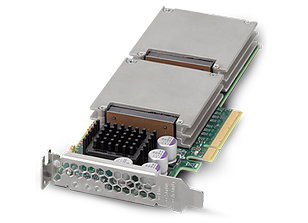
While I haven't seen one in action yet, the flash pack seems to be 6 Sun Flash Accelerator F40 PCIe Cards each of which has a capacity of 400 Gb. These cards run amazingly fast with read times of more than 2 GB/second (write time is about half that speed at 1+ GB/second). These cards normally sell for almost $6K each, so Oracle is providing the flash add-on pack for no more markup than you'd get if you bought them on your own (but you'd then have to get them into the Exalytics machine all on your own).
This Matters If You Own EssbaseWhy would you want this? Essbase, primarily. Essbase uses a ton of disk I/O and one of the ways Exalytics can speed up Essbase is by pulling your cubes into a RAMDisk (since you have 1 Tb of RAM to play with). At some point, though, it has to get that data from physical drives to a RAMDisk (unless you're building all your cubes at start up in memory each time). Having blazingly speedy flash drives with .25 millisecond read latency allows you to store your cubes on the flash drive and then pull into RAM much more quickly than reading from traditional drives.
We have tested Essbase running on flash drives and it helps everything (particularly minimizes the negative effects of fragmentation since seek time drops to basically nothing on flash). For customers buying Exalytics primarily for Essbase, the Exalytics Flash Upgrade Kit should be strongly considered with every Exalytics purchase (and if you already own Exalytics, buy it to put on top).
OBIEE is much less affected by hard drives, so while it may help OBIEE, this really matters a lot more to Essbase customers.
Oracle EPM Fully Supported on ExalyticsSince we're on the subject of Exalytics, now that 11.1.2.3 is out, all Oracle EPM/Hyperion components certified to run on Linux will run on Exalytics PS2. These include:
While I haven't seen one in action yet, the flash pack seems to be 6 Sun Flash Accelerator F40 PCIe Cards each of which has a capacity of 400 Gb. These cards run amazingly fast with read times of more than 2 GB/second (write time is about half that speed at 1+ GB/second). These cards normally sell for almost $6K each, so Oracle is providing the flash add-on pack for no more markup than you'd get if you bought them on your own (but you'd then have to get them into the Exalytics machine all on your own).
This Matters If You Own EssbaseWhy would you want this? Essbase, primarily. Essbase uses a ton of disk I/O and one of the ways Exalytics can speed up Essbase is by pulling your cubes into a RAMDisk (since you have 1 Tb of RAM to play with). At some point, though, it has to get that data from physical drives to a RAMDisk (unless you're building all your cubes at start up in memory each time). Having blazingly speedy flash drives with .25 millisecond read latency allows you to store your cubes on the flash drive and then pull into RAM much more quickly than reading from traditional drives.
We have tested Essbase running on flash drives and it helps everything (particularly minimizes the negative effects of fragmentation since seek time drops to basically nothing on flash). For customers buying Exalytics primarily for Essbase, the Exalytics Flash Upgrade Kit should be strongly considered with every Exalytics purchase (and if you already own Exalytics, buy it to put on top).
OBIEE is much less affected by hard drives, so while it may help OBIEE, this really matters a lot more to Essbase customers.
Oracle EPM Fully Supported on ExalyticsSince we're on the subject of Exalytics, now that 11.1.2.3 is out, all Oracle EPM/Hyperion components certified to run on Linux will run on Exalytics PS2. These include:
- Administration Services
- Calculation Manager
- EPM Workspace
- Essbase Server
- Essbase Studio Server
- Financial Reporting
- Interactive Reporting (32-bit only)
- Oracle HTTP Server
- Planning
- Profitability and Cost Management
- Production Reporting (32-bit only)
- Provider Services
- Reporting and Analysis Framework Services and Web Application
- Shared Services
- Web Analysis
Categories: BI & Warehousing
Hyperion 11.1.1.x Drops Off Full Support in July 2013
Someone recently told me that they just upgraded their Hyperion applications to 11.1.1.4. I asked them why they didn't go to 11.1.2. They gave me the standard story about wanting to wait until the current version got stable (even though 11.1.2.0 came out over 3 years ago in April of 2010).
What they didn't know (cause apparently it hasn't been communicated well) is that Hyperion 11.1.1.x support drops from Premier Support to Sustaining Support in July of 2013 (only two months from the time I'm writing this). For anyone who doesn't know, Sustaining Support is equivalent to life support. While Oracle's Lifetime Support Policy does say that you can stay on versions of Oracle's products indefinitely, they don't agree to fully support them.
At the Premier Support level (the one all products start on), you get all the support you'd expect. When you call in, the support people help you find the bug, they patch it in the next release, you install it, and life goes on happily. Also, as new versions of supporting products come out like new versions of Office, Windows, or your web browser, Premier Support will make sure the Oracle products work with these new versions.
Extended Support (if offered at all for your Oracle product) comes about 5 years after a product is released. At this point, Oracle will still let you do all the Premier Support things, they'll just charge you a premium for doing so. Extended Support will not be offered on Hyperion 11.1.1.x (there aren't enough customers to warrant it).
Sustaining Support (AKA "life support") allows you to call in to ask for support. Oracle will help you with questions, look up your problems in their knowledgebase, and help you troubleshoot. They won't patch anything, make versions available that are compatible with new releases of Windows, Office, etc., and in general do anything beyond the bare minimum required. From Oracle's Lifetime Support Policy document from March 2013, here's what Sustaining Support doesn't do:
If you want to read the sunset dates (the dates they drop to Sustaining Support) for all the current releases, visit Oracle.com for the current Lifetime Support Policy. Here's the one from March 2013 (scroll to page 22) for the Hyperion products:
http://www.oracle.com/us/support/library/lifetime-support-applications-069216.pdf
What they didn't know (cause apparently it hasn't been communicated well) is that Hyperion 11.1.1.x support drops from Premier Support to Sustaining Support in July of 2013 (only two months from the time I'm writing this). For anyone who doesn't know, Sustaining Support is equivalent to life support. While Oracle's Lifetime Support Policy does say that you can stay on versions of Oracle's products indefinitely, they don't agree to fully support them.
At the Premier Support level (the one all products start on), you get all the support you'd expect. When you call in, the support people help you find the bug, they patch it in the next release, you install it, and life goes on happily. Also, as new versions of supporting products come out like new versions of Office, Windows, or your web browser, Premier Support will make sure the Oracle products work with these new versions.
Extended Support (if offered at all for your Oracle product) comes about 5 years after a product is released. At this point, Oracle will still let you do all the Premier Support things, they'll just charge you a premium for doing so. Extended Support will not be offered on Hyperion 11.1.1.x (there aren't enough customers to warrant it).
Sustaining Support (AKA "life support") allows you to call in to ask for support. Oracle will help you with questions, look up your problems in their knowledgebase, and help you troubleshoot. They won't patch anything, make versions available that are compatible with new releases of Windows, Office, etc., and in general do anything beyond the bare minimum required. From Oracle's Lifetime Support Policy document from March 2013, here's what Sustaining Support doesn't do:
- New updates, fixes, security alerts, data fixes, and critical patch updates
- New tax, legal, and regulatory updates
- New upgrade scripts
- Certification with new third-party products/versions
- Certification with new Oracle products
If you want to read the sunset dates (the dates they drop to Sustaining Support) for all the current releases, visit Oracle.com for the current Lifetime Support Policy. Here's the one from March 2013 (scroll to page 22) for the Hyperion products:
http://www.oracle.com/us/support/library/lifetime-support-applications-069216.pdf
Categories: BI & Warehousing
All the Cool New Features in Oracle EPM 11.1.2.3
Oracle EPM 11.1.2.3 is out and there are some great features in it (Planning and Financial Reporting have my favorites which you'll see in a second). 11.1.2.3 is not as impressive as 11.1.2.1 or 11.1.2.2, though. A lot of the products got new features in between releases like Smart View (which adds new features with every patch set), Strategic Finance, HFM (which got Tax Provisioning in February), and Financial Close Management instead of making those products wait until 11.1.2.3 was officially released.
Below are the features I think are most interesting in 11.1.2.3. This is by no means an exhaustive list and I didn't include every product though I did hit all the ones with significant market share (and a few others including a shout-out to the long-forgotten "EPM Workspace"). All the new feature documents are on Oracle.com. If you see anything major I missed, let me know in the comments.
Oracle Essbase
Smart View
Hyperion Planning
Data Relationship Management
Hyperion Financial Management (HFM)
Financial Data Quality Management (FDM)
Financial Reporting
EPM Workspace
Web Analysis, Interactive Reporting, SQR Production Reporting...
General Comments
Below are the features I think are most interesting in 11.1.2.3. This is by no means an exhaustive list and I didn't include every product though I did hit all the ones with significant market share (and a few others including a shout-out to the long-forgotten "EPM Workspace"). All the new feature documents are on Oracle.com. If you see anything major I missed, let me know in the comments.
Oracle Essbase
- Essbase didn't change much in 11.1.2.3 and users are never going to see any of the changes.
- There are several new BSO functions and calc script commands like @INTERSECT, @ISMBRUDA, @ISRANGENONEMPTY, @MEMBERAT, @RANGEFIRSTVAL, and @RANGELASTVAL. My favorite is @CREATEBLOCK which, wait for it, creates a sparse block with all the dense combinations in it set to missing. Yes, we finally have a specific command to create specific blocks after 20+ years of silly block creation workarounds.
- There's a new calc script SET command called RUNTIMESUBVARS that let's you create substitution variables in the script that are passed to the script at run-time. You can then pass values to these variables when you call the calc scripts from MaxL or the API. There's a new optional argument (with runtimesubvars) to MaxL's "execute calculation" command that sends the run-time variables to the calc script as you call it.
- There's a new Essbase.CFG setting called ESTIMATEDHASHSIZE that lets you specify (in millions) how many members should be loaded into memory from the outline. It's meant to speed up massive dimension builds and outline edits. There are two other new CFG settings as well: ENABLERTSVLOGGING (which logs the new run-time substitution variables) and UNICODEENABLE (which sets the server to unicode mode, basically).
- Performance has been improved on ASO dimension builds (specifically with duplicate members), the JAPI, and most helpful for many people including Hyperion Planning users, @XREF has been improved in some cases as much as 40-times.
- Data Mining is gone. Many people didn't even know it was there, but it's been removed.
- Speaking of gone, there is no Essbase Excel Add-In 11.1.2.3. Further, earlier versions of the Add-In that you may have (like 11.1.2.2) are not supported against Essbase 11.1.2.3. It probably will work (the Add-In is wonderfully backwards and forwards compatible) but it's not supported.
Smart View
- There were a lot of improvements to Smart View in 11.1.2.2.3xx which came out about a month ago, so there isn't much new in Smart View 11.1.2.3. Smart View is the new strategic Microsoft Office add-in for all the Business Analytics (BI and EPM) products, though, so that's why the newest release supported direct access to OBIEE 11.1.1.7. Hyperion Strategic Finance is also now fully supported in Smart View.
- The only major improvement is actually in Hyperion Planning just exposed through Smart View. There is a new "Planning Admin" extension that lets administrators update Planning metadata (and a few other things) from Smart View. I'll say more about this under Planning.
Hyperion Planning
- Essbase ASO databases can now be created as Planning Plan Types. These databases will allow writeback provided it's at level-0. This is stunning. These ASO cubes can be displayed on Planning composite forms with Essbase BSO cubes just like current BSO cubes in multiple plan types can be combined on a single composite form. For some reason, this release doesn't put security filters on the ASO cubes, so you have to access these cubes through Planning or through the Planning ADM driver in Hyperion Financial Reporting. Still, ASO in Planning is a step in the right direction. Oh, and you have to own full-use Essbase to create these ASO cubes; just a Planning license doesn't cut it.
- You can create members on the fly (kinda) if they don't exist when business rules need them. This may only work in modules and not custom plan types. The documentation says only modules, but I admittedly haven't tried it on custom plan types yet.
- Custom dimension hierarchies can now vary by plan type.
- Task lists can now include "Copy Version" and "Job Console" as tasks.
- There is a new Task List Dashboard (gives you an overview of tasks by user, due date, etc.) and a Task List Report Page (that exports to XLS and PDF).
- Grid Scroll Preferences lets you control if all rows/columns in a form are retrieved at once or only when you scroll down. This should improve performance for large forms (and not slow down the internet when we want to watch cat videos on YouTube).
- Users can now control through user preferences if they want member names, aliases, or both. This can be set to override the form settings.
- Outline Load Utility has been enhanced to do fun things like export metadata to a relational database or export data to a text file. There's a new user interface for loading dimensions and data from flat files (and exporting them too). This was previously only doable through the command line.
- There's a new "Plan Type Editor" that lets admins add and delete plan types to already existing applications. Previously, this required going back to the initial creation step or hacking the underlying tables. The Plan Type Editor can be used to add ASO to an existing Planning application.
- Admins can now do some administration of Planning from within Smart View like editing dimensions, creating cubes, and refreshing cubes.
- Workforce and CapEx have been enhanced to get them up to speed with Project Financial Planning's improvements to these modules in 11.1.2.2. You won't get these improvements with a straight migration: you have to create a new "shell" application and manually migrate your old dimensions into the new application.
- You can create, assign, and delete substitution variables directly from the Planning web interface.
Data Relationship Management
- There's an entirely new module within DRM (no word yet on if it costs money, but my gut feeling is that it's included with DRM) called "Data Relationship Governance." To oversimplify what is actually quite cool, it adds workflow to DRM. It lets data stewards coordinate entry, validation, and approval of hierarchies but it does a lot more too. Users can request hierarchy changes and they go into a worklist so nothing gets lost. It has built-in alerts for when users have requested changes and it also sends e-mails when something has been sent to you or it's something you should be informed of. In my humble opinion, this is the greatest improvement to DRM since it was created.
- Dynamic scripting lets you use JavaScript instead of formulas to create derived properties and validations. This is a welcome improvement over formulas since we now have access to a real programming language.
- You can now connect directly to external relational database tables to import hierarchies.
Hyperion Financial Management (HFM)
- There's a new module (that technically was released in February) called Hyperion Tax Provision. It handles tax automation, data collection, tax calculations, reporting and it does it all within HFM. Now when you create an application in HFM, you tell it if you want a Consolidation (traditional) application type or Tax Provision.
- Data forms let you show/hide the POV members, access the dynamic POV member lists, and run "on-demand rules" to essentially calculate the data form (by running the on-demand rule on a subset of data).
- Data grids also let you control which POV dimensions you're showing and gives you access to dynamic POV member lists.
- Admins can turn off modules for all users if they aren't applicable (for instance, if you don't allow intercompanies in HFM).
Financial Data Quality Management (FDM)
- FDM and ERPi (ERP Integrator) combine in 11.1.2.3 into a single product: FDMEE (Financial Data Quality Management Enterprise Edition). It's more than just ERPi renamed which is what some are claiming. Below are some of the improvements.
- The UI (user interface) is now consistent with the other Hyperion products like Planning and HFM.
- FDM is fully supported in Shared Services and Lifecycle Management.
- Data loads are sped up. Scaling and load balancing are fully supported.
- ERPi users will now see full FDM functionality that they couldn't access before.
- SAP BW is now supported directly as a data source.
- FDM and ERPi owners have access (at no charge) to all the new FDMEE capabilities.
Financial Reporting
- I know what you're thinking and yes, Financial Reporting actually got improved in 11.1.2.3 (it is a strategic product for Oracle). So for the coolest thing you'll see since ASO in Hyperion Planning...
- Financial Reporting is now mobile. That's right: it runs on Apple iPhones, iPads, Android phones and Android tablets. Users can browse the repository, launch reports (HTML or PDF), run books (HTML or PDF), change POVs, change page members, expand rows and columns, and even launch related content. Pick your jaw off the floor.
- Books have been enhanced to allow cover pages before the table of contents, embedding (and launching) Word DOCs from an HTML book, and changing the starting page number of books.
- The designer has new authoring features including a row property to show dots after the member name (to fill the column) in PDF output, custom text colors, and auto-sizing text boxes in PDF output.
- Annotations have a new auditing capability that puts annotation info (like creation date or modified date) in a log file on the server.
EPM Workspace
- OBIEE 11.1.1.7 is back in Workspace (it used to be there back in OBIEE 10). You can both create and launch OBIEE from Workspace.
- OBIEE uses single-sign on if you're logged into Workspace (OBIEE now can also share a security model with Essbase).
Web Analysis, Interactive Reporting, SQR Production Reporting...
- Seriously? People, move to OBIEE. These are dead products.
General Comments
- You can upgrade to 11.1.2.3 directly only from 11.1.1.4 and 11.1.2.x. Earlier versions require going to either 11.1.1.4 or 11.1.2.2 first.
- 11.1.2.3 still doesn't officially support Chrome or Safari. The documentation says that Oracle recommends IE (Internet Explorer) 9 or Firefox 10 because older versions are slower.
- The EPM documentation is now fully supported on Apple mobile devices (in ePub format). It already worked on Amazon Kindles (in Mobi format).
That's all folks. You can thank me at Kscope13 for making it so you don't have to scour all the readme files yourself.
Oh, that reminds me. Since you read this entire essay of bullets, I owe you a reward. When you register for Kscope13 (the best Oracle BI, EPM, and Hyperion conference in the world bar none), mention promo code IRC. It'll save you $100 off whatever the prevailing rate is. You can tell your friends or make them read this blog to find that out themselves.
Categories: BI & Warehousing
StarAnalytics Bought by IBM

On February 1, it was announced that Star Analytics (one of our favorite software companies in the world) is being bought by IBM (not one of our favorite software companies in the world) for an undisclosed amount. Star, founded in 2004, made two excellent products (Star Integration Server and Star Command Center) and IBM's strategy, at the moment, is to continue the two products under IBM's Business Analytics Software group.
As everyone knows, IBM has been on an acquisitions kick for the last 5 years particularly around business analytics. They own Cognos, TM/1, Clarity and a whole lot of other products... or at least they bought the companies that made those products and then stopped some of those products and continued others. Unlike Oracle that is quite good at buying companies and then immediately knowing which products they want to strategically continue, IBM can take some time to make up their mind and half the time, people internal to IBM don't know which products are being discontinued. There are still people internal to IBM that are touting Clarity's planning and consolidations products, and those have been virtually dead since IBM first bought Clarity.
 It may seem odd to some that Star was bought by IBM considering that IBM owns Cognos and Star is traditionally awesome at Hyperion integration not Cognos, TM/1, and the like. What many people don't realize is that Star's products have been expanded beyond their traditional Hyperion roots over the last few years and now talk well to other products including relational databases. Star Integration Server is still found almost exclusively at Hyperion shops, and one has to believe that part of the reason IBM bought Star is to be able to easily extract data from Essbase, Planning, and HFM.
Judging from IBM's announcement and FAQ on the purchase, it seems that being able to extract and control Oracle (particularly Hyperion) is the main reason they bought Star. That makes it odd that Oracle didn't go ahead and buy them instead. All I can think of is that either IBM offered a better price or Oracle felt they had competing products with some of the same functionality already (I'll be getting to that in a second).
So what does that mean for you? If you bought Star's products, congratulations. They are excellent products and I would continue using them for as long as IBM continues to support them. If you're considering a purchase, I would wait until IBM decides what they're going to do. At bare minimum, IBM will probably begin to favor Cognos and TM/1 more than Hyperion and for a lot of us, Hyperion expertise was the reason we bought Star's products.
If you want to consider something else, I would suggest buying Hyperion Financial Data Quality Management or Oracle Data Integrator instead of Star Integration Server and Hyperion Financial Close Management instead of Star Command Center. They don't exactly overlap functionality-wise, but they are the closest replacements I can readily think of. Note that Star Integration Server has some very cool extraction technologies that are patented, so any product extracting data or hierarchies from Hyperion is probably going to be a lot slower, for the time being, than Star.
We will miss you, Star Analytics. It was a good 7+ year run, and the Hyperion world will always fondly remember your company, your products, and your employees (particularly your iconic leader, and my close friend, Quinlan Eddy). May your staying agreements at IBM be short.
Categories: BI & Warehousing
Whatever Happened to Edward Roske?
Where have I been for 8 months?
September 11
Hyperion Solutions Road Trip to Denver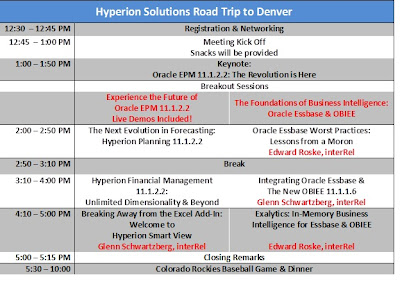
September 30 to October 4Oracle OpenWorld
San Francisco, California
October 16Hyperion Solutions Road Trip to Seattle
November 5-6
OAUG Connection Point - EPM&BI
Orlando, FloridaEach year, OAUG puts on a 2-day Oracle EPM&BI focused conference. It has nowhere near as many sessions on Hyperion as Kscope, but it's by far the second-best conference out there. It has around 50 sessions and this year, interRel is giving 6 of them. I'm giving a session on Exalytics and other interRel speakers will include Glenn Schwartzberg on Smart View 11.1.2.2, Tracy McMullen on multiple topics, and Dr. Troy Seguin talking on Predictive Analytics. We will also have a booth there with our newest 11.1.2.2 books.
Unlike the Road Trips mentioned above, this conference isn't free. That said, it's a lot cheaper than OpenWorld with far better targeted content. If you're in the Southeastern United States, I strongly encourage you to make it to Connection Point at the Peabody Hotel.
November 15-16ODTUG Seriously Practical - EPM&BI
Auckland, New ZealandODTUG is putting on two 2-day conferences in Australia and New Zealand in November. This is the first of those conferences. There's a charge for them, but it's minimal for the content you get over 2 days. Cameron Lackpour (ACE Director and all-around decent human being) and I are the featured speakers.
There are actually two tracks: one is focused on Hyperion and Oracle EPM. The other track is focused on Oracle BI. I'm giving sessions in both rooms as well as some excellent local speakers and Oracle luminaries. Make sure you visit the ODTUG website closer to the date for more details.
November 19-20ODTUG Seriously Practical - EPM&BI
Melbourne, AustraliaThis is basically the same 2-day, 2-room itinerary as the event in Auckland. I have presented at the InSync conference in Melbourne before and I love the city. If you can't make it to Auckland, I'm hoping you can fly down to Melbourne. They have koalas.
After this, I hope to return back to the good ole US-of-A with a month to spare before TEOTWAWKI. I have some final things I need to take care of before December 21. Among other things, I'm hoping to clean out my Inbox, because my mother always told me that you don't want to face an apocalypse unless you have a clean Inbox.
Oh, is that all?Seriously?!? That's the busiest conference schedule I've ever had with the exception of the 3-week multi-continent trip last year with some of the Oracle ACE Directors from the Oracle Technology Network. I'm hoping that with all those travel dates over the next 2 months, I'll run into some of you in-person. If you're anywhere near, please try to stop by. I'm also hoping that all this travel will give me time to blog on airplanes.
It's good to be back.
Answering that could take a while. Suffice to say, it's been a busy year. The largest amount of time beyond my normal job was spent being Conference Chair for the last two years for ODTUG's Kscope conference. If anyone ever offers to let you chair a conference and then tells you "it's mostly a symbolic position that doesn't require much work," they're lying. Run away quickly. Chairing these things is a lot of work, and I am happy to say that my replacement as Conference Chair, Mike Riley, will doubtless put my conference chairing to shame as he carries on the good I did and takes it up a notch from good to great.
While running Kscope was an amazing lot of work, it was definitely worth it. I encourage every one of you to make it to Kscope13 in New Orleans, LA from June 23-27 in 2013. Kscope13 will continue to be the home for Hyperion, Essbase, Oracle EPM & BI (in addition to ApEx, Oracle RDBMS, Fusion, and lots more) and it's adding content in those areas including entirely new tracks around EPM. Side note: abstract submission is open through October 15, so if you want to get a free pass to Kscope13, now's your chance: http://bit.ly/Content13.
Kscope kept me busy from early in 2010 until the summer of 2012. I then took a month off to recuperate (in other words, focus on my actual duties at interRel which apparently include CEO: who knew?) and now I'm back to blogging. I'm sure you're shedding a single tear right now and I'm choosing to believe it's because you're so choked up with emotion.
The next few weeks are going to be filled with a great deal of travel as I'm presenting at several conferences. I'm hoping to be able to blog from a few of these conferences. If you're at any of them, be sure to find me either up on stage somewhere speaking or at our booth. If you want to know more about any of these conferences, you can always send an e-mail over to the intelligent, beautiful, and obscenely overworked Danielle White at info@interrel.com.
Hyperion Solutions Road Trip to Denver
Oracle and interRel put on a series of free, multi-track training days around North America each year. We have one on September 11 at the Grand Hyatt in Denver and like most of the Roadshows we do, it's open to both current and prospective customers of Oracle EPM & BI. I'm giving three sessions at this conference including the keynote on the future of Oracle EPM (11.1.2.2 and beyond). If you're anywhere near Denver (or could fly there easily), there's a great half-day agenda followed by free tickets to a Colorado Rockies game afterwards (they're playing the San Francisco Giants). My good buddy, Glenn Schwartzberg, will also be presenting along with a few Oracle speakers talking in detail about 11.1.2.2.

San Francisco, California
If you don't want to miss your annual chance to hear Oracle talk about Oracle, you'll want to come to a city vaguely resembling San Francisco during the first week of quarter close for most companies. That's right: in what is, I'm sure, not a big "sod off" to finance and accounting users everywhere, Oracle has decided to hold their annual Oracle awesomeness conference during the first week of October.
To be completely honest, I actually like being able to hear once per year directly from Oracle their stance on recent releases and future plans. While it's huge, overcrowded, 90%+ marketing, and expensive, there are great networking and educational opportunities to be found if you know where to look. Word of advice, though: don't ever try to stand in a cab line; you'll be there for 2 hours and it's probably quicker to just walk wherever you're headed.
I've got 3 or 4 sessions at this year's conference including a non-Hyperion one on the Fusion User Experience. Most of my sessions will be part of the ODTUG's EPM Symposium at Moscone West in room 2008 on Sunday afternoon. interRel also has a kiosk in the Hyperion Pavilion on the 5th floor of the Intercontinental Hotel. Make sure you stop by and see us at one of those locations.
Pearl Jam and Kings of Leon will be performing at the Wednesday night party on Treasure Island, so bare minimum, you can get in touch with your alternative side. There's also free booze, so ya, you got that going for you.
This conference is similar to the one in Denver except for three important differences:
- It's in Bellevue, Washington on a different date.
- The keynote speaker is the VP of Oracle EPM Development, Matt Bradley. He's a great speaker and this is an excellent opportunity to hear from development themselves about all the great things they have planned for the next year.
- The after event is at Lucky Strike instead of at a baseball park, because let's face it: there's no way in Hell that the Seattle Mariners will still be playing baseball in mid-October.
This event, like the other road trips, is free. You just have to get yourself to Seattle (and not be a competitor, obviously).
October 23Hyperion Solutions Road Trip to Phoenix
This time, we're heading down South to Phoenix, Arizona. The agenda will be very similar to the Denver event above and there will be great fun in the evening after, so join us for education and networking all for free. Just to prove that geography is not our strong suit, in this exact same week, we'll be traveling to:
October 25Hyperion Solutions Road Trip to Calgary
I'm told that Canadians are very scary and intimidating, but I'm hoping they'll be nice as we take our first road trip North of the border. Expect a similar agenda to the others but with a dash of vegetarian back bacon. I'm looking forward to the Calgary Flames game after the day's education is complete because apparently hockey is trying to become a major sport, and this is my one chance to learn something about it (red line? blue line? icing?). Jenny, our business coordinator at interRel, is from Canada and she assures me that if hockey doesn't take off, at least curling will.
October 30Hyperion Solutions Road Trip to Los Angeles
The agenda for this event is quite different. Among other things, it's a full-day instead of a half-day and it has 3 full tracks instead of 2. It's basically a one-day, free Hyperion conference. This year, it'll be at the Hilton inside Universal Studios and our after event will be at Jillian's on the Universal City Walk. Here's the complete agenda:
Hyperion Solutions Road Trip to
Southern California
8:30 AM
Check In & Registration
9:00 AM
Keynote: Analytics-Led Business Innovation, Matt Bradley, Oracle
Experience the Future of Oracle EPM 11.1.2.2
Live Demos Included!
The World of
Hyperion Applications
The Foundations of Business Intelligence: Oracle Essbase & OBIEE
10:00 AM
Taking Control of Your Hierarchies with
DRM 11.1.2.2
Introduction to
Integrated Business Planning
BI Foundation Suite:
Integrating Oracle Essbase & The New OBIEE 11.1.1.6
11:00 AM
The Next Evolution
in Forecasting:
Hyperion Planning 11.1.2.2
Reducing Your Close Cycle:
Financial Close & Account Reconciliation Management
Oracle Essbase
Worst Practices:
Lessons from a Moron
11:50 PM
Lunch
12:20 PM
Ask a Guru Panel Session
1:30 PM
Managing Your
Project Budgets:
Introduction to the
New Hyperion Planning Project Module
Best Practices for Your Strategic Oracle EPM Road Map: Building Your 3 Year Plan
Extending the Value of Oracle eBusiness Suite with Oracle EPM
2:30 PM
Hyperion Financial Management 11.1.2.2: Unlimited Dimensionality & Financial Management Analytics
Optimizing Your Oracle Hyperion Planning & Oracle Essbase Outlines
Exalytics: In-Memory Business Intelligence for Oracle Essbase & OBIEE
3:20 PM
Break
3:50 PM
Breaking Away from the Excel Add-In:
Welcome to
Smart View 11.1.2.2
Integrating Hyperion Financial Management & Hyperion Planning
What’s New in
OBIEE 11.1.1.6:
Oracle on Your iPhone & Other Cool Things
4:40 PM
Drawings / Networking
5:30 PM
Dinner/Drinks/Entertainment at Jillian’s at Universal Studios City Walk
November 5-6
OAUG Connection Point - EPM&BI
Orlando, FloridaEach year, OAUG puts on a 2-day Oracle EPM&BI focused conference. It has nowhere near as many sessions on Hyperion as Kscope, but it's by far the second-best conference out there. It has around 50 sessions and this year, interRel is giving 6 of them. I'm giving a session on Exalytics and other interRel speakers will include Glenn Schwartzberg on Smart View 11.1.2.2, Tracy McMullen on multiple topics, and Dr. Troy Seguin talking on Predictive Analytics. We will also have a booth there with our newest 11.1.2.2 books.
Unlike the Road Trips mentioned above, this conference isn't free. That said, it's a lot cheaper than OpenWorld with far better targeted content. If you're in the Southeastern United States, I strongly encourage you to make it to Connection Point at the Peabody Hotel.
November 15-16ODTUG Seriously Practical - EPM&BI
Auckland, New ZealandODTUG is putting on two 2-day conferences in Australia and New Zealand in November. This is the first of those conferences. There's a charge for them, but it's minimal for the content you get over 2 days. Cameron Lackpour (ACE Director and all-around decent human being) and I are the featured speakers.
There are actually two tracks: one is focused on Hyperion and Oracle EPM. The other track is focused on Oracle BI. I'm giving sessions in both rooms as well as some excellent local speakers and Oracle luminaries. Make sure you visit the ODTUG website closer to the date for more details.
November 19-20ODTUG Seriously Practical - EPM&BI
Melbourne, AustraliaThis is basically the same 2-day, 2-room itinerary as the event in Auckland. I have presented at the InSync conference in Melbourne before and I love the city. If you can't make it to Auckland, I'm hoping you can fly down to Melbourne. They have koalas.
After this, I hope to return back to the good ole US-of-A with a month to spare before TEOTWAWKI. I have some final things I need to take care of before December 21. Among other things, I'm hoping to clean out my Inbox, because my mother always told me that you don't want to face an apocalypse unless you have a clean Inbox.
Oh, is that all?Seriously?!? That's the busiest conference schedule I've ever had with the exception of the 3-week multi-continent trip last year with some of the Oracle ACE Directors from the Oracle Technology Network. I'm hoping that with all those travel dates over the next 2 months, I'll run into some of you in-person. If you're anywhere near, please try to stop by. I'm also hoping that all this travel will give me time to blog on airplanes.
It's good to be back.
Categories: BI & Warehousing